 Back
BackMicrobiology Exam 2 Study Guide: Genetics, Microbial Diversity, and Molecular Techniques
Study Guide - Smart Notes
 Tailored notes based on your materials, expanded with key definitions, examples, and context.
Nitrogen-Fixing Alphaproteobacteria
Overview and Importance
Nitrogen-fixing bacteria are essential for converting atmospheric nitrogen (N2) into ammonia (NH3), which plants can use for growth. Alphaproteobacteria include several genera that participate in this process, either as free-living organisms or in symbiosis with plants.
Free-Living Bacteria: Azotobacter, Beijerinckia fix nitrogen independently in the rhizosphere.
Symbiotic Bacteria: Rhizobium, Bradyrhizobium, Azorhizobium form root nodules on legumes, facilitating nitrogen fixation.
Cyanobacteria: Anabaena fixes nitrogen in heterocysts, specialized cells providing anaerobic conditions.
Root Nodule Formation Process:
Attachment to root hairs
Infection thread formation
Bacteroid formation (specialized for nitrogen fixation)
Nodule development
Example: Bradyrhizobium infects soybean roots, forming nodules and enhancing soil fertility.
Genetic Concepts and Mechanisms
Definition of Gene
A gene is a segment of DNA that codes for a functional product, usually a protein or RNA molecule.
DNA Structure
DNA consists of two antiparallel strands of nucleotides. Each nucleotide contains:
Deoxyribose (pentose sugar)
Phosphate group
Nitrogenous base: Adenine (A), Thymine (T), Cytosine (C), Guanine (G)
Base Pairing: A pairs with T (2 hydrogen bonds), G pairs with C (3 hydrogen bonds).
Mechanisms of Genetic Regulation
Repression
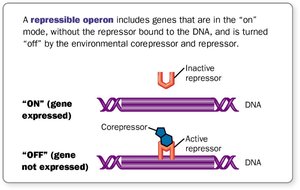
Repression is a genetic control mechanism where a corepressor activates a repressor protein, which then binds to DNA and blocks transcription.
In a repressible operon, genes are "on" unless the repressor is activated by a corepressor.
When the corepressor binds the repressor, it becomes active and attaches to the operator region, preventing RNA polymerase from transcribing the genes.
Translation
Translation is the process where mRNA is decoded at the ribosome to build a protein. The operon structure includes:
Promoter (P): RNA polymerase binding site
Operator (O): Regulatory switch
Structural genes: Code for proteins
Catabolite Repression
Catabolite repression is a regulatory mechanism where glucose inhibits transcription of other sugar-metabolizing genes (e.g., lac operon).
When glucose is present, cAMP levels are low, preventing CAP from activating transcription.
When glucose is absent, cAMP rises, CAP binds to the promoter, and transcription occurs if lactose is present.
DNA Polymerase
DNA polymerase synthesizes new DNA strands during replication. It requires a primer and adds nucleotides to the 3' end.
Leading strand: Synthesized continuously (5' to 3')
Lagging strand: Synthesized in Okazaki fragments, joined by DNA ligase
Induction
Induction is the activation of transcription when an inducer inactivates a repressor, allowing gene expression.
Functions of Key Enzymes
RNA polymerase: Synthesizes RNA from DNA template
Transposase: Moves transposons (jumping genes) within the genome
Restriction enzymes: Cut DNA at specific sequences
DNA ligase: Joins DNA fragments
DNA polymerase: Replicates DNA
Inducible Enzyme
An enzyme produced in response to the presence of a substrate is called an inducible enzyme.
Genetic Changes in Bacteria
Mutation: Change in DNA sequence
Transformation: Uptake of naked DNA
Transduction: DNA transfer via bacteriophages
Conjugation: DNA transfer through direct contact
Molecular Techniques
FISH (Fluorescent In Situ Hybridization)
FISH uses fluorescent DNA probes to detect specific DNA or RNA sequences in cells. It is used in oncology, prenatal testing, genomics, and microbiology.
Probe preparation: Fluorescently labeled DNA
Denaturation: Separates DNA strands
Hybridization: Probe binds to target sequence
Visualization: Fluorescence microscopy
Advantages: High sensitivity, versatility. Limitations: Targeted, costly.
Microbial Diversity and Classification
Domain Bacteria
Prokaryotic
Peptidoglycan cell wall
Binary fission
Gram-positive/Gram-negative classification
Domain Archaea
Prokaryotic
No peptidoglycan
Unique membrane lipids
Extremophiles (methanogens, halophiles, hyperthermophiles)
Proteobacteria
Gram-negative
Largest bacterial group
Includes many pathogens
Metabolic versatility
Plants
Multicellular
Photosynthetic
Cellulose cell walls
Alternation of generations
Additional Key Terms and Concepts
Clone
A clone is a genetically identical population derived from one cell.
Mycology
Mycology is the study of fungi. Systemic mycoses are fungal infections affecting internal organs (e.g., histoplasmosis).
Gram-Positive Endospore-Forming Bacteria
Bacillus
Clostridium
Similarities Between Archaea & Bacteria
Prokaryotic
No nucleus
Circular DNA
Ribosomes (70S)
Nucleic Acid Hybridization
Technique using complementary DNA/RNA strands to identify organisms (e.g., DNA probe tests).
Viruses vs. Bacteria
Viruses: Not cells, require host, DNA or RNA
Bacteria: Living cells, independent metabolism, DNA only
Culturing Viruses
Viruses must be cultured in living cells (cell culture, embryonated eggs, animals).
Complex Viruses
Complex viruses have unusual structures (e.g., bacteriophages).
Definitions
Prion: Infectious protein
Bacteriophage: Virus that infects bacteria
Retrovirus: RNA virus using reverse transcriptase
Persistent infection: Virus remains long-term
Latent infection: Virus dormant (e.g., Herpes simplex)
Virus Families
Picornavirus: Small RNA viruses (e.g., polio)
Togavirus: RNA viruses (e.g., rubella)
Papovavirus: DNA viruses (HPV)
Herpesvirus: Latent DNA viruses
Retrovirus: RNA + reverse transcriptase (e.g., HIV)
Viruses with Reverse Transcriptase
Retroviruses (e.g., HIV) contain reverse transcriptase.
Definitions (Reproduction)
Dioecious: Male & female on separate individuals
Monoecious: Both sexes in one organism
Budding: Asexual reproduction by outgrowth
Fission: Cell splitting into two
Uses of Algae
Red algae: Food (agar)
Brown algae: Alginates (thickeners)
Green algae: Oxygen production
Diatoms: Filters, abrasives
Transmission of Helminths
Contaminated food/water
Skin penetration
Insect vectors
Gammaproteobacteria
Escherichia
Salmonella
Vibrio
Pseudomonas
Cyanobacteria
Photosynthetic bacteria (blue-green algae).
Lichens
Symbiosis: fungus + algae/cyanobacteria
Indicators of air quality
Kingdom Plants
Multicellular
Photosynthetic
Alternation of generations
Definitions (Fungi Reproduction)
Karyogamy: Fusion of nuclei
Plasmogamy: Fusion of cytoplasm
Meiosis: Reduction division producing haploid cells
Anamorph: Asexual fungal stage
Deuteromycota: Fungi without known sexual stage
