Back
BackMicrobiology Exam 2 Study Guide: Innate & Adaptive Immunity, Immunization
Study Guide - Smart Notes
 Tailored notes based on your materials, expanded with key definitions, examples, and context.
Q1. Define innate immunity. Include speed of response, specificity, and whether it generates immunological memory.
Background
Topic: Innate Immunity
This question tests your understanding of the basic characteristics of the innate immune system, including how quickly it responds, its specificity, and whether it creates memory of past infections.
Key Terms:
Innate immunity: The body's first line of defense against pathogens.
Immunological memory: The ability to "remember" past infections for faster response.
Specificity: How targeted the response is to a particular pathogen.
Step-by-Step Guidance
Start by describing the speed of the innate immune response (is it immediate or delayed?).
Explain whether innate immunity is specific to individual pathogens or more general.
Discuss if innate immunity generates immunological memory after exposure to a pathogen.
Summarize how these features distinguish innate immunity from adaptive immunity.
Try solving on your own before revealing the answer!
Q2. List and briefly explain the three major categories of innate defenses. Provide specific examples for each.
Background
Topic: Categories of Innate Defenses
This question tests your knowledge of the main types of innate immune defenses and your ability to provide examples.
Key Terms:
Physical barriers: Structures that block pathogen entry.
Chemical barriers: Substances that inhibit pathogens.
Cellular defenses: Immune cells that attack pathogens.
Step-by-Step Guidance
Identify the three major categories: physical, chemical, and cellular defenses.
For each category, briefly explain its role in innate immunity.
Provide at least one specific example for each category (e.g., skin for physical, lysozyme for chemical, neutrophils for cellular).
Explain how these defenses work together to prevent infection.
Try solving on your own before revealing the answer!
Q3. Explain the role of barrier defenses in preventing infection. Include at least two examples.
Background
Topic: Barrier Defenses
This question focuses on how physical and chemical barriers protect the body from pathogens.
Key Terms:
Barrier defenses: Structures or substances that block pathogen entry.
Examples: Skin, mucous membranes, stomach acid.
Step-by-Step Guidance
Define what barrier defenses are in the context of innate immunity.
Describe how these barriers physically or chemically prevent pathogens from entering the body.
Provide two specific examples and explain how each functions as a barrier.
Discuss the importance of these barriers in the overall immune response.
Try solving on your own before revealing the answer!
Q4. Define PAMPs and PRRs. Provide two examples of PAMPs.
Background
Topic: Pathogen Recognition
This question tests your understanding of how the innate immune system recognizes pathogens using molecular patterns and receptors.
Key Terms:
PAMPs: Pathogen-Associated Molecular Patterns (molecules found on pathogens).
PRRs: Pattern Recognition Receptors (host receptors that detect PAMPs).
Step-by-Step Guidance
Define PAMPs and explain their significance in innate immunity.
Define PRRs and describe their role in recognizing PAMPs.
List two examples of PAMPs (e.g., LPS from gram-negative bacteria, flagellin).
Explain how recognition of PAMPs by PRRs initiates an immune response.
Try solving on your own before revealing the answer!
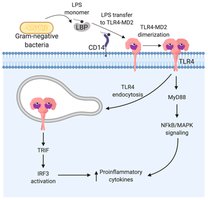
Q5. Explain how PRR recognition leads to cytokine production (recognition → signaling → cytokines).
Background
Topic: Innate Immune Signaling
This question tests your understanding of the molecular steps from pathogen recognition to cytokine production.
Key Terms and Formula:
PRR: Pattern Recognition Receptor
Cytokines: Signaling proteins released by cells
Signaling pathway: PRR activation → intracellular signaling → cytokine gene expression
Step-by-Step Guidance
Describe how PRRs (like TLRs) recognize PAMPs on pathogens.
Explain the intracellular signaling cascade that is triggered by PRR activation (e.g., MyD88, NFκB pathway).
Discuss how this signaling leads to the transcription and release of proinflammatory cytokines.
Summarize the importance of cytokines in coordinating the immune response.
Try solving on your own before revealing the answer!
Q6. Define inflammation. What are its primary goals?
Background
Topic: Inflammation
This question tests your understanding of the inflammatory response and its purpose in immunity.
Key Terms:
Inflammation: A localized response to infection or injury.
Primary goals: Contain infection, recruit immune cells, promote tissue repair.
Step-by-Step Guidance
Define inflammation in the context of the immune system.
List the primary goals of inflammation (containment, recruitment, repair).
Explain how inflammation achieves these goals.
Discuss why inflammation must be regulated to prevent tissue damage.
Try solving on your own before revealing the answer!
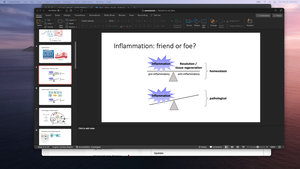
Q7. Explain this figure, mention why inflammation must be balanced by anti-inflammation. Also mention what happens when our immune system (B and T cells) become dysregulated and can no longer “turn off.” In your answer explain why macrophage and dendritic cell polarization are on a spectrum rather than a fixed position.
Background
Topic: Regulation of Inflammation
This question tests your ability to interpret diagrams and understand the balance between pro- and anti-inflammatory responses.
Key Terms:
Homeostasis: Balance between pro- and anti-inflammatory signals.
Polarization: The functional state of immune cells (macrophages, dendritic cells).
Dysregulation: Loss of control over immune responses.
Step-by-Step Guidance
Describe what the figure shows about the balance between inflammation and anti-inflammation.
Explain why this balance is necessary for tissue repair and homeostasis.
Discuss what happens when B and T cells are dysregulated and cannot "turn off" (e.g., chronic inflammation, autoimmunity).
Explain why macrophage and dendritic cell polarization is a spectrum, not a fixed state.
Try solving on your own before revealing the answer!