 Back
Microbiology Exam 2 Study Guide: Principles of Disease, Immunity, and Antimicrobial Drugs
Study Guide - Smart Notes
 Tailored notes based on your materials, expanded with key definitions, examples, and context.
Principles of Disease and Epidemiology
Normal Microbiota
Normal microbiota are permanent residents of the human body that do not cause disease under normal conditions. They play essential roles in health and disease prevention.
Microbial antagonism: Normal microbiota compete with pathogens for resources, preventing their colonization.
Consume waste/dead cells: Help maintain tissue health.
Produce beneficial products: Such as vitamins (e.g., Escherichia coli synthesizes vitamin K).
Examples: Staphylococcus (skin, nose, throat), Corynebacterium (eyes), Lactobacillus (intestine, mouth, reproductive system), Escherichia coli (intestine).
Symbiosis: Types and Roles
Symbiosis describes close relationships between two species:
Commensalism: One benefits, other unaffected (e.g., skin bacteria).
Mutualism: Both benefit (e.g., E. coli produces vitamin K).
Parasitism: One benefits at the other's expense.
Opportunistic Pathogens
Microbes that normally do not cause disease but can under certain conditions (e.g., immune suppression, changes in microbiota, introduction to unusual sites).
Etiology and Koch’s Postulates
Etiology: Study of disease causes. Robert Koch demonstrated microbes cause disease (anthrax).
Pathogen present in every case.
Isolate and grow in pure culture.
Introduce to healthy host; same disease develops.
Re-isolate pathogen from new host.
Limitations: Not all diseases fit (e.g., viral diseases, unculturable pathogens, ethical issues).
Signs vs. Symptoms
Signs: Objective, measurable (fever, rash).
Symptoms: Subjective, felt by patient (pain, nausea).
Types of Disease
Communicable: Spread person-to-person (e.g., influenza).
Noncommunicable: Not spread person-to-person (e.g., diabetes).
Disease Frequency Terms
Endemic: Constantly present.
Sporadic: Occasional.
Epidemic: High frequency in area.
Pandemic: High frequency worldwide.
Acute, Chronic, and Latent Disease
Acute: Rapid onset (e.g., influenza).
Chronic: Long-lasting (e.g., tuberculosis).
Latent: Dormant, then reactivates (e.g., herpes).
Reservoirs and Transmission
Reservoirs: Human (TB), animal (rabies), nonliving (soil, water).
Transmission: Direct contact, indirect (fomite), droplet, vehicle (water, food), vector (mechanical, biological).
Nosocomial Infections
Acquired in hospitals; prevented by hygiene, sterilization, PPE, aseptic technique.
Innate Immunity: Nonspecific Defenses
Immunity and Types
Immunity: Ability to resist disease. Divided into innate (nonspecific, present from birth) and adaptive (specific, memory).
Innate: Skin, mucous membranes, phagocytosis, inflammation, fever, complement, interferon, iron-binding proteins, antimicrobial peptides.
Adaptive: T cells, B cells, antibodies.
Activation of Innate Defenses
Some defenses are always present; others activated by PAMPs (Pathogen-Associated Molecular Patterns) binding to TLRs (Toll-like Receptors) on host cells, triggering cytokine production.
First Line of Defense
Skin: Physical (epidermis, keratin), chemical (sebum, sweat, lysozyme).
Mucous membranes: Epithelial cells, mucus, cilia, secretions.
Lacrimal apparatus: Tears wash, contain lysozyme.
Movement: Coughing, sneezing, urination, defecation.
Normal microbiota: Compete with pathogens.
Second Line of Defense
Leukocytes: Neutrophils, macrophages, dendritic cells, eosinophils, basophils, NK cells.
Phagocytosis: Engulf and destroy microbes.
Lymphatic system: Lymph, vessels, nodes, spleen, thymus, tonsils, bone marrow.
Inflammation: Redness, heat, swelling, pain; acute vs. chronic.
Fever: Intensifies defenses, inhibits microbes.
Complement: Proteins causing cytolysis, opsonization, inflammation.
Interferons: Antiviral proteins.
Iron-binding proteins: Starve bacteria.
Antimicrobial peptides: Destroy microbes.
Phagocytosis Steps
Chemotaxis
Adherence (opsonization enhances)
Ingestion (pseudopods, phagosome)
Phagolysosome formation
Digestion (killing)
Exocytosis
Inflammation Steps
Tissue injury/infection
Release of chemicals (histamine, leukotrienes)
Vasodilation, increased blood flow
Leukocyte migration (diapedesis)
Phagocyte action
Tissue repair
Adaptive Immunity: Specific Defenses
Recognition and Antigens
Adaptive immunity recognizes pathogens by specific antigens. B and T cells have unique receptors for antigens. Antigens are foreign substances that trigger immune responses.
Exogenous antigens: Enter from outside (bacteria, viruses).
Endogenous antigens: Produced by infected/cancer cells.
Autoantigens: Normal proteins; recognized in autoimmune disease.
MHC proteins: Present antigens on cell surfaces. MHC I (all nucleated cells, endogenous), MHC II (APCs, exogenous).
Modes of Adaptive Immunity
Humoral: B cells, antibodies, extracellular pathogens.
Cell-mediated: T cells, intracellular pathogens, infected cells.
Antibodies: Structure and Function
Antibodies (immunoglobulins) are proteins produced by B cells. They have two identical antigen-binding sites (valence), usually bivalent (monomer: two light, two heavy chains, Y-shaped).
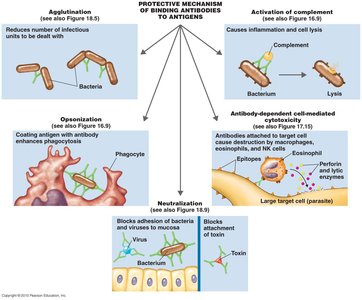
Neutralization: Block pathogen/toxin attachment.
Opsonization: Coat pathogens for phagocytosis.
Agglutination: Clump pathogens for removal.
Activation of complement: Trigger complement pathway.
ADCC: Antibody-dependent cellular cytotoxicity (NK cells, eosinophils destroy infected cells).
B Cells and Antibody Production
Develop in bone marrow, mature there, circulate in blood/lymph.
Produce antibodies after activation by antigen and T helper cell cytokines.
Clonal expansion: Plasma cells (antibody production), memory B cells.
T Cells: Types and Activation
T Helper (CD4+): Coordinate immune response, activate B cells, cytotoxic T cells, NK cells, eosinophils.
T Cytotoxic (CD8+): Kill infected cells.
T Regulatory: Prevent autoimmunity.
Immunological Memory
Memory B and T cells respond rapidly to repeat exposure, often preventing disease symptoms.
Types of Adaptive Immunity
Naturally Acquired Active: Infection, memory cells produced.
Naturally Acquired Passive: Maternal antibodies, no memory.
Artificially Acquired Active: Vaccination, memory cells produced.
Artificially Acquired Passive: Injection of antibodies (antisera), immediate protection, no memory.
Practical Applications of Immunology & Antimicrobial Drugs
Vaccines and Antisera
Vaccine: Suspension of pathogens/antigens to induce adaptive immunity and memory.
Antisera: Ready-made antibodies for immediate passive immunity; used for rapid diseases (rabies, tetanus, antivenom).
Antimicrobial Drugs and Selective Toxicity
Antimicrobial drugs: Chemicals that kill/interfere with pathogens, little harm to host.
Selectivity: Target features not present in host (cell wall, ribosome differences, membrane components, nucleic acid synthesis, essential metabolites).
Spectrum of Activity
Broad-spectrum: Wide variety of pathogens (e.g., tetracycline).
Narrow-spectrum: Few pathogens (e.g., ketaconzole).
Mechanisms of Antibiotic Action
Inhibition of cell wall synthesis
Inhibition of protein synthesis
Injury to plasma membrane
Inhibition of nucleic acid synthesis
Inhibition of essential metabolite synthesis
Drug Resistance
Mutation: Random DNA changes (antigenic drift in viruses).
Acquisition of new DNA: Horizontal gene transfer (transformation, conjugation, transduction).
Mechanisms: Block drug entry, drug inactivation, change target molecule, efflux pumps.
Bacterial Conjugation and Viral Antigenic Shift
Conjugation: Transfer of plasmids (often carrying resistance genes) via pilus.
Antigenic shift: Mixing of viral genes from two strains, producing new resistant strains (e.g., influenza).
Practice Problems and Applications
First line of defense: Sebum, normal microbiota, saliva, tears.
Phagocytosis: Neutrophils leave bloodstream to attack pathogens.
NK cells: Kill infected/damaged host cells.
Eosinophils: Kill parasitic worms, phagocytosis.
PAMPs: Chitin, bacterial DNA, viral spike proteins.
Second line of defense: Macrophages, inflammation.
Phagocytosis steps: Chemotaxis → Adherence → Ingestion → Digestion.
Antimicrobial peptides: Short chains, important in innate immunity.
Innate immunity against viruses: Interferon.
Adaptive immunity: Antibodies, B cell receptors, T cell receptors.
Antigen types: Autoantigens (healthy cells), endogenous (infected cells), exogenous (microbes).
Antibody structure: Two identical light and heavy chains (monomer).
IgM: Pentamer, IgA: Dimer, IgG: Monomer.
Antibody functions: Opsonization, complement activation.
Artificially acquired passive immunity: Injection of antibodies.
COVID-19 vaccines: Recombinant (J&J), nucleic acid (Moderna/Pfizer), subunit (Novavax).
Antimicrobial drugs vs. disinfectants: Selective toxicity is key difference.
