 Back
BackMicrobiology Exam Study Guide: Step-by-Step Guidance
Study Guide - Smart Notes
 Tailored notes based on your materials, expanded with key definitions, examples, and context.
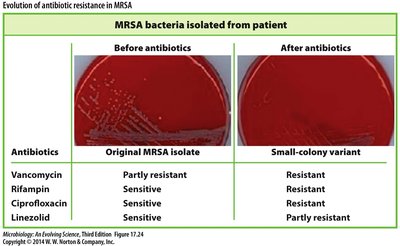
Q1. How has the evolution of MRSA after antibiotic treatment affected its fitness, and what information is provided by the size of the two bacterial strains?
Background
Topic: Antibiotic Resistance and Bacterial Fitness
This question explores how MRSA (Methicillin-resistant Staphylococcus aureus) adapts to antibiotic pressure, the concept of fitness in microbial populations, and how colony morphology can reflect underlying genetic and physiological changes.
Key Terms and Concepts:
Fitness: The ability of an organism to survive and reproduce in its environment.
Antibiotic resistance: The capacity of bacteria to withstand the effects of antibiotics.
Colony morphology: Physical characteristics of bacterial colonies, such as size and shape, which can indicate physiological changes.
Step-by-Step Guidance
Examine the table comparing antibiotic sensitivity before and after treatment. Note which antibiotics the original isolate and the small-colony variant are resistant or sensitive to.
Consider how resistance to multiple antibiotics might affect the bacterium's fitness in the presence and absence of antibiotics.
Analyze the significance of the colony size difference. What might a small-colony variant indicate about metabolic activity or growth rate?
Think about why the small-colony variant could cause disease in the patient but not in a healthy individual. What factors could influence pathogenicity?
Try solving on your own before revealing the answer!
Final Answer:
The evolution of MRSA under antibiotic pressure led to increased resistance, but possibly reduced fitness in environments without antibiotics. The small-colony variant may have slower growth or altered metabolism, which can affect its ability to cause disease in different hosts. The size difference reflects these physiological changes, and the variant's pathogenicity may depend on host immune status.
Q2. What are the general steps in metagenomic analysis, and what biases might be introduced at each step?
Background
Topic: Metagenomics and Microbial Community Analysis
This question tests your understanding of the workflow for metagenomic studies, including sample collection, DNA extraction, sequencing, and data analysis, as well as potential sources of bias.
Key Terms and Concepts:
Metagenome: The collective genome of all organisms in an environmental sample.
Bias: Systematic errors introduced during sample processing or analysis.
Culture-based vs. culture-independent approaches: Methods for studying microbial communities.
Step-by-Step Guidance
List the main steps in metagenomic analysis: sample collection, DNA extraction, library preparation, sequencing, and bioinformatics analysis.
For each step, consider what could introduce bias (e.g., selective DNA extraction, PCR amplification errors).
Compare metagenomics to culture-based methods. What are the strengths and limitations of each?
Think about how protein or transcript-based metagenomics might offer additional insights, and what challenges they present.
Try solving on your own before revealing the answer!
Final Answer:
Metagenomic analysis involves several steps, each with potential biases. DNA-based approaches can miss organisms with tough cell walls, while protein/transcript-based methods may be affected by extraction efficiency and stability. Metagenomics complements culture-based methods by revealing unculturable microbes, but both have limitations.
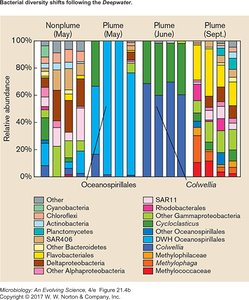
Q3. What information can you get from bacterial diversity data after an environmental event, such as the Deepwater spill?
Background
Topic: Microbial Diversity and Environmental Impact
This question focuses on interpreting data showing changes in microbial community composition following an environmental disturbance.
Key Terms and Concepts:
Bacterial diversity: The variety and abundance of bacterial species in a sample.
Relative abundance: The proportion of each species or group in the community.
Environmental microbiology: Study of microbial communities in natural environments.
Step-by-Step Guidance
Examine the graph showing bacterial diversity before and after the Deepwater spill. Identify major shifts in community composition.
Consider what these shifts indicate about the response of microbial communities to environmental changes.
Think about how this information can be used in environmental and microbiome studies (e.g., monitoring recovery, identifying key species).
Try solving on your own before revealing the answer!
Final Answer:
Bacterial diversity data reveal which groups increase or decrease after an environmental event, helping to identify resilient or sensitive species and track ecosystem recovery. This information is valuable for environmental monitoring and understanding microbiome dynamics.
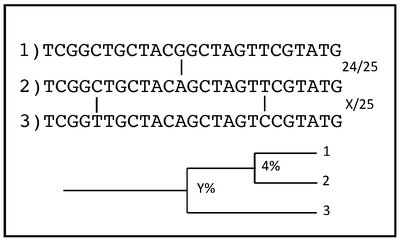
Q6. Based on the DNA sequence alignment and phylogenetic tree, what is the percent divergence of Organism 3 from 1 and 2, and what do phylogenetic trees define?
Background
Topic: Molecular Phylogeny and Sequence Analysis
This question tests your ability to interpret sequence alignments, calculate percent divergence, and understand the purpose of phylogenetic trees.
Key Terms and Concepts:
Percent divergence: The proportion of sequence differences between organisms.
Phylogenetic tree: A diagram showing evolutionary relationships based on genetic data.
Molecular clock: Method for estimating evolutionary time based on sequence changes.
Step-by-Step Guidance
Count the number of sequence differences between Organism 3 and Organisms 1 and 2.
Calculate percent divergence using the formula:
Interpret what the phylogenetic tree shows about the relationships among the organisms.
Consider whether multiple phylogenetic trees can be generated from the same data and why.
Try solving on your own before revealing the answer!
Final Answer:
The percent divergence is calculated based on sequence differences. Phylogenetic trees define evolutionary relationships, and multiple trees can be generated depending on the method and data interpretation.
Q7. What are the key processes and organisms involved in the nitrogen cycle, and how has human activity altered this cycle?
Background
Topic: Nitrogen Cycle and Environmental Microbiology
This question covers the biotic and abiotic processes that cycle nitrogen through the biosphere, the role of microbes, and the impact of human activity.
Key Terms and Concepts:
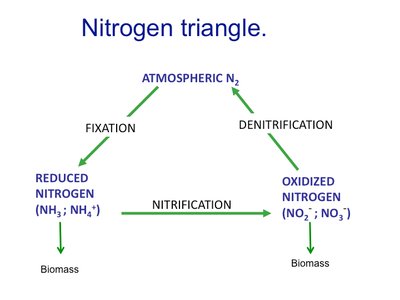
Nitrogen fixation: Conversion of atmospheric N2 to reduced nitrogen (NH3, NH4+).
Nitrification: Conversion of reduced nitrogen to oxidized forms (NO2-, NO3-).
Denitrification: Conversion of oxidized nitrogen back to atmospheric N2.
Environmental impact: How human activity (e.g., fertilizer use) alters the nitrogen cycle.
Step-by-Step Guidance
Identify the main nitrogen-containing compounds and the microbial processes that interconvert them.
Consider which compounds can cause environmental problems (e.g., nitrate pollution).
Analyze how human activity has affected the different vertices of the nitrogen triangle.
Think about the missing arrow in the triangle and whether it occurs in aerobic or anaerobic environments.
Try solving on your own before revealing the answer!
Final Answer:
The nitrogen cycle involves fixation, nitrification, and denitrification, with microbes playing key roles. Human activity has altered the cycle, especially through fertilizer use, leading to environmental issues like nitrate pollution. The missing arrow represents a process not shown, and its occurrence depends on environmental conditions.
