Back
BackMicrobiology Exam Study Guide: Viral Life Cycles, Genetic Exchange, and Antigenic Variation
Study Guide - Smart Notes
 Tailored notes based on your materials, expanded with key definitions, examples, and context.
Q1. What is the function of the ribosome?
Background
Topic: Ribosome Function
This question tests your understanding of the ribosome's role in cellular biology, specifically in protein synthesis.
Key Terms:
Ribosome: A cellular structure responsible for translating mRNA into protein.
Protein synthesis: The process of building proteins from amino acids using instructions from mRNA.
Step-by-Step Guidance
Recall that ribosomes are found in all living cells and are essential for translating genetic information.
Think about the process of translation, where mRNA is decoded to build a polypeptide chain.
Consider the ribosome's location (cytoplasm or attached to the endoplasmic reticulum) and its role in assembling amino acids.
Review how ribosomes use tRNA to match codons and add the correct amino acids to the growing protein chain.
Try solving on your own before revealing the answer!
Q2. What is a plasmid?
Background
Topic: Plasmids in Microbiology
This question tests your knowledge of plasmids, which are extra-chromosomal DNA elements in bacteria.
Key Terms:
Plasmid: Small, circular DNA molecule separate from chromosomal DNA.
Gene transfer: The movement of genetic material between organisms.
Step-by-Step Guidance
Recall that plasmids are commonly found in bacteria and can carry genes for antibiotic resistance.
Think about how plasmids replicate independently of the bacterial chromosome.
Consider the role of plasmids in horizontal gene transfer, such as conjugation.
Review examples of plasmid functions, like encoding enzymes or toxins.
Try solving on your own before revealing the answer!
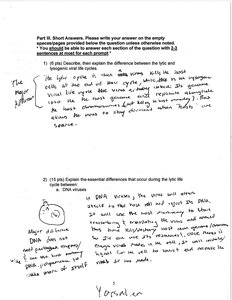
Q3. What is the lytic cycle of a virus?
Background
Topic: Viral Life Cycles
This question tests your understanding of the lytic cycle, a process by which viruses replicate and destroy host cells.
Key Terms:
Lytic cycle: Viral replication process resulting in cell lysis.
Phage: A virus that infects bacteria.
Host cell: The cell that a virus infects.
Step-by-Step Guidance
Recall the steps of the lytic cycle: attachment, penetration, replication, assembly, and release.
Think about how the virus uses the host cell's machinery to replicate its genome and produce new viral particles.
Consider the outcome of the lytic cycle—destruction of the host cell and release of new viruses.
Review the differences between the lytic and lysogenic cycles.
Try solving on your own before revealing the answer!
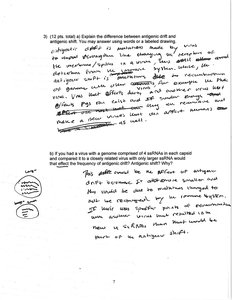
Q4. Explain the difference between antigenic drift and antigenic shift.
Background
Topic: Viral Evolution and Immune Evasion
This question tests your understanding of how viruses change over time to evade the immune system.
Key Terms:
Antigenic drift: Gradual changes in viral antigens due to mutations.
Antigenic shift: Sudden changes in viral antigens due to reassortment of genome segments.
Influenza virus: A common example where both drift and shift occur.
Step-by-Step Guidance
Recall that antigenic drift involves small mutations in viral genes encoding surface proteins.
Think about how these mutations accumulate over time, leading to new viral strains.
Consider antigenic shift, which occurs when two different viruses infect the same cell and exchange genetic material.
Review the consequences of antigenic shift, such as the emergence of new pandemic strains.
Try solving on your own before revealing the answer!
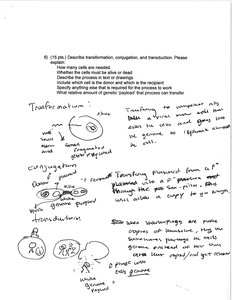
Q5. Describe transformation, conjugation, and transduction.
Background
Topic: Horizontal Gene Transfer in Bacteria
This question tests your knowledge of the mechanisms by which bacteria exchange genetic material.
Key Terms:
Transformation: Uptake of free DNA from the environment.
Conjugation: Direct transfer of DNA between bacteria via a pilus.
Transduction: Transfer of DNA by a bacteriophage (virus).
Step-by-Step Guidance
Recall the requirements for each process (e.g., competent cells for transformation, donor and recipient for conjugation).
Think about the source of DNA in each process (environment, another cell, or virus).
Consider the role of plasmids in conjugation and the importance of bacteriophages in transduction.
Review the outcomes of each process—genetic diversity and adaptation.
Try solving on your own before revealing the answer!