 Back
Microbiology: Infection, Disease, and Epidemiology Review Guidance
Study Guide - Smart Notes
 Tailored notes based on your materials, expanded with key definitions, examples, and context.
Q7. What is an infectious dose (ID)? What is its role in infection?
Background
Topic: Infectious Dose and Virulence
This question tests your understanding of the concept of infectious dose (ID) and how it relates to the ability of a microbe to cause disease (virulence).
Key Terms and Concepts:
Infectious Dose (ID): The minimum number of microbes required to establish an infection in a host.
Virulence: The degree of pathogenicity or ability of a microbe to cause disease.
Step-by-Step Guidance
Define infectious dose (ID) in your own words, focusing on the minimum number of organisms needed to initiate infection.
Explain how a lower ID indicates higher virulence, using examples (e.g., Q fever vs. cholera).
Discuss why understanding ID is important for infection control and public health.
Try solving on your own before revealing the answer!
Q8. Describe three ways microbes cause tissue damage.
Background
Topic: Mechanisms of Microbial Pathogenicity
This question asks you to identify and explain the main mechanisms by which microbes damage host tissues during infection.
Key Terms and Concepts:
Enzymes: Microbial proteins that break down host tissues (e.g., hyaluronidase, mucinase, coagulase).
Toxins: Substances produced by microbes that harm host cells (exotoxins and endotoxins).
Immune Response: Host's own immune reaction can cause collateral tissue damage.
Step-by-Step Guidance
List and briefly describe direct tissue damage by microbial enzymes, giving at least one example.
Explain the role of toxins, distinguishing between exotoxins and endotoxins.
Describe how the host's immune response can indirectly cause tissue damage (e.g., excessive inflammation).
Try solving on your own before revealing the answer!
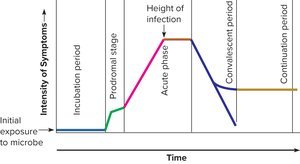
Q9. Describe the four phases of infection and disease.
Background
Topic: Stages of Infectious Disease
This question tests your knowledge of the typical progression of an infectious disease in the host.
Key Terms and Concepts:
Incubation Period: Time between exposure and first symptoms.
Prodromal Stage: Early, nonspecific symptoms.
Acute Phase: Peak of infection and symptoms.
Convalescent Period: Recovery phase.
Continuation/Latency: In some diseases, symptoms or pathogens persist.
Step-by-Step Guidance
Define each phase in your own words, focusing on what is happening to the microbe and the host.
Describe the typical symptoms or events associated with each phase.
Explain why some diseases have a continuation or latency phase.
Try solving on your own before revealing the answer!
Q10. Compare and contrast endotoxins and exotoxins.
Background
Topic: Bacterial Toxins
This question asks you to distinguish between two major types of bacterial toxins, focusing on their properties, effects, and sources.
Key Terms and Concepts:
Exotoxins: Secreted proteins with specific targets, produced by both Gram-positive and Gram-negative bacteria.
Endotoxins: Lipopolysaccharide (LPS) component of Gram-negative outer membrane, released upon cell death.
Step-by-Step Guidance
List the main features of exotoxins (e.g., specificity, potency, heat stability).
List the main features of endotoxins (e.g., general effects, source, heat stability).
Compare and contrast their effects on the host and their roles in disease.
Try solving on your own before revealing the answer!
Q11. What are virulence factors? Give examples.
Background
Topic: Microbial Virulence
This question tests your understanding of the traits that enable microbes to cause disease.
Key Terms and Concepts:
Virulence Factors: Traits that help microbes enter, attach, evade immunity, and cause damage.
Examples: Capsules, toxins, enzymes, adhesion molecules.
Step-by-Step Guidance
Define virulence factors and explain their importance in pathogenesis.
List at least three examples and briefly describe how each contributes to infection.
Try solving on your own before revealing the answer!
Q12. Differentiate among reservoirs. Provide examples.
Background
Topic: Reservoirs of Infection
This question asks you to distinguish between different types of reservoirs and give examples for each.
Key Terms and Concepts:
Reservoir: Primary habitat where a pathogen lives and multiplies.
Types: Human, animal (zoonoses), nonliving (soil, water, air).
Step-by-Step Guidance
Define what a reservoir is in the context of infectious disease.
Describe the three main types of reservoirs and provide at least one example for each.
Explain why understanding reservoirs is important for disease control.
Try solving on your own before revealing the answer!
Q13. List and describe the modes of transmission of infectious agents.
Background
Topic: Transmission of Infectious Diseases
This question tests your knowledge of how infectious agents are spread from one host to another.
Key Terms and Concepts:
Direct Transmission: Physical contact (touching, kissing, droplets).
Indirect Transmission: Fomites, vehicles (food, water, air).
Vector Transmission: Mechanical or biological transfer by arthropods.
Vertical Transmission: Parent to offspring (placenta, milk).
Step-by-Step Guidance
List each mode of transmission and define it.
Give an example of each mode (e.g., mosquito for biological vector).
Explain why understanding transmission is crucial for prevention.
Try solving on your own before revealing the answer!
Q14. What are nosocomial infections? Give examples.
Background
Topic: Healthcare-Associated Infections
This question asks you to define nosocomial infections and recognize common examples.
Key Terms and Concepts:
Nosocomial Infection: Infection acquired in a healthcare setting.
Examples: MRSA surgical wound infection, catheter-associated UTI, ventilator-associated pneumonia, C. difficile colitis.
Step-by-Step Guidance
Define nosocomial infection and explain why they are a concern in healthcare.
List at least two examples and describe how they might occur.
Try solving on your own before revealing the answer!
Q15. State Koch’s postulates and explain when they do not apply.
Background
Topic: Microbial Etiology of Disease
This question tests your understanding of the classic criteria for linking microbes to disease and their limitations.
Key Terms and Concepts:
Koch’s Postulates: Four criteria for establishing causation between a microbe and a disease.
Limitations: Some microbes cannot be cultured, some diseases are polymicrobial, ethical issues, asymptomatic carriers.
Step-by-Step Guidance
List the four postulates in order.
Describe at least two situations where the postulates cannot be fully applied.
Try solving on your own before revealing the answer!
Q16. What is epidemiology?
Background
Topic: Study of Disease in Populations
This question asks you to define epidemiology and its main goals.
Key Terms and Concepts:
Epidemiology: Study of disease patterns, causes, and control in populations.
Goals: Track outbreaks, identify risk factors, prevent spread.
Step-by-Step Guidance
Define epidemiology in your own words.
List at least two main goals of epidemiology.
Try solving on your own before revealing the answer!
Q17. Differentiate between incidence and prevalence.
Background
Topic: Epidemiological Measures
This question tests your understanding of two key measures used to describe disease frequency in populations.
Key Terms and Concepts:
Incidence: Number of new cases in a given time period.
Prevalence: Total number of existing cases at a given time.
Step-by-Step Guidance
Define incidence and prevalence, highlighting the difference in what they measure.
Give an example of how each might be used in public health.
Try solving on your own before revealing the answer!
Q18. Define and distinguish sporadic, endemic, epidemic, and pandemic disease patterns.
Background
Topic: Patterns of Disease Occurrence
This question asks you to recognize and differentiate the main patterns of infectious disease in populations.
Key Terms and Concepts:
Sporadic: Occasional, irregular cases.
Endemic: Constant, steady rate in a population.
Epidemic: Sudden increase above normal levels.
Pandemic: Worldwide epidemic.
Step-by-Step Guidance
Define each term and provide a real-world example if possible.
Explain how these patterns differ in terms of frequency and geographic spread.
Try solving on your own before revealing the answer!
Q19. How are infectious diseases different from other diseases?
Background
Topic: Infectious vs. Non-infectious Diseases
This question tests your understanding of what makes infectious diseases unique compared to other types of diseases.
Key Terms and Concepts:
Infectious Disease: Caused by microbes, transmissible, often preventable.
Non-infectious Disease: Not caused by microbes (e.g., genetic, metabolic).
Step-by-Step Guidance
List the main features that distinguish infectious diseases from other diseases.
Explain why these differences are important for prevention and control.
Try solving on your own before revealing the answer!
Q20. Describe the course of infection from contact to exit.
Background
Topic: Pathogenesis of Infectious Disease
This question asks you to outline the typical steps a microbe takes from entering the host to exiting and potentially infecting others.
Key Terms and Concepts:
Steps: Contact, entry, adhesion, surviving defenses, causing damage, exit.
Step-by-Step Guidance
List each step in order and briefly describe what happens at each stage.
Explain why each step is necessary for successful infection and transmission.
Try solving on your own before revealing the answer!
Q21. Case study: Kaitlyn’s knee scrape – What is your interpretation?
Background
Topic: Clinical Application – Local vs. Systemic Infection
This question asks you to interpret symptoms and signs to distinguish between local and systemic infection.
Key Terms and Concepts:
Local Infection: Signs and symptoms confined to one area (e.g., redness, oozing at wound).
Systemic Infection: Signs and symptoms affecting the whole body (e.g., fever, dizziness).
Step-by-Step Guidance
Identify which symptoms are local and which are systemic.
Explain what the presence of both types of symptoms suggests about the progression of the infection.
Try solving on your own before revealing the answer!
Q. What is herd immunity and why is it important?
Background
Topic: Population Immunity and Disease Control
This question tests your understanding of how immunity in a population can protect individuals and reduce disease spread.
Key Terms and Concepts:
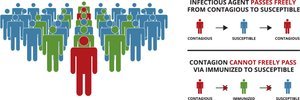
Herd Immunity: When enough people are immune, the spread of disease is limited, protecting those who are not immune.
Vaccination: A key method to achieve herd immunity.
Step-by-Step Guidance
Define herd immunity and explain the principle behind it.
Describe how herd immunity protects susceptible individuals.
Explain the role of vaccination in achieving herd immunity.
Try solving on your own before revealing the answer!
