 Back
BackMicrobiology Lab Exam 2 Review – Biochemical and Differential Tests, Antimicrobial Susceptibility, Plaque Assay, and Urine Cultures
Study Guide - Smart Notes
 Tailored notes based on your materials, expanded with key definitions, examples, and context.
Q1. Is this microbe positive or negative for salt tolerance?
Background
Topic: Salt Tolerance Test (Osmotolerance)
This question tests your understanding of how to interpret results from a salt tolerance test, which is used to determine if a microorganism can grow in the presence of high salt concentrations (e.g., 6.5% NaCl). This is important for differentiating between species based on their ability to survive in hypertonic environments.
Key Terms and Concepts:
Salt Tolerance (Osmotolerance): The ability of a microorganism to grow in media containing high concentrations of salt.
TSB (Tryptic Soy Broth): A general-purpose nutrient broth used for growing bacteria.
TSB + 6.5% NaCl: TSB medium supplemented with 6.5% sodium chloride to test for salt tolerance.
Positive Result: Growth (turbidity) in TSB + 6.5% NaCl indicates salt tolerance.
Negative Result: No growth in TSB + 6.5% NaCl indicates lack of salt tolerance.
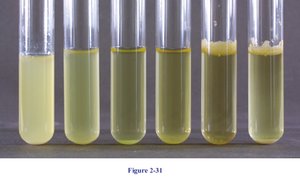
Step-by-Step Guidance
Observe the TSB tube (control) to confirm that the microbe is viable and capable of growth in standard conditions.
Compare the TSB + 6.5% NaCl tube to the control. Look for visible turbidity (cloudiness) as evidence of growth.
If there is growth in both the TSB and TSB + 6.5% NaCl tubes, the microbe is considered salt tolerant (positive result).
If there is growth in TSB but not in TSB + 6.5% NaCl, the microbe is not salt tolerant (negative result).
If there is no growth in either tube, the test is invalid (the organism may not be viable or the inoculation was unsuccessful).
Try solving on your own before revealing the answer!
Q2. Is this microbe positive or negative for salt tolerance?
Background
Topic: Salt Tolerance Test (Osmotolerance)
This question is similar to the previous one and tests your ability to interpret salt tolerance results using a different set of tubes.
Key Terms and Concepts:
Salt tolerance, TSB, TSB + 6.5% NaCl, positive/negative results (see above).
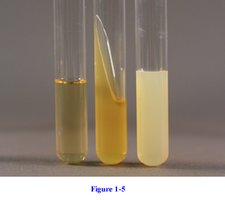
Step-by-Step Guidance
Check the TSB tube for growth to ensure the microbe is viable.
Examine the TSB + 6.5% NaCl tube for turbidity or lack thereof.
If there is no growth in the salt tube but growth in the control, the microbe is not salt tolerant.
If both tubes show no growth, the test is invalid.
Try solving on your own before revealing the answer!
Q3. Is this microbe positive or negative for salt tolerance?
Background
Topic: Salt Tolerance Test (Osmotolerance)
This question presents a scenario where there is no growth in either tube, which requires you to consider test validity.
Key Terms and Concepts:
Salt tolerance, TSB, TSB + 6.5% NaCl, test validity (see above).
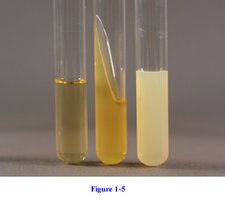
Step-by-Step Guidance
Observe both tubes for growth. If neither tube shows turbidity, consider possible reasons (e.g., non-viable organism, inoculation error).
Recall that a valid test requires growth in the control tube (TSB) to interpret salt tolerance accurately.
If both tubes are clear, you cannot determine salt tolerance from this test.
Try solving on your own before revealing the answer!
