 Back
BackMicrobiology Lab Introduction, Safety, and Microscopy Study Guide
Study Guide - Smart Notes
 Tailored notes based on your materials, expanded with key definitions, examples, and context.
Lab Introduction and Safety
General Lab Safety and Biosafety Practices
Microbiology laboratories require strict adherence to safety protocols to prevent contamination and ensure the well-being of all participants. Understanding biosafety levels and proper lab conduct is essential for handling microorganisms safely.
Biosafety Levels (BSL): There are four biosafety levels, each with increasing containment and safety requirements. Most introductory microbiology labs operate at BSL-1, which involves standard practices and minimal risk.
BSL-1: Basic containment, standard microbiological practices, no special facilities except a sink for handwashing.
BSL-2: Includes handwashing, autoclave for waste, PPE, and handling of pathogens.
BSL-3: Pathogens transmitted by respiratory route, special facilities required.
BSL-4: Highest level, for dangerous pathogens with no treatment or vaccine, specialized building and systems.
Lab Conduct and Procedures
Proper lab conduct ensures safety and accuracy in microbiological experiments. Students must follow general procedures and biosafety practices at all times.
Read laboratory exercises before class and plan your work.
Label all experiments with your name and lab section.
Keep accurate notes and records for future reference.
Clean your work area with disinfectant at the beginning and end of each lab.
Wear a lab coat at all times; lab coats must be CLEAN, WHITE, and wrinkle-free.
Wash hands with soap when entering or leaving the lab.
Do not bring personal items or electronic devices onto benchtops.
Dispose of all materials in the correct containers.
Report accidents immediately to the instructor.
Appropriate Lab Attire
Wearing proper attire is crucial for safety and hygiene in the microbiology lab.
Wear conservative, closed-toed shoes; athletic shoes are preferred.
Shirts must cover the stomach, lower back, and upper arms.
Long pants that cover the ankles; no jeans, lycra, or tight-fitting clothing.
Hair should be pulled back and secured.
No visible body piercing except earrings; jewelry should be limited.
Tattoos should not be visible and must be covered.
Chemical Hazard Signals
Understanding chemical hazard signals is essential for safe handling of reagents and materials in the lab.
Warning Sign | Meaning |
|---|---|
Flammable | Easily catches fire. |
Compressed Gas | Gas under pressure; may explode if heated. |
Corrosive | Causes skin burns and damages metals. |
Oxidizing | Can cause or intensify fires. |
Harmful / Irritant | Causes irritation or less serious health effects. |
Health Hazard | May cause serious or long-term health effects. |
Toxic | Poisonous; can be fatal if inhaled, swallowed, or absorbed. |
Explosive | May explode due to heat, shock, or friction. |
Microscopy in Microbiology
History and Types of Microscopes
The microscope is a fundamental tool in microbiology, allowing scientists to observe microorganisms invisible to the naked eye. The invention and development of microscopes revolutionized the study of microbes.
Invented by: Zacharias Janssen (1600s).
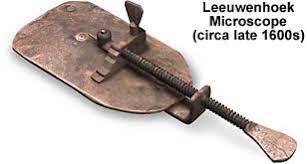
First documentation of microorganisms: Antoni van Leeuwenhoek (1680s) using simple microscopes.
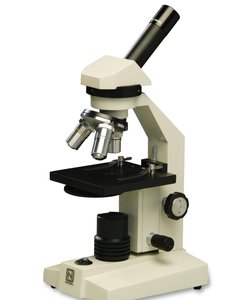
Modern classroom microscope: Brightfield compound microscope.
Major Parts of the Microscope
Understanding the parts of a microscope is essential for proper use and maintenance.
Ocular lens: Eyepiece, usually 10X or 15X magnification.
Objective lenses: Closest to the specimen, provide various magnifications.
Stage: Platform for placing slides.
Coarse and fine adjustment: Focus the specimen.
Illumination: Light source, typically a bulb.
Iris diaphragm: Adjusts light reaching the specimen.
Condenser: Focuses light onto the specimen.
Base and arm: Support and connect microscope components.
Calculating Total Magnification
Total magnification is determined by multiplying the magnification of the objective lens by the ocular lens.
Formula:
Example: Using a 100x oil immersion lens and a 10x ocular lens:
Resolution and Resolving Power
Resolution is the ability of a microscope to distinguish two points as separate. Resolving power is the minimum distance between two points that can still be seen as distinct.
Resolution: How clearly two points are seen as separate.
Resolving Power Formula:
Decreasing wavelength or increasing numerical aperture improves resolving power.
Microscope Handling Tips
Proper handling ensures the longevity and accuracy of the microscope.
Carry with both hands: one on base, one on arm.
Use both eyes when observing specimens.
Focus slowly and carefully; start with the lowest power lens.
Microscopes are parfocal: focus with one lens, others will be in focus.
Use oil with oil immersion lens; clean lenses and stage after use.
Bacterial Shapes and Classification
Common Bacterial Shapes
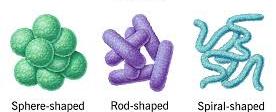
Bacteria are classified based on their shapes, which are important for identification and understanding their biology.
Cocci: Sphere-shaped bacteria.
Bacilli: Rod-shaped bacteria.
Spirilla: Spiral-shaped bacteria.
Gram Staining and Bacterial Morphology
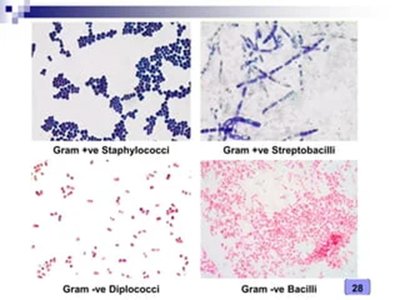
Gram staining is a fundamental technique in microbiology used to differentiate bacteria based on their cell wall structure and morphology.
Gram-positive: Stain purple/blue, thick peptidoglycan layer.
Gram-negative: Stain pink/red, thin peptidoglycan layer and outer membrane.
Common morphologies: Staphylococci (clusters), Streptobacilli (chains), Diplococci (pairs), Bacilli (rods).
Medical Terminology: Cranial Region Prefixes
Key Prefixes and Their Meanings
Understanding medical terminology is essential for describing anatomical regions and functions in microbiology and medicine.
Cephalo-: Head
Cranio-: Skull (protects the brain)
Encephalo-: Brain
Neuro-: Nerves and nervous system
Meningo-: Protective layers covering brain and spinal cord
Ophthalmo-: Eye
Oto-: Ear
Rhino-: Nose
Oro-/Stomato-: Mouth
Audi-: Hearing
Example: The term encephalitis refers to inflammation of the brain, using the prefix 'encephalo-'.
Additional info: Academic context was added to clarify biosafety levels, microscope history, and bacterial classification for completeness and exam preparation.
