 Back
BackMicrobiology Lab: Urease, Nitrate Reduction, Catalase, and Oxidase Tests
Study Guide - Smart Notes
 Tailored notes based on your materials, expanded with key definitions, examples, and context.
Urease Test
Principle and Biochemical Basis
The urease test is used to identify bacteria capable of hydrolyzing urea into ammonia and carbon dioxide using the enzyme urease. Urea is a nitrogen-containing organic compound, commonly found as a waste product in urine. The hydrolysis of urea increases the pH of the medium due to the production of ammonia, which is alkaline.
Urea formula: (NH2)2CO
Indicator: Phenol red is used to detect pH changes.
Interpretation:
Bright pink: Rapid urease activity (strong positive)
Orange-red: Slow urease activity (weak positive)
Yellow: Negative (no urease activity)
Example: Proteus vulgaris is known for rapid urease activity, while many enteric bacteria hydrolyze urea slowly.
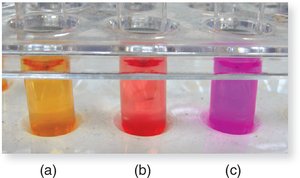
Laboratory Procedure
Inoculate urea broth with the test organism.
Incubate and observe color change after 24 hours.
Only urease-positive bacteria can grow in urea broth due to limited nutrients.
Applications: The urease test is especially useful for distinguishing Proteus species from other enteric bacteria.
Nitrate Reduction Test
Nitrogen Cycle and Microbial Roles
Nitrogen is essential for the synthesis of nucleic acids and proteins. Most organisms cannot use atmospheric nitrogen (N2), but bacteria play key roles in converting nitrogen into usable forms through the nitrogen cycle:
Nitrogen fixation: Conversion of N2 to NH4+ by bacteria (e.g., Rhizobium, Azotobacter).
Nitrification: Conversion of NH4+ to NO2– and then to NO3– by nitrifying bacteria.
Denitrification: Reduction of NO3– to N2 or N2O by denitrifying bacteria (e.g., Pseudomonas, Clostridium).
Key enzymes:
Nitrate reductase: Reduces nitrate (NO3–) to nitrite (NO2–).
Nitrite reductase: Reduces nitrite to nitrogen gas (N2) or nitrous oxides (N2O).
Test Procedure and Interpretation
Inoculate nitrate broth with the test organism and incubate.
Add 5 drops each of nitrate reagent A (alpha-naphthylamine) and B (sulfanilic acid):
Red color: Positive for nitrate reduction (nitrate to nitrite).
No color change: Proceed to step 2.
Add zinc powder:
Red color: Negative (nitrate was not reduced by the organism; zinc reduced it chemically).
No color change: Positive for complete reduction (nitrate reduced beyond nitrite to N2 or N2O).
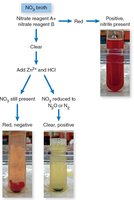
Example: Pseudomonas aeruginosa is a denitrifier and can reduce nitrate all the way to nitrogen gas.
Catalase Test
Principle and Biochemical Basis
The catalase test detects the presence of the enzyme catalase, which breaks down hydrogen peroxide (H2O2) into water and oxygen. Hydrogen peroxide is a toxic byproduct of aerobic metabolism, and catalase protects cells from oxidative damage.
Reaction: 2 H2O2 → 2 H2O + O2 (gas)
Interpretation:
Bubbling: Catalase-positive (oxygen gas released)
No bubbling: Catalase-negative
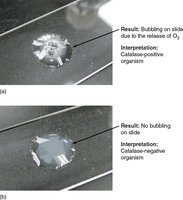
Applications: Differentiates Staphylococcus (catalase-positive) from Streptococcus (catalase-negative).
Oxidase Test
Principle and Biochemical Basis
The oxidase test identifies bacteria that produce cytochrome c oxidase, an enzyme involved in the electron transport chain during aerobic respiration. The test reagent donates electrons to cytochrome c oxidase if present, turning blue or purple.
Interpretation:
Blue/purple color: Oxidase-positive
No color change: Oxidase-negative
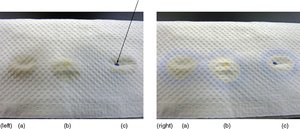
Applications: Distinguishes among Gram-negative rods; Pseudomonas aeruginosa is oxidase-positive, while enteric bacteria are oxidase-negative.
Summary Table: Biochemical Tests for Bacterial Identification
Test | Enzyme Detected | Positive Result | Negative Result | Example Positive Organism |
|---|---|---|---|---|
Urease | Urease | Bright pink | Yellow | Proteus vulgaris |
Nitrate Reduction | Nitrate reductase | Red after reagents or clear after zinc | Red after zinc | Pseudomonas aeruginosa |
Catalase | Catalase | Bubbling | No bubbling | Staphylococcus epidermidis |
Oxidase | Cytochrome c oxidase | Blue/purple | No color change | Pseudomonas aeruginosa |
Applications and Importance
These biochemical tests are essential for the identification and differentiation of clinically important bacteria.
They help guide appropriate treatment and further characterization of microbial isolates.
Additional info: The tests described are foundational laboratory techniques in microbiology, directly supporting the identification of unknown bacterial species and understanding their metabolic capabilities.
