 Back
BackMicrobio lecture midterm pt.1
Study Guide - Smart Notes
 Tailored notes based on your materials, expanded with key definitions, examples, and context.
Q1. Explain the Calvin cycle process that produces a full molecule of glucose and regenerates the ribulose bisphosphate molecule.
Background
Topic: Calvin Cycle (Photosynthetic Carbon Fixation)
This question tests your understanding of the biochemical pathway by which autotrophic organisms (like plants and cyanobacteria) convert CO2 into glucose, and how ribulose bisphosphate (RuBP) is regenerated to sustain the cycle.
Key Terms and Formulas:
Calvin Cycle: A series of enzyme-catalyzed reactions that occur in the stroma of chloroplasts.
RuBP (Ribulose-1,5-bisphosphate): The molecule that accepts CO2 in the first step.
Key enzymes: Rubisco, phosphoglycerate kinase, glyceraldehyde-3-phosphate dehydrogenase.
ATP and NADPH: Energy and reducing power required for the cycle.
Step-by-Step Guidance
Start by identifying the three main phases of the Calvin cycle: carbon fixation, reduction, and regeneration.
Describe how CO2 is fixed by Rubisco to RuBP, forming 3-phosphoglycerate (3-PGA).
Explain how ATP and NADPH are used to reduce 3-PGA to glyceraldehyde-3-phosphate (G3P).
Discuss how some G3P molecules are used to synthesize glucose, while others are recycled to regenerate RuBP.
Set up the stoichiometry: 6 turns of the cycle are needed to produce one glucose molecule and regenerate RuBP.
Try solving on your own before revealing the answer!
Final Answer:
The Calvin cycle requires 6 turns to produce one molecule of glucose (C6H12O6), using 6 CO2, 18 ATP, and 12 NADPH. RuBP is regenerated through a series of rearrangements of G3P, ensuring the cycle can continue.
This process is essential for autotrophic carbon fixation and sustains the energy needs of the cell.
Q2. Under what circumstances does oxygenic photophosphorylation use noncyclic photophosphorylation and when does it use cyclic photophosphorylation? Also, describe what occurs during each process.
Background
Topic: Photosynthetic Electron Transport (Photophosphorylation)
This question tests your understanding of the two types of photophosphorylation in oxygenic photosynthesis: cyclic and noncyclic, and the conditions under which each occurs.
Key Terms and Formulas:
Noncyclic photophosphorylation: Electrons flow from water to NADP+, producing ATP, NADPH, and O2.
Cyclic photophosphorylation: Electrons cycle back to photosystem I, producing ATP but not NADPH or O2.
Photosystem I (PSI) and Photosystem II (PSII): Protein complexes involved in light reactions.
Step-by-Step Guidance
Identify the main products of each pathway: ATP, NADPH, and O2 for noncyclic; ATP only for cyclic.
Explain that noncyclic photophosphorylation occurs when the cell needs both ATP and NADPH for the Calvin cycle.
Describe that cyclic photophosphorylation is favored when the cell needs more ATP relative to NADPH.
Outline the electron flow in each process: noncyclic involves both PSII and PSI, while cyclic involves only PSI.
Set up the conditions: light intensity, NADP+ availability, and cellular energy demands influence which pathway is used.
Try solving on your own before revealing the answer!
Final Answer:
Noncyclic photophosphorylation is used when both ATP and NADPH are needed, and electrons flow from water to NADP+, producing O2. Cyclic photophosphorylation is used when the cell needs more ATP than NADPH, and electrons cycle back to PSI, producing only ATP.
Each process is regulated by the cell's metabolic needs and environmental conditions.
Q3. Why does an organism that is able to respire both aerobically and anaerobically preferentially undergo aerobic respiration?
Background
Topic: Cellular Respiration (Aerobic vs. Anaerobic)
This question tests your understanding of the energetic differences between aerobic and anaerobic respiration and why organisms prefer aerobic conditions when available.
Key Terms and Formulas:
Aerobic respiration: Uses O2 as the terminal electron acceptor, yielding more ATP.
Anaerobic respiration: Uses other electron acceptors (e.g., nitrate, sulfate), yielding less ATP.
ATP yield: Aerobic respiration produces up to 38 ATP per glucose; anaerobic yields less.
Step-by-Step Guidance
Compare the energy yield (ATP) of aerobic vs. anaerobic respiration.
Explain the role of oxygen as a highly efficient electron acceptor.
Discuss how higher ATP yield supports faster growth and cellular functions.
Set up the reasoning: organisms will use aerobic respiration when O2 is available due to its efficiency.
Try solving on your own before revealing the answer!
Final Answer:
Organisms preferentially undergo aerobic respiration because oxygen is a highly efficient electron acceptor, resulting in greater ATP production and supporting faster growth and metabolism.
Q4. How do Cyanobacteria impact the ecology of both aquatic and terrestrial environments on Earth?
Background
Topic: Microbial Ecology (Cyanobacteria)
This question tests your understanding of the ecological roles of cyanobacteria, including their contributions to primary production and nitrogen fixation.
Key Terms and Formulas:
Cyanobacteria: Photosynthetic prokaryotes found in diverse environments.
Primary production: Generation of organic matter from CO2 via photosynthesis.
Nitrogen fixation: Conversion of atmospheric N2 to bioavailable forms.
Step-by-Step Guidance
Describe the role of cyanobacteria in oxygenic photosynthesis and primary production.
Explain their ability to fix nitrogen, enriching soil and aquatic environments.
Discuss their impact on food webs and ecosystem stability.
Set up examples of their ecological importance in both aquatic and terrestrial systems.
Try solving on your own before revealing the answer!
Final Answer:
Cyanobacteria contribute to primary production and oxygen generation in aquatic and terrestrial environments, and their nitrogen fixation supports ecosystem fertility and stability.
Q5. Based on your knowledge of microbial transformations of inorganic nitrogen species, what impact would you predict extensive tilling to have on the fate of ammonium-based nitrogen fertilizer?
Background
Topic: Nitrogen Cycle (Microbial Transformations)
This question tests your understanding of how soil oxygenation affects microbial processes like nitrification and the fate of ammonium fertilizers.
Key Terms and Formulas:
Nitrification: Microbial conversion of NH4+ to NO3- in the presence of oxygen.
Ammonium (NH4+): Preferred nitrogen source for plants.
Nitrate (NO3-): More mobile, prone to leaching.
Step-by-Step Guidance
Explain how tilling increases soil oxygen levels.
Describe how increased oxygen promotes nitrification by aerobic microbes.
Discuss the conversion of ammonium to nitrate and its implications for fertilizer retention.
Set up the prediction: more nitrate formation leads to greater risk of leaching and loss from soil.
Try solving on your own before revealing the answer!
Final Answer:
Extensive tilling increases soil oxygen, promoting nitrification and converting ammonium to nitrate, which is more likely to be lost from the soil due to leaching.
Q6. What metabolism would be favored when there is a lack of electron acceptors?
Background
Topic: Metabolic Pathways (Fermentation vs. Respiration)
This question tests your understanding of how cells adapt their metabolism when external electron acceptors are unavailable.
Key Terms and Formulas:
Fermentation: Metabolic process that generates ATP via substrate-level phosphorylation.
Electron acceptors: Molecules like O2, NO3-, SO42- used in respiration.
Step-by-Step Guidance
Identify the role of electron acceptors in respiration.
Explain why fermentation is favored when electron acceptors are absent.
Discuss how ATP is produced via substrate-level phosphorylation in fermentation.
Try solving on your own before revealing the answer!
Final Answer:
Fermentation is favored when there is a lack of electron acceptors, as it allows cells to generate ATP without an electron transport chain.
Q7. Escherichia coli can grow in glucose broth both aerobically and anaerobically. When grown aerobically, these bacteria divide every 20 minutes. However, when grown anaerobically they require about 100 minutes to divide. What may account for this difference in growth rate?
Background
Topic: Microbial Growth Rates (Aerobic vs. Anaerobic)
This question tests your understanding of how energy yield affects microbial growth rates under different conditions.
Key Terms and Formulas:
ATP yield: Higher in aerobic respiration.
Growth rate: Dependent on energy available for biosynthesis.
Step-by-Step Guidance
Compare the ATP yield of aerobic and anaerobic metabolism.
Explain how lower energy yield slows biosynthetic processes and cell division.
Set up the reasoning: E. coli grows faster aerobically due to more efficient energy production.
Try solving on your own before revealing the answer!
Final Answer:
The slower growth rate under anaerobic conditions is due to lower ATP yield, which limits biosynthesis and cell division compared to aerobic growth.
Q8. What is the Glyoxylate shunt or cycle and what is it important for?
Background
Topic: Metabolic Pathways (Glyoxylate Cycle)
This question tests your understanding of the glyoxylate cycle, its role in bypassing decarboxylation steps of the TCA cycle, and its importance for growth on C2 compounds.
Key Terms and Formulas:
Glyoxylate cycle: An alternative pathway to the TCA cycle.
Key enzymes: Isocitrate lyase, malate synthase.
Importance: Allows organisms to convert acetyl-CoA to succinate for biosynthesis.
Step-by-Step Guidance
Describe the steps of the glyoxylate cycle and its key enzymes.
Explain how it bypasses CO2 loss, enabling net carbon gain.
Discuss its importance for growth on acetate or fatty acids.
Try solving on your own before revealing the answer!
Final Answer:
The glyoxylate cycle enables organisms to grow on C2 compounds by bypassing decarboxylation steps and conserving carbon for biosynthesis.
Q9. Differentiate between exergonic and endergonic in terms of free-energy calculations.
Background
Topic: Bioenergetics (Free Energy)
This question tests your understanding of the thermodynamic concepts of exergonic and endergonic reactions.
Key Terms and Formulas:
Exergonic: Releases energy; ΔG < 0.
Endergonic: Requires energy input; ΔG > 0.
ΔG: Gibbs free energy change.
Step-by-Step Guidance
Define exergonic and endergonic reactions in terms of ΔG.
Explain what negative and positive ΔG values mean for spontaneity.
Set up examples of each type of reaction.
Try solving on your own before revealing the answer!
Final Answer:
Exergonic reactions have negative ΔG and release energy, while endergonic reactions have positive ΔG and require energy input.
Q10. Describe in as much detail as possible what Nitrogen fixation is and what the key products of this process are.
Background
Topic: Nitrogen Cycle (Nitrogen Fixation)
This question tests your understanding of the biochemical process by which certain microbes convert atmospheric nitrogen (N2) into bioavailable forms.
Key Terms and Formulas:
Nitrogen fixation: Conversion of N2 to NH3 by nitrogenase enzyme.
Key products: Ammonia (NH3), which can be assimilated by organisms.
Energy requirement: High ATP demand due to triple bond in N2.
Step-by-Step Guidance
Describe the role of nitrogenase in breaking the N2 triple bond.
Explain the ATP and electron requirements for the process.
Discuss the ecological importance of ammonia production.
Try solving on your own before revealing the answer!
Final Answer:
Nitrogen fixation converts atmospheric N2 into ammonia (NH3), which is essential for biosynthesis in living organisms.
Q11. Define anaplerotic reactions and give one example of such. See Q8 as example.
Background
Topic: Metabolic Pathways (Anaplerotic Reactions)
This question tests your understanding of reactions that replenish TCA cycle intermediates.
Key Terms and Formulas:
Anaplerotic reactions: Reactions that refill TCA cycle intermediates.
Example: Pyruvate carboxylase converting pyruvate to oxaloacetate.
Step-by-Step Guidance
Define anaplerotic reactions and their importance.
Describe an example, such as pyruvate carboxylation.
Set up the context: why replenishing TCA intermediates is necessary.
Try solving on your own before revealing the answer!
Final Answer:
Anaplerotic reactions replenish TCA cycle intermediates; an example is pyruvate carboxylase converting pyruvate to oxaloacetate.
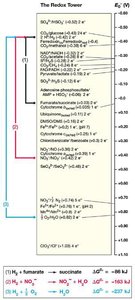
Q12. What does this equation define? Give names and values where known for each term in the equation. What would negative or positive values of the equation imply for chemical reactions? ΔG°′ = [−nF] ∙ [ΔE′o ]
Background
Topic: Bioenergetics (Redox Reactions)
This question tests your understanding of the relationship between free energy change and redox potential in biochemical reactions.
Key Terms and Formulas:
ΔG°′: Standard free energy change.
n: Number of electrons transferred.
F: Faraday constant (96,485 C/mol).
ΔE′o: Standard reduction potential difference.
Step-by-Step Guidance
Identify each term in the equation and its significance.
Explain how ΔE′o relates to electron transfer and energy yield.
Discuss what negative or positive ΔG°′ values mean for reaction spontaneity.
Set up the context for interpreting redox reactions in metabolism.
Try solving on your own before revealing the answer!
Final Answer:
This equation defines the relationship between free energy change and redox potential. Negative ΔG°′ indicates a spontaneous, exergonic reaction; positive ΔG°′ indicates a non-spontaneous, endergonic reaction.
Q13. Calculate the ΔG°′ for each of the above reactions. What type of reactions are these?
Background
Topic: Bioenergetics (Redox Calculations)
This question tests your ability to calculate free energy changes for redox reactions using the provided equation and redox tower.
Key Terms and Formulas:
ΔG°′: Standard free energy change.
ΔE′o: Standard reduction potential difference (from redox tower).
n: Number of electrons transferred.
F: Faraday constant.
Step-by-Step Guidance
Identify the reactants and products for each reaction.
Determine the number of electrons transferred (n).
Find the ΔE′o values for each half-reaction from the redox tower.
Set up the calculation using the formula: .
Prepare to solve for ΔG°′ for each reaction, but stop before plugging in the final values.
Try solving on your own before revealing the answer!
Final Answer:
ΔG°′ values are calculated using the formula and the redox tower. The reactions are redox reactions, classified as exergonic or endergonic based on the sign of ΔG°′.
Q14. What does the Great Plate Count Anomaly refer to and how would the microbial ecologist trying to describe an ecosystem circumvent this problem?
Background
Topic: Microbial Ecology (Cultivation Techniques)
This question tests your understanding of the limitations of traditional culturing methods and modern approaches to studying microbial diversity.
Key Terms and Formulas:
Great Plate Count Anomaly: Discrepancy between microscopic counts and colony counts.
Culture-independent methods: DNA sequencing, metagenomics.
Step-by-Step Guidance
Define the Great Plate Count Anomaly and its significance.
Explain why many microbes cannot be cultured on standard media.
Discuss alternative methods for assessing microbial diversity.
Try solving on your own before revealing the answer!
Final Answer:
The Great Plate Count Anomaly refers to the underestimation of microbial diversity by culturing. Ecologists use molecular techniques to circumvent this problem.
Q15. In class you were introduced to three types of photosynthesis carried out by phototrophic bacteria. What are the major differences between these three and what groups of microbes carry out which form? Be sure to distinguish between electron donation and acceptance, energy production and photosystem type.
Background
Topic: Microbial Photosynthesis (Phototrophic Bacteria)
This question tests your understanding of the diversity of photosynthetic mechanisms among bacteria, including differences in electron donors, energy production, and photosystem structure.
Key Terms and Formulas:
Oxygenic photosynthesis: Uses water as electron donor, produces O2.
Anoxygenic photosynthesis: Uses other electron donors (e.g., H2S), does not produce O2.
Photosystem types: PSI, PSII, bacterial reaction centers.
Step-by-Step Guidance
Identify the three types of photosynthesis: oxygenic, anoxygenic (purple bacteria), anoxygenic (green bacteria).
Describe the electron donors and acceptors for each type.
Explain the differences in energy production and photosystem structure.
Set up the groups of microbes associated with each type.
Try solving on your own before revealing the answer!
Final Answer:
Oxygenic photosynthesis is carried out by cyanobacteria and uses water as an electron donor. Anoxygenic photosynthesis is carried out by purple and green bacteria, using other electron donors and different photosystem structures.
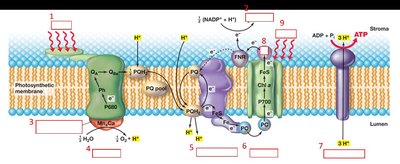
Q16. In one sentence describe the above process and fill in each numbered label.
Background
Topic: Photosynthetic Electron Transport Chain (Labeling)
This question tests your ability to interpret and label the components of the photosynthetic electron transport chain.
Key Terms and Formulas:
Photosystem II, Photosystem I, electron carriers, ATP synthase.
Key molecules: NADP+, H2O, O2, ATP.
Step-by-Step Guidance
Identify the main steps in the diagram: water splitting, electron transport, ATP and NADPH formation.
Label each numbered box with the appropriate molecule or process.
Describe the overall process in one sentence.
Set up the context for filling in the labels, but stop before revealing all answers.
Try solving on your own before revealing the answer!
Final Answer:
The process is oxygenic photosynthesis, and the labels correspond to key molecules and steps in the electron transport chain (e.g., H2O, O2, NADP+, ATP).
Q17. Distinguish between Dissimilative Sulfur reducers and dissimilative sulfur oxidizers.
Background
Topic: Microbial Sulfur Metabolism
This question tests your understanding of the differences between sulfur-reducing and sulfur-oxidizing microbes in energy metabolism.
Key Terms and Formulas:
Dissimilative sulfur reduction: Uses sulfur compounds as electron acceptors.
Dissimilative sulfur oxidation: Uses sulfur compounds as electron donors.
Energy production: Both processes are linked to microbial respiration.
Step-by-Step Guidance
Define dissimilative sulfur reduction and oxidation.
Describe the electron donors and acceptors for each process.
Set up the context for energy production in each pathway.
Try solving on your own before revealing the answer!
Final Answer:
Dissimilative sulfur reducers use sulfur compounds as electron acceptors, while dissimilative sulfur oxidizers use them as electron donors in energy metabolism.
