 Back
BackMicrobiology of the Built Environment: Mining, Bioremediation, Wastewater Treatment, and Biodeterioration
Study Guide - Smart Notes
 Tailored notes based on your materials, expanded with key definitions, examples, and context.
Microbiology of the Built Environment
Introduction
The built environment encompasses all human-made surroundings that provide the setting for human activity, ranging from buildings and parks to industrial sites. Microorganisms play critical roles in these environments, influencing processes such as mining, pollution remediation, wastewater treatment, and the deterioration of construction materials. Understanding these microbial processes is essential for both harnessing their benefits and mitigating their negative impacts.
Mining with Microorganisms
Microbial Leaching
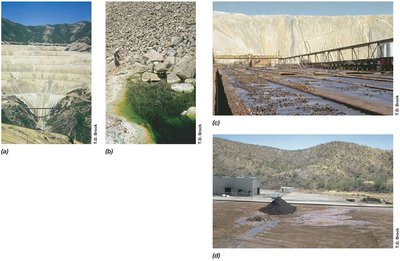
Microbial leaching, also known as bioleaching, is the process by which microorganisms are used to extract valuable metals from ores, particularly sulfide ores. This method is especially important for low-grade ores where traditional mining is not economically feasible.
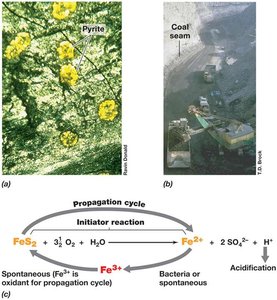
Pyrite (FeS2) is a common iron sulfide mineral found in coal and metal ores.
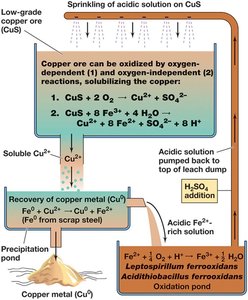
Microbial leaching involves the oxidation of metal sulfides by bacteria, resulting in the solubilization of metals such as copper.
Approximately 25% of the world's copper is obtained through microbial leaching.
The process is facilitated by bacteria such as Leptospirillum ferrooxidans and Acidithiobacillus ferrooxidans.
Key Reactions:
Oxygen-dependent:
Oxygen-independent:
Example: In copper mining, low-grade ore is crushed and piled into leach dumps. Acidic solution is sprinkled over the pile, and the resulting metal-rich solution is collected for metal recovery.
Environmental Impact: Acid Mine Drainage
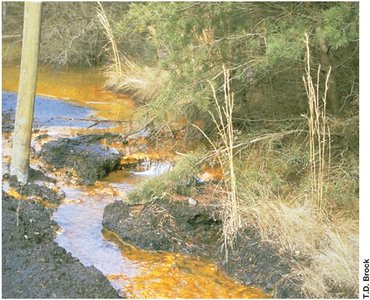
While microbial leaching is economically beneficial, it can also cause significant environmental damage if not properly managed. Acid mine drainage (AMD) occurs when sulfide minerals are exposed to oxygen and water, leading to the production of sulfuric acid and the release of toxic metals.
AMD is a major problem in coal-mining regions.
pH values in affected waters can drop below 1, making them extremely acidic and toxic to aquatic life.
Iron-oxidizing bacteria accelerate the oxidation of pyrite, increasing acid production.
Key Reaction:
Initiator:
Propagation:
Example: The yellowish-red coloration in streams near mining sites is due to precipitated iron oxides from AMD.
Bioremediation of Organic Pollutants
Hydrocarbon Degradation
Bioremediation uses microorganisms to degrade environmental pollutants, including hydrocarbons from oil spills. Many bacteria, fungi, cyanobacteria, and green algae can oxidize petroleum products, converting them ultimately to carbon dioxide.
Bioremediation is enhanced by optimizing temperature and nutrient levels.
Hydrocarbon-degrading bacteria attach to oil droplets, decompose the oil, and help disperse oil slicks.
Prokaryotes have been used in the cleanup of major oil spills, such as the Exxon Valdez spill.
Example: In situ treatment of oil-contaminated beaches by adding inorganic nutrients to stimulate microbial activity.

Microbial Activity in Fuel Storage Tanks
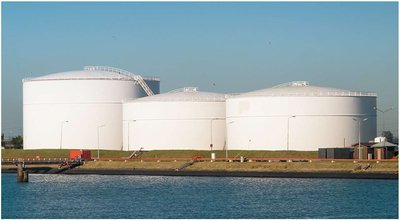
Fuel storage tanks can support the growth of hydrocarbon-oxidizing microbes, especially at oil–water interfaces. If sulfate is present, sulfate-reducing bacteria can degrade hydrocarbons anaerobically, sometimes causing operational problems such as corrosion.
Wastewater Treatment
Overview and Goals
Wastewater treatment is essential for reducing organic and inorganic pollutants to levels that do not support microbial growth and for removing toxic substances. The process relies heavily on microbial bioconversion and is measured by the reduction in biochemical oxygen demand (BOD).
Wastewater includes domestic sewage and industrial liquid waste.
BOD is the amount of dissolved oxygen required by microbes to oxidize all organic and inorganic matter in a water sample.
Primary Treatment
Primary treatment uses physical methods to separate solid and particulate materials from wastewater. The resulting sludge is further processed, while the liquid undergoes secondary treatment.

Secondary Treatment
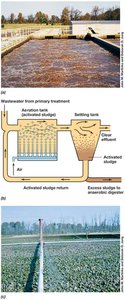
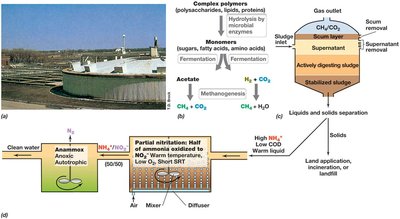
Secondary treatment employs microbial processes to further degrade organic material. It can be aerobic or anaerobic:
Aerobic treatment uses activated sludge or trickling filters, where microbes oxidize organic compounds.
Anaerobic treatment (in sludge digesters or bioreactors) involves fermentation and methanogenesis, producing methane and carbon dioxide.
Tertiary Treatment
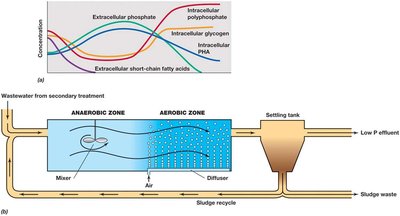
Tertiary treatment is an advanced process for further removal of organic matter, suspended solids, and inorganic nutrients such as phosphate and nitrate. It is the most complete method but is costly and not widely adopted.
Microbial communities transition from anaerobic to aerobic zones, facilitating the removal of phosphorus and nitrogen.
High-phosphorus sludge is harvested for disposal.
Biodeterioration of Stone and Concrete
Microbial Colonization and Damage
Biodeterioration refers to the loss of structural integrity in stone or concrete due to microbial activity. Microorganisms can colonize surfaces or grow within the material, leading to physical and chemical damage.
Common colonizers include bacteria, archaea, fungi, algae, and cyanobacteria.
Endolithic growth occurs within the stone, while surface colonization leads to discoloration and weakening.
Crown Corrosion in Concrete Sewers
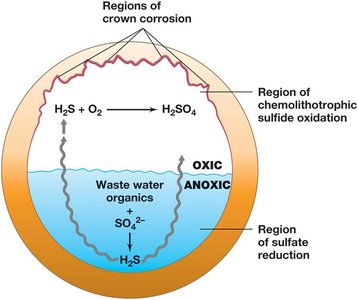
A rapid form of biodeterioration is crown corrosion in concrete sewer lines, caused by the microbial sulfur cycle. Sulfate-reducing bacteria produce hydrogen sulfide (H2S) under anoxic conditions, which is then oxidized by sulfur-oxidizing bacteria to sulfuric acid (H2SO4), accelerating corrosion.
This process also affects concrete holding tanks and cooling towers.
Process | Microbial Group | Key Product | Impact |
|---|---|---|---|
Microbial Leaching | Iron- and sulfur-oxidizing bacteria | Soluble metals (e.g., Cu2+) | Metal recovery |
Acid Mine Drainage | Iron-oxidizing bacteria | Acidic water, dissolved metals | Environmental pollution |
Bioremediation | Hydrocarbon-degrading bacteria | CO2, H2O | Pollutant removal |
Wastewater Treatment | Various (aerobic, anaerobic) | Clean water, methane | Water purification |
Biodeterioration | Sulfate-reducing and sulfur-oxidizing bacteria | H2SO4 | Material corrosion |
