 Back
BackMicrobiology Study Guide: Antimicrobial Drugs (Chapter 15)
Study Guide - Smart Notes
 Tailored notes based on your materials, expanded with key definitions, examples, and context.
Q1. What superfamily of drugs work by blocking cell wall synthesis? What molecule do most bacterial cell walls consist of?
Background
Topic: Antibacterial Drug Mechanisms
This question tests your understanding of how certain drug families inhibit bacterial cell wall synthesis, a key target for antibacterial therapy.
Key Terms and Concepts:
Beta-lactam antibiotics: A superfamily of drugs that block cell wall synthesis by interfering with peptidoglycan construction.
Peptidoglycan: The main molecule that makes up most bacterial cell walls.
Step-by-Step Guidance
Recall that bacterial cell walls are primarily composed of peptidoglycan, which provides structural integrity.
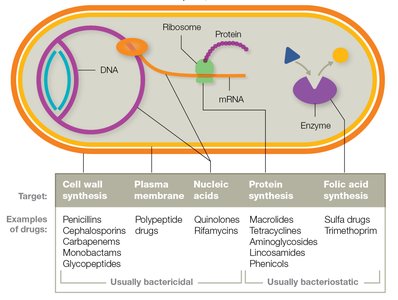
Identify the drug superfamily that targets cell wall synthesis. Beta-lactam antibiotics (including penicillins, cephalosporins, carbapenems, and monobactams) are key examples.
Understand that these drugs act by binding to transpeptidase enzymes, which are essential for forming peptide cross-links in peptidoglycan.
Review the chemical structure of beta-lactam antibiotics, which includes a four-sided beta-lactam ring.
Try solving on your own before revealing the answer!
Final Answer:
Beta-lactam antibiotics (penicillins, cephalosporins, carbapenems, monobactams) block cell wall synthesis by targeting peptidoglycan, the main molecule in bacterial cell walls.
These drugs inhibit transpeptidase enzymes, preventing the formation of peptide cross-links in peptidoglycan.
Q2. What is the function of beta-lactamases?
Background
Topic: Bacterial Resistance Mechanisms
This question tests your knowledge of how bacteria resist beta-lactam antibiotics.
Key Terms:
Beta-lactamase: An enzyme produced by bacteria that inactivates beta-lactam antibiotics.
Step-by-Step Guidance
Recall that beta-lactam antibiotics rely on their beta-lactam ring to inhibit cell wall synthesis.
Beta-lactamases are enzymes that bacteria produce to break down the beta-lactam ring, rendering the drug ineffective.
Consider how this resistance mechanism impacts the effectiveness of beta-lactam drugs.
Try solving on your own before revealing the answer!
Final Answer:
Beta-lactamases inactivate beta-lactam antibiotics by breaking the beta-lactam ring, preventing the drug from inhibiting cell wall synthesis.
Q3. How do beta-lactamase inhibitors such as clavulanate work?
Background
Topic: Overcoming Bacterial Resistance
This question focuses on strategies to counteract beta-lactamase-mediated resistance.
Key Terms:
Beta-lactamase inhibitor: A compound that binds to beta-lactamase enzymes, preventing them from inactivating beta-lactam antibiotics.
Clavulanate: A common beta-lactamase inhibitor.
Step-by-Step Guidance
Beta-lactamase inhibitors have a similar structure to beta-lactam antibiotics, allowing them to bind strongly to beta-lactamase enzymes.
By binding to beta-lactamase, these inhibitors block the enzyme's activity, protecting the administered antibiotic from degradation.
Consider how co-administration of a beta-lactamase inhibitor with a beta-lactam antibiotic enhances the drug's effectiveness against resistant bacteria.
Try solving on your own before revealing the answer!
Final Answer:
Beta-lactamase inhibitors like clavulanate bind to beta-lactamase enzymes, preventing them from breaking down beta-lactam antibiotics and allowing the antibiotic to remain effective.
Q4. Which generation of cephalosporin is used to combat MRSA/ORSA strains?
Background
Topic: Drug Generations and Resistance
This question tests your knowledge of cephalosporin generations and their effectiveness against resistant bacteria.
Key Terms:
MRSA/ORSA: Methicillin-resistant Staphylococcus aureus/Oxacillin-resistant Staphylococcus aureus.
Cephalosporin generations: Later generations have expanded capabilities against resistant strains.
Step-by-Step Guidance
Recall that cephalosporins are classified into generations based on their chemical modifications and spectrum of activity.
Identify which generation is specifically designed to combat MRSA/ORSA strains.
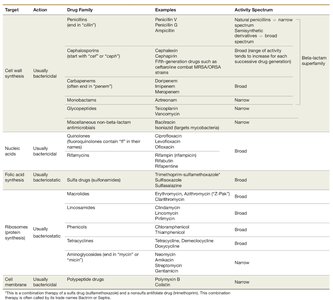
Review the properties of fifth-generation cephalosporins, such as ceftaroline.
Try solving on your own before revealing the answer!
Final Answer:
Fifth-generation cephalosporins, such as ceftaroline, are used to combat MRSA/ORSA strains.
