 Back
BackMicrobiology Study Guide: Biochemical Tests, Selective & Differential Media, and Pathogenic Cocci
Study Guide - Smart Notes
 Tailored notes based on your materials, expanded with key definitions, examples, and context.
Biochemical Tests and Microbial Media
Overview of Biochemical Tests
Biochemical tests are essential tools in microbiology for identifying and differentiating microorganisms based on their metabolic capabilities. These tests are typically performed on differential media, which reveal visible differences such as color changes, indicating the presence or absence of specific metabolic pathways.
Biochemical Tests: Detect metabolic pathways by observing visible changes (e.g., color change) in the medium.
Metabolic Pathways: If an organism possesses a specific pathway, biochemical tests can identify it.
Applications: Used to distinguish between bacterial species, especially in clinical and environmental samples.
Selective and Differential Media
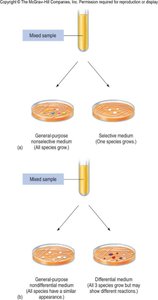
In microbiology, selective and differential media are used to grow and distinguish bacterial species.
Selective Media: Inhibits the growth of certain microorganisms while allowing others to grow. Contains agents such as antibiotics, dyes, or specific nutrients.
Differential Media: Differentiates between microbial colonies based on observable traits, often a color change. Contains chemicals or substrates that produce distinct outcomes when acted upon by different bacteria.
Combined Media: Some media, such as MSA (Mannitol Salt Agar) and EMB (Eosin Methylene Blue Agar), are both selective and differential.
Biochemical Tests for Enterobacteriaceae
Phenol Red Broth (PR Broth)
Phenol Red Broth is used to differentiate members of the Enterobacteriaceae family and distinguish them from other gram-negative rods.
Principle: Detects carbohydrate fermentation. Fermentation produces acids, alcohols, and gases, lowering the pH and changing phenol red from orange-red to yellow.
Results:
Yellow: Acidic, positive for fermentation.
Bubbles in Durham tube: Gas production.
Pink/Magenta: Alkaline, peptone utilization.
Orange-red: No fermentation or peptone utilization.
Inoculation Tool: Loop
Type: Differential
Triple Sugar Iron Agar (TSI)
TSI is used to differentiate Enterobacteriaceae and other gram-negative rods.
Principle: Detects fermentation of glucose, lactose, and/or sucrose, and sulfur reduction.
Results:
Yellow (A): Acid production from sugar fermentation.
Red/Pink (K): Alkaline, peptone utilization.
Black precipitate: Sulfur reduction (H2S production).
Inoculation Tool: Needle/Loop
Type: Differential
Methyl Red and Voges-Proskauer (MR-VP)
MR-VP tests detect fermentation pathways.
Principle:
MR: Detects mixed acid fermentation (pH < 4).
VP: Detects 2,3-butanediol fermentation via acetoin production.
Results:
MR Red: Acid produced.
MR Yellow: Non-acidic.
VP Red: Acetoin produced.
Inoculation Tool: Loop
Type: Differential
Urease Test
Urease test detects organisms that hydrolyze urea.
Principle: Urease enzyme breaks down urea into ammonia and CO2, raising pH.
Results:
Pink/Fuchsia: Positive (alkaline).
Yellow/Orange: Negative.
Inoculation Tool: Loop
Type: Differential
SIM (Sulfur, Indole, Motility)
SIM tests for sulfur and indole production, as well as motility.
Principle:
Iron tests for H2S production (black FeS).
Kovacs’ reagent detects indole from tryptophan.
Motility observed by growth spreading from stab line.
Results:
Black: Positive for sulfur reduction.
Red layer: Positive for indole production.
Growth away from stab: Motility positive.
Growth only along stab: Motility negative.
Inoculation Tool: Needle
Type: Differential
Citrate Test
Citrate test determines if citrate is the sole carbon source.
Principle: Only microbes able to catabolize citrate will grow, producing alkaline byproducts detected by bromothymol blue.
Results:
Blue color and growth: Positive.
Green/no growth: Negative.
Inoculation Tool: Loop
Type: Both selective and differential
Eosin Methylene Blue Agar (EMB)
EMB is both selective and differential.
Principle: Eosin and methylene blue dyes inhibit Gram-positive bacteria and react to acid produced from lactose/sucrose fermentation.
Results:
Metallic green sheen: Strong lactose fermenter (e.g., E. coli).
Purple/dark colonies: Lactose fermenter.
Colorless colonies: Non-lactose fermenter.
Inoculation Tool: Loop
Type: Both selective and differential
Pathogenic Cocci: Staphylococcus and Streptococcus Tests
Staphylococcus Tests
Test | Purpose | Principle | Results/Interpretation | Inoculation Tool | Type |
|---|---|---|---|---|---|
Catalase | Detects ability to detoxify hydrogen peroxide | Catalase converts H2O2 to water and O2 | Bubbles = positive; No bubbles = negative | Loop/Stick | Differential |
Coagulase | Identifies pathogenic Staphylococcus spp. | Coagulase reacts with rabbit plasma to form a clot | Clot = positive; No clot = negative | Loop | Differential |
DNase | Detects DNA hydrolysis | DNase breaks down DNA; methyl green loses color | Clear zone = positive; No clearing = negative | Loop | Differential |
MSA | Detects salt tolerance and mannitol fermentation | High salt selects; mannitol fermentation produces acid | Yellow = fermentation; Red/pink = no fermentation; Growth only = salt tolerant | Loop | Both |
Streptococcus Tests
Test | Purpose | Principle | Results/Interpretation | Inoculation Tool | Type |
|---|---|---|---|---|---|
BAP (Blood Agar) | Detects hemolysis | Hemolysins lyse red blood cells | Beta = clear zone; Alpha = greenish zone; Gamma = no change | Loop | Differential |
Bile Esculin | Detects esculin hydrolysis in presence of bile | Bile salts inhibit most Gram-positives; esculin hydrolysis produces black color | Blackening = positive; No color change = negative | Loop | Both |
Summary Table: Media Types and Their Purposes
Medium | Selective | Differential | Key Indicator |
|---|---|---|---|
MSA | Yes (high salt) | Yes (mannitol fermentation) | Phenol red |
EMB | Yes (dyes inhibit Gram-positives) | Yes (lactose/sucrose fermentation) | Eosin/methylene blue |
BAP | No | Yes (hemolysis) | Red blood cells |
Bile Esculin | Yes (bile salts) | Yes (esculin hydrolysis) | Iron salts |
Citrate | Yes (citrate sole C source) | Yes (pH change) | Bromothymol blue |
Key Terms and Concepts
Selective Media: Allows growth of specific organisms, inhibits others.
Differential Media: Distinguishes organisms based on observable traits.
Biochemical Test: Identifies metabolic capabilities.
Hemolysis: Lysis of red blood cells; used to differentiate Streptococcus species.
Fermentation: Metabolic process producing acids, alcohols, and gases.
Example Applications
Clinical Microbiology: Identifying pathogens in patient samples using selective and differential media.
Environmental Microbiology: Differentiating soil bacteria based on metabolic tests.
Equations and Formulas
Carbohydrate Fermentation:
Urease Reaction:
Catalase Reaction:
Additional info: Academic context was added to clarify the principles and applications of each test and media type, as well as to provide self-contained explanations suitable for exam preparation.
