 Back
Microbiology Study Guide: Chapters 1–3 Step-by-Step Guidance
Study Guide - Smart Notes
 Tailored notes based on your materials, expanded with key definitions, examples, and context.
Q1. List two ways in which microbes affect our lives and two ways in which they can be beneficial.
Background
Topic: Microbial Impact on Human Life
This question tests your understanding of the diverse roles microbes play in both positive and negative aspects of human health and society.
Key Terms:
Microbes: Microscopic organisms including bacteria, viruses, fungi, protozoa, and algae.
Pathogenic: Disease-causing.
Beneficial: Helpful or advantageous to humans or the environment.
Step-by-Step Guidance
Think about common diseases or infections caused by microbes (e.g., bacterial infections, viral illnesses).
Consider environmental or industrial impacts, such as food spoilage or water contamination.
Now, reflect on beneficial roles, such as microbes in digestion or in the production of antibiotics.
Also, consider microbes used in biotechnology or environmental cleanup.
Try solving on your own before revealing the answer!
Final Answer:
Microbes affect our lives by causing diseases (e.g., tuberculosis, influenza) and by spoiling food. They can be beneficial by aiding digestion (gut microbiota) and by producing antibiotics or fermented foods (e.g., yogurt, cheese).
Q2. Define: a) Microbiome; b) Normal microbiota
Background
Topic: Microbial Ecology and Human Health
This question tests your understanding of the terminology related to the collection of microbes living in and on the human body.
Key Terms:
Microbiome: The community of microorganisms and their genetic material present in a particular environment.
Normal microbiota: The microbes that are typically found in a healthy individual.
Step-by-Step Guidance
Recall that the microbiome includes all microbes and their genes in a specific environment (e.g., gut, skin).
Normal microbiota refers to the usual, non-pathogenic microbes found in healthy humans.
Think about how these terms relate to health, disease, and microbial balance.
Try solving on your own before revealing the answer!
Final Answer:
a) Microbiome: The collection of all microorganisms and their genetic material in a particular environment, such as the human gut. b) Normal microbiota: The population of microbes that normally inhabit the body and do not cause disease under normal conditions.
Q3. Complete the following table: Microorganism, Domain, 7 Characteristics
Background
Topic: Classification and Characteristics of Microorganisms
This question tests your ability to classify different types of microorganisms and describe their main features.
Key Terms:
Domain: Highest taxonomic rank (Bacteria, Archaea, Eukarya).
Characteristics: Features such as cell type, reproduction, nutrition, etc.
Step-by-Step Guidance
List each microorganism (Bacteria, Archaea, Fungi, Protozoa, Algae, Viruses, Multicellular Animal Parasites).
Assign the correct domain to each (e.g., Bacteria to Bacteria, Fungi to Eukarya).
Identify seven characteristics for each, such as cell structure, reproduction, metabolism, motility, etc.
Fill in the table with these details, stopping before the final completion.
Try solving on your own before revealing the answer!
Final Answer:
The completed table should include each microorganism, its domain, and seven characteristics (e.g., Bacteria: Domain - Bacteria; Characteristics - unicellular, prokaryotic, cell wall, binary fission, etc.).
Q4. Compare spontaneous generation and biogenesis.
Background
Topic: Historical Concepts in Microbiology
This question tests your understanding of two competing theories about the origin of life.
Key Terms:
Spontaneous generation: The idea that life arises from non-living matter.
Biogenesis: The concept that life comes only from pre-existing life.
Step-by-Step Guidance
Define spontaneous generation and biogenesis.
Identify key experiments or scientists (e.g., Pasteur) who disproved spontaneous generation.
Compare the implications of each theory for microbiology.
Try solving on your own before revealing the answer!
Final Answer:
Spontaneous generation proposed that life could arise from non-living matter, while biogenesis states that life arises only from existing life. Pasteur's experiments supported biogenesis.
Q5. What is the cell theory?
Background
Topic: Fundamental Principles of Biology
This question tests your knowledge of the basic tenets of cell theory.
Key Terms:
Cell theory: The foundational concept in biology regarding cells.
Step-by-Step Guidance
Recall the three main points of cell theory.
Think about how this theory applies to all living organisms.
Try solving on your own before revealing the answer!
Final Answer:
Cell theory states that all living things are composed of cells, cells are the basic unit of life, and all cells come from pre-existing cells.
Q6. What is the importance of Koch's postulates?
Background
Topic: Microbial Pathogenesis
This question tests your understanding of the criteria used to establish a causal relationship between a microbe and a disease.
Key Terms:
Koch's postulates: Four criteria for linking a microorganism to a specific disease.
Step-by-Step Guidance
Recall the four postulates and their purpose.
Think about how these postulates are used in modern microbiology.
Try solving on your own before revealing the answer!
Final Answer:
Koch's postulates are important because they provide a systematic method to prove that a specific microbe causes a specific disease.
Q7. What is the importance of Jenner’s work?
Background
Topic: Immunology and Vaccination
This question tests your knowledge of the historical development of vaccines.
Key Terms:
Jenner: Scientist who developed the first vaccine (smallpox).
Vaccination: Process of inducing immunity.
Step-by-Step Guidance
Recall Jenner's experiment with cowpox and smallpox.
Think about the impact of vaccination on public health.
Try solving on your own before revealing the answer!
Final Answer:
Jenner's work was important because it led to the development of vaccines, which have saved millions of lives by preventing infectious diseases.
Q8. What is Pasteurization?
Background
Topic: Food Safety and Microbial Control
This question tests your understanding of a process used to reduce microbial contamination in food and beverages.
Key Terms:
Pasteurization: Heat treatment to kill pathogens and spoilage organisms.
Step-by-Step Guidance
Recall the purpose and method of pasteurization.
Think about its application in milk, juice, and other products.
Try solving on your own before revealing the answer!
Final Answer:
Pasteurization is a process of heating liquids to a specific temperature for a set time to kill harmful microbes without affecting the quality of the product.
Q9. Summarize in your own words the germ theory of disease.
Background
Topic: Microbial Pathogenesis
This question tests your understanding of the concept that microorganisms cause disease.
Key Terms:
Germ theory: The idea that diseases are caused by microorganisms.
Step-by-Step Guidance
Recall the main points of germ theory.
Think about how this theory changed medical practice.
Try solving on your own before revealing the answer!
Final Answer:
The germ theory of disease states that microorganisms are the cause of many diseases, leading to improved hygiene and medical practices.
Q10. Give an example of how we can use recombinant DNA technology to help develop medical treatments.
Background
Topic: Biotechnology and Genetic Engineering
This question tests your understanding of how genetic manipulation can be used in medicine.
Key Terms:
Recombinant DNA: DNA formed by combining genetic material from different sources.
Medical treatments: Therapies developed using biotechnology.
Step-by-Step Guidance
Recall examples such as insulin production or gene therapy.
Think about how recombinant DNA is used to produce proteins or correct genetic defects.
Try solving on your own before revealing the answer!
Final Answer:
Recombinant DNA technology is used to produce human insulin by inserting the insulin gene into bacteria, which then produce insulin for diabetic patients.
Q11. Define Resistance
Background
Topic: Microbial Defense Mechanisms
This question tests your understanding of how organisms defend against harmful microbes.
Key Terms:
Resistance: The ability to ward off disease or infection.
Step-by-Step Guidance
Recall the mechanisms by which organisms resist infection (e.g., immune system, antibiotics).
Think about how resistance can be innate or acquired.
Try solving on your own before revealing the answer!
Final Answer:
Resistance is the ability of an organism to defend against infection or disease, either through innate or acquired mechanisms.
CHAPTER 2 – Chemical Principles
Q1. What is the difference between anabolic and catabolic reactions?
Background
Topic: Metabolic Pathways
This question tests your understanding of the two main types of metabolic reactions in cells.
Key Terms:
Anabolic: Building up molecules.
Catabolic: Breaking down molecules.
Step-by-Step Guidance
Recall that anabolic reactions require energy and build complex molecules.
Catabolic reactions release energy by breaking down complex molecules.
Think about examples of each (e.g., protein synthesis vs. glycolysis).
Try solving on your own before revealing the answer!
Final Answer:
Anabolic reactions build up molecules and require energy, while catabolic reactions break down molecules and release energy.
Q2. What is metabolism?
Background
Topic: Cellular Processes
This question tests your understanding of the sum of all chemical reactions in a cell.
Key Terms:
Metabolism: All chemical reactions in a cell.
Step-by-Step Guidance
Recall that metabolism includes both anabolic and catabolic reactions.
Think about how metabolism is essential for life.
Try solving on your own before revealing the answer!
Final Answer:
Metabolism is the sum of all chemical reactions that occur within a living organism.
Q3. Draw the structure of ATP and explain its importance
Background
Topic: Energy Molecules
This question tests your understanding of ATP's structure and its role in cellular energy transfer.
Key Terms:
ATP: Adenosine triphosphate, the energy currency of the cell.
Step-by-Step Guidance
Recall the components of ATP: adenine, ribose, and three phosphate groups.
Draw or visualize the structure, labeling each part.
Explain how ATP stores and releases energy through phosphate bonds.
Try solving on your own before revealing the answer!
Final Answer:
ATP consists of adenine, ribose, and three phosphate groups. It is important because it stores and releases energy for cellular processes.
Q4. Complete the following table about Organic Compounds: Carbohydrates, Lipids, Proteins, Nucleic Acids
Background
Topic: Biomolecules
This question tests your ability to identify examples, building blocks, significance, and locations of major organic compounds.
Key Terms:
Carbohydrates, Lipids, Proteins, Nucleic Acids: Major biomolecules.
Step-by-Step Guidance
List examples for each biomolecule (e.g., glucose for carbohydrates).
Identify building blocks (e.g., amino acids for proteins).
Describe their significance and where they are found in the body.
Try solving on your own before revealing the answer!
Final Answer:
The completed table should include examples, building blocks, significance, and locations for each biomolecule.
Q5. Compare Saturated vs Unsaturated fats
Background
Topic: Lipid Chemistry
This question tests your understanding of the differences between types of fats.
Key Terms:
Saturated fats: No double bonds, solid at room temperature.
Unsaturated fats: Have double bonds, liquid at room temperature.
Step-by-Step Guidance
List characteristics for each type (e.g., structure, physical state).
Provide examples of foods containing each.
Discuss health implications.
Try solving on your own before revealing the answer!
Final Answer:
Saturated fats are solid at room temperature, have only single bonds, and are found in animal products. Unsaturated fats are liquid, have double bonds, and are found in plant oils.
Q6. Draw the 4 structures of proteins: Primary, Secondary, Tertiary, Quaternary
Background
Topic: Protein Structure
This question tests your understanding of the levels of protein structure.
Key Terms:
Primary: Sequence of amino acids.
Secondary: Alpha helices and beta sheets.
Tertiary: 3D folding.
Quaternary: Multiple polypeptides.
Step-by-Step Guidance
Draw or visualize each level of protein structure.
Label the features of each structure.
Explain the significance of each level.
Try solving on your own before revealing the answer!
Final Answer:
Primary: Amino acid sequence; Secondary: Alpha helix/beta sheet; Tertiary: 3D folding; Quaternary: Multiple polypeptides.
Q7. What is the effect of Temperature and pH on enzyme’s structure and function?
Background
Topic: Enzyme Activity
This question tests your understanding of how environmental factors affect enzymes.
Key Terms:
Enzyme: Protein that catalyzes reactions.
Denaturation: Loss of structure and function.
Step-by-Step Guidance
Recall that extreme temperature or pH can denature enzymes.
Think about how this affects enzyme activity.
Provide examples of optimal conditions for enzymes.
Try solving on your own before revealing the answer!
Final Answer:
Extreme temperature or pH can denature enzymes, reducing their activity or rendering them inactive.
Q8. List 4 differences between DNA and RNA
Background
Topic: Nucleic Acids
This question tests your understanding of the structural and functional differences between DNA and RNA.
Key Terms:
DNA: Deoxyribonucleic acid.
RNA: Ribonucleic acid.
Step-by-Step Guidance
List differences in sugar, bases, structure, and function.
Provide examples for each difference.
Try solving on your own before revealing the answer!
Final Answer:
DNA has deoxyribose, is double-stranded, uses thymine, and stores genetic information. RNA has ribose, is single-stranded, uses uracil, and is involved in protein synthesis.
CHAPTER 3 – Observing Microorganisms through a Microscope
Q1. Complete the following graph regarding the path of light in a compound microscope. Name the microscope’s structures corresponding to the path the light follows (in order) from the light source (bottom) until it reaches your eyes (top).
Background
Topic: Microscopy and Microbial Observation
This question tests your understanding of the structure and function of a compound microscope, specifically the path of light through its components.
Key Terms:
Compound microscope: Instrument used to magnify small objects using multiple lenses.
Light path: The route light takes from the source to the observer's eye.
Step-by-Step Guidance
Start by identifying the light source at the base of the microscope.
Trace the path upward: condenser, stage, specimen, objective lens, body tube, ocular lens (eyepiece).
Label each structure in the order the light passes through.
Consider the function of each part (e.g., condenser focuses light, objective lens magnifies).
Try solving on your own before revealing the answer!
Final Answer:
The path of light in a compound microscope is: light source → condenser → stage/specimen → objective lens → body tube → ocular lens (eyepiece) → eye. Each structure plays a role in focusing, magnifying, and directing light to allow observation of microorganisms.
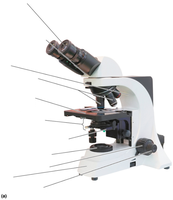
Q2. In the following compound (light) microscope, write the name of the structures indicated and their function:
Background
Topic: Microscopy and Microbial Observation
This question tests your ability to identify and describe the function of key parts of a compound microscope.
Key Terms:
Microscope parts: Components such as eyepiece, objective lens, stage, condenser, etc.
Step-by-Step Guidance
Examine the microscope image and identify each labeled part.
Recall the function of each part (e.g., stage holds specimen, objective lens magnifies).
Write the name and function for each indicated structure.
Try solving on your own before revealing the answer!
Final Answer:
Each labeled structure corresponds to a specific part of the microscope, such as eyepiece (magnifies), objective lens (magnifies), stage (holds specimen), condenser (focuses light), coarse/fine focus (adjusts clarity), and light source (provides illumination).
Q3. If the objective lens magnification is 4x and the ocular lens magnification is 10x, what is the total magnification?
Background
Topic: Microscopy Calculations
This question tests your ability to calculate total magnification in a compound microscope.
Key Formula:
Step-by-Step Guidance
Identify the magnification of the objective lens (4x).
Identify the magnification of the ocular lens (10x).
Set up the formula for total magnification.
Try solving on your own before revealing the answer!
Final Answer:
Total magnification = 4x × 10x = 40x. The specimen will appear 40 times larger than its actual size.
Q4. Define: a) Resolution; b) Parfocal; c) Electron Microscope; d) Staining; e) Smear; f) Fixing Microorganisms to the slide
Background
Topic: Microscopy and Sample Preparation
This question tests your understanding of key terms related to observing microorganisms.
Key Terms:
Resolution: Ability to distinguish two points as separate.
Parfocal: Ability to stay in focus when switching lenses.
Electron Microscope: Uses electrons for imaging.
Staining: Coloring cells for visibility.
Smear: Thin layer of specimen on slide.
Fixing: Attaching cells to slide.
Step-by-Step Guidance
Define each term based on its role in microscopy.
Think about how each process or feature improves observation.
Try solving on your own before revealing the answer!
Final Answer:
a) Resolution: Ability to distinguish two points. b) Parfocal: Stays in focus when switching lenses. c) Electron Microscope: Uses electrons for high-resolution imaging. d) Staining: Adds color to cells. e) Smear: Thin layer of specimen. f) Fixing: Attaches cells to slide.
Q5. Describe the purpose of the following types of staining: Simple Staining, Gram Staining (Gram + and Gram -), Acid Fast, Endospore Staining
Background
Topic: Microbial Identification
This question tests your understanding of staining techniques used to differentiate and identify microorganisms.
Key Terms:
Simple Staining: Uses one dye.
Gram Staining: Differentiates Gram + and Gram - bacteria.
Acid Fast: Identifies mycobacteria.
Endospore Staining: Detects spores.
Step-by-Step Guidance
Describe the purpose and clinical significance of each staining method.
List examples of organisms and expected results (e.g., color).
Try solving on your own before revealing the answer!
Final Answer:
Simple staining highlights cell shape; Gram staining differentiates bacteria by cell wall; Acid fast identifies mycobacteria; Endospore staining detects spores. Each method helps identify and classify microbes.
