 Back
BackMicrobiology Study Guide: Key Concepts and Visuals
Study Guide - Smart Notes
 Tailored notes based on your materials, expanded with key definitions, examples, and context.
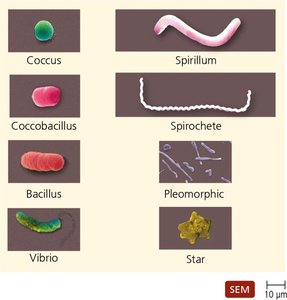
Q1. What are the different shapes of prokaryotic cells?
Background
Topic: Prokaryotic Cell Morphology
This question tests your understanding of the diversity of shapes found among prokaryotic cells, which is important for identification and classification in microbiology.
Key Terms:
Coccus: Spherical-shaped bacteria.
Bacillus: Rod-shaped bacteria.
Spirillum: Spiral-shaped bacteria.
Spirochete: Flexible, corkscrew-shaped bacteria.
Vibrio: Comma-shaped bacteria.
Coccobacillus: Short, oval rod-shaped bacteria.
Pleomorphic: Bacteria that can have variable shapes.
Star-shaped: Rare, star-like bacteria.
Step-by-Step Guidance
Review the definitions of each prokaryotic cell shape listed above.
Observe the visual differences between each shape, noting how they might appear under a microscope.
Consider why certain shapes might provide advantages in specific environments (e.g., motility, surface area).
Think about how these shapes are used in bacterial classification and identification in the lab.
Try solving on your own before revealing the answer!
Final Answer:
The main shapes of prokaryotic cells are coccus, bacillus, spirillum, spirochete, vibrio, coccobacillus, pleomorphic, and star-shaped. These shapes help microbiologists identify and classify bacteria.
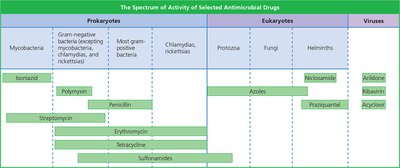
Q2. What is the spectrum of activity of selected antimicrobial drugs?
Background
Topic: Antimicrobial Drug Spectrum
This question is about understanding which types of microorganisms (prokaryotes, eukaryotes, viruses) are affected by different antimicrobial drugs. This is crucial for selecting the appropriate treatment for infections.
Key Terms and Concepts:
Spectrum of Activity: The range of microorganisms an antimicrobial drug is effective against.
Narrow-spectrum drugs: Effective against a limited group of microbes.
Broad-spectrum drugs: Effective against a wide variety of microbes.
Examples of drugs: Isoniazid, Polymyxin, Penicillin, Streptomycin, Erythromycin, Tetracycline, Sulfonamides, Azoles, Niclosamide, Praziquantel, Arildone, Ribavirin, Acyclovir.
Step-by-Step Guidance
Examine the table to see which drugs are effective against which groups of organisms (e.g., prokaryotes, fungi, helminths, viruses).
Identify which drugs have a broad spectrum (covering multiple groups) and which are narrow-spectrum (targeting specific groups).
Note any drugs that are specific to certain pathogens, such as isoniazid for mycobacteria or azoles for fungi.
Consider why it is important to choose a drug with the appropriate spectrum for a given infection (to avoid resistance, protect normal flora, etc.).
Try solving on your own before revealing the answer!
Final Answer:
The spectrum of activity varies by drug: some (like tetracycline) are broad-spectrum and affect many prokaryotes, while others (like azoles or acyclovir) are specific to fungi or viruses. The table helps match the drug to the pathogen type for effective treatment.
