Back
BackMicrobiology Study Guide: Media Types, Indicators, and Hemolysis
Study Guide - Smart Notes
 Tailored notes based on your materials, expanded with key definitions, examples, and context.
Microbial Growth Media
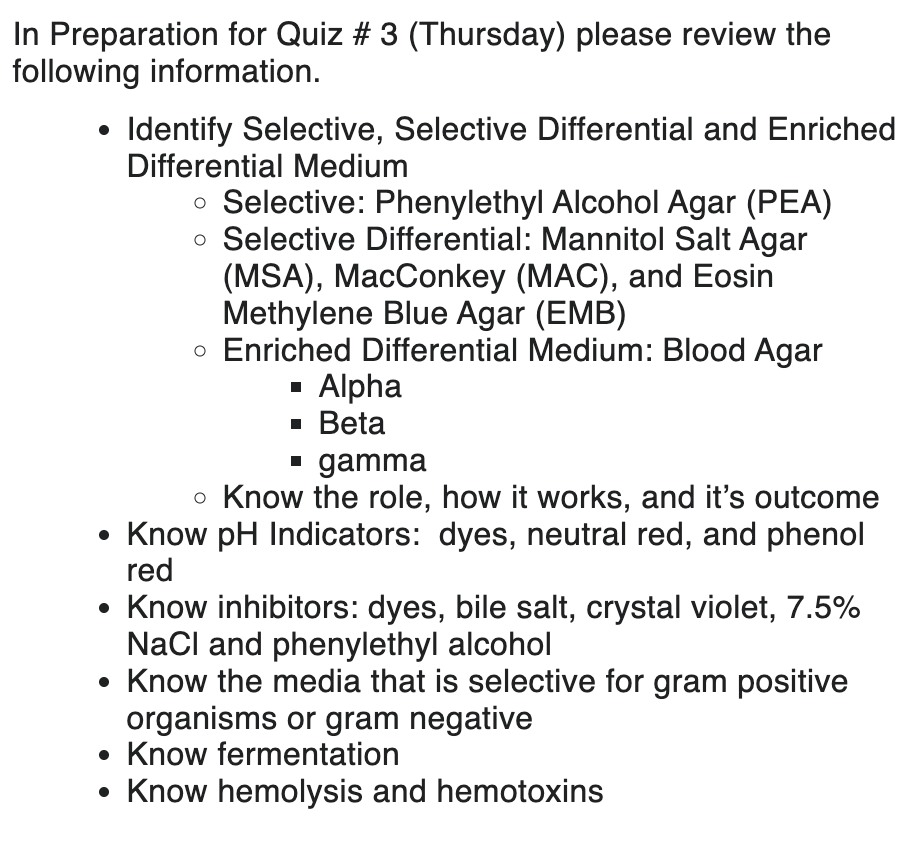
Types of Culture Media
Culture media are essential tools in microbiology for isolating, identifying, and differentiating microorganisms. They are classified based on their function and composition.
Selective Media: Designed to suppress the growth of unwanted microbes and encourage the growth of desired organisms.
Phenylethyl Alcohol Agar (PEA): Inhibits Gram-negative bacteria, allowing Gram-positive bacteria to grow.
Selective Differential Media: Combine selective agents with differential components to distinguish between organisms based on biochemical reactions.
Mannitol Salt Agar (MSA): Selective for Staphylococcus species due to high salt concentration; differentiates based on mannitol fermentation (phenol red indicator).
MacConkey Agar (MAC): Selective for Gram-negative bacteria (contains bile salts and crystal violet); differentiates lactose fermenters (neutral red indicator).
Eosin Methylene Blue Agar (EMB): Selective for Gram-negative bacteria; differentiates lactose fermenters (dyes act as indicators).
Enriched Differential Medium: Supports growth of fastidious organisms and differentiates based on hemolytic activity.
Blood Agar: Enriched with blood; differentiates bacteria based on hemolysis patterns:
Alpha hemolysis: Partial hemolysis, greenish discoloration.
Beta hemolysis: Complete hemolysis, clear zone around colonies.
Gamma hemolysis: No hemolysis, no change in medium.
Role, Mechanism, and Outcomes of Media
Role: Media are used to isolate, identify, and differentiate microorganisms based on their growth and biochemical properties.
How it works: Selective agents inhibit certain groups, while differential agents reveal metabolic differences (e.g., fermentation, hemolysis).
Outcome: Enables identification of microbial species and their physiological traits.
Indicators and Inhibitors in Microbiology Media
pH Indicators
pH indicators are used in differential media to detect metabolic activity, such as fermentation.
Dyes: Used as colorimetric indicators (e.g., eosin, methylene blue).
Neutral Red: Turns red in acidic conditions (used in MacConkey agar).
Phenol Red: Turns yellow in acidic conditions (used in Mannitol Salt Agar).
Inhibitors
Inhibitors are chemicals added to media to suppress the growth of certain microorganisms.
Dyes: Eosin and methylene blue inhibit Gram-positive bacteria.
Bile Salts: Inhibit Gram-positive bacteria (used in MacConkey agar).
Crystal Violet: Inhibits Gram-positive bacteria.
7.5% NaCl: High salt concentration inhibits most bacteria except staphylococci (used in MSA).
Phenylethyl Alcohol: Inhibits Gram-negative bacteria (used in PEA).
Selective Media for Gram Positive and Gram Negative Organisms
Gram Positive Selective Media
Phenylethyl Alcohol Agar (PEA): Selective for Gram-positive bacteria.
Mannitol Salt Agar (MSA): Selective for staphylococci (Gram-positive).
Gram Negative Selective Media
MacConkey Agar (MAC): Selective for Gram-negative bacteria.
Eosin Methylene Blue Agar (EMB): Selective for Gram-negative bacteria.
Microbial Fermentation
Definition and Importance
Fermentation: An anaerobic metabolic process where microorganisms convert sugars into acids, gases, or alcohol.
Application: Used in differential media to distinguish bacteria based on their ability to ferment specific carbohydrates.
Example: Staphylococcus aureus ferments mannitol on MSA, turning the medium yellow.
Hemolysis and Hemotoxins
Hemolysis
Hemolysis refers to the breakdown of red blood cells, observed on blood agar.
Alpha hemolysis: Partial lysis, greenish color.
Beta hemolysis: Complete lysis, clear zone.
Gamma hemolysis: No lysis, unchanged medium.
Hemotoxins
Hemotoxins: Toxins produced by bacteria that cause hemolysis.
Example: Streptococcus pyogenes produces streptolysin, causing beta hemolysis.
Summary Table: Media Types and Their Properties
Medium | Type | Selective Agent | Differential Agent | Indicator | Target Organism |
|---|---|---|---|---|---|
PEA | Selective | Phenylethyl Alcohol | None | None | Gram-positive |
MSA | Selective Differential | 7.5% NaCl | Mannitol | Phenol Red | Staphylococci |
MAC | Selective Differential | Bile Salts, Crystal Violet | Lactose | Neutral Red | Gram-negative |
EMB | Selective Differential | Eosin, Methylene Blue | Lactose | Dyes | Gram-negative |
Blood Agar | Enriched Differential | None | Hemolysis | Blood | Fastidious bacteria |