 Back
Microbiology Study Guide: Microbes, Microscopy, and Microbial Diversity
Study Guide - Smart Notes
 Tailored notes based on your materials, expanded with key definitions, examples, and context.
Q1. List several ways in which microbes affect our lives.
Background
Topic: Microbial Impact on Human Life
This question explores the various roles that microorganisms play in our daily lives, both positive and negative.
Key Terms:
Microbes: Microscopic organisms including bacteria, viruses, fungi, protozoa, and algae.
Pathogens: Microbes that cause disease.
Biotechnology: The use of microbes in industrial processes.
Step-by-Step Guidance
Think about both harmful and beneficial effects of microbes on humans, animals, and the environment.
Consider examples such as disease, food production, environmental roles, and biotechnology.
List at least two negative and two positive impacts.
Try solving on your own before revealing the answer!
Final Answer:
Microbes affect our lives by causing diseases (e.g., infections), decomposing organic matter, aiding in digestion, producing foods (like yogurt and cheese), and being used in biotechnology (e.g., antibiotics, insulin production). They also play roles in nutrient cycling and environmental cleanup.
Q2. Define microbiome, normal microbiota
Background
Topic: Microbial Communities
This question tests your understanding of the terms used to describe the collection of microorganisms living in and on the human body.
Key Terms:
Microbiome: The total collection of microbes and their genetic material in a particular environment.
Normal microbiota: The microbes that normally reside in or on the human body without causing disease.
Step-by-Step Guidance
Recall the definition of the microbiome and its significance in health.
Differentiate between the microbiome and normal microbiota.
Think about where these microbes are found and their roles.
Try solving on your own before revealing the answer!
Final Answer:
The microbiome is the collection of all microorganisms and their genes in a particular environment, such as the human body. Normal microbiota are the microbes that are typically found living in or on the body and usually do not cause disease.
Q3. Describe some of the destructive and beneficial actions of microbes. List at least four beneficial activities of microorganisms.
Background
Topic: Microbial Roles in Health and Environment
This question asks you to distinguish between harmful and helpful effects of microbes, with a focus on beneficial activities.
Key Terms:
Pathogenicity: The ability to cause disease.
Decomposition: Breakdown of organic matter by microbes.
Bioremediation: Use of microbes to clean up pollutants.
Step-by-Step Guidance
List at least one destructive action (e.g., causing disease).
Identify four beneficial activities, such as food production, environmental cleanup, or health-related roles.
Think about examples from medicine, industry, and ecology.
Try solving on your own before revealing the answer!
Final Answer:
Destructive actions include causing diseases in humans, animals, and plants. Beneficial activities include: (1) decomposition of organic matter, (2) production of antibiotics, (3) fermentation in food production, (4) nitrogen fixation, and (5) bioremediation of pollutants.
Q4. What is staph?
Background
Topic: Bacterial Pathogens
This question focuses on the common name for a group of bacteria and their relevance to human health.
Key Terms:
Staphylococcus aureus: A species of bacteria commonly found on the skin and in the nose.
Carrier: A person who harbors bacteria without showing symptoms.
Step-by-Step Guidance
Recall the full scientific name for "staph."
Think about where these bacteria are commonly found in the human body.
Consider their role in health and disease.
Try solving on your own before revealing the answer!
Final Answer:
"Staph" refers to Staphylococcus aureus, a bacterium commonly carried on the skin or in the nose of about 30% of people. It can cause infections if it enters the body through cuts or wounds.
Q5. What are the three domains?
Background
Topic: Classification of Life
This question tests your knowledge of the highest taxonomic categories used to classify all living organisms.
Key Terms:
Domain: The broadest taxonomic category.
Bacteria, Archaea, Eukarya: The three domains of life.
Step-by-Step Guidance
Recall the three domains and what types of organisms are included in each.
Think about the main differences between these domains, especially regarding cell structure and cell walls.
Try solving on your own before revealing the answer!
Final Answer:
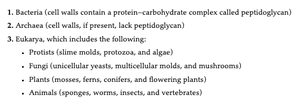
The three domains are Bacteria, Archaea, and Eukarya. Bacteria and Archaea are prokaryotic, while Eukarya includes all eukaryotic organisms (protists, fungi, plants, and animals).
Q6. Do you know: Pasteur’s work influenced Lister and Koch? The importance of Jenner’s work.
Background
Topic: History of Microbiology
This question asks about the historical contributions of key scientists in microbiology.
Key Terms:
Pasteur: Discovered fermentation, pasteurization, and disproved spontaneous generation.
Lister: Developed antiseptic surgery techniques.
Koch: Established Koch's postulates for linking microbes to disease.
Jenner: Developed the first vaccine (smallpox).
Step-by-Step Guidance
Recall how Pasteur’s discoveries about microbes and disease transmission influenced Lister’s and Koch’s work.
Think about Jenner’s contribution to immunology and public health.
Try solving on your own before revealing the answer!
Final Answer:
Pasteur’s work on germ theory influenced Lister’s development of antiseptic techniques and Koch’s methods for identifying disease-causing microbes. Jenner’s work was important because he developed the first successful vaccine (against smallpox), laying the foundation for immunology.
Q7. How many nanometers is 10 μm?
Background
Topic: Units of Measurement in Microbiology
This question tests your ability to convert between units commonly used to measure microorganisms.
Key Formula:
Step-by-Step Guidance
Recall the conversion factor between micrometers (μm) and nanometers (nm).
Multiply the number of micrometers by the conversion factor to get nanometers.
Try solving on your own before revealing the answer!
Final Answer:
10 μm is equal to 10,000 nm. (10 × 1,000 = 10,000)
Q8. Define total magnification and resolution. What does it mean when a microscope has a resolution of 0.2 nm?
Background
Topic: Microscopy
This question focuses on the basic principles of microscopy, specifically magnification and resolution.
Key Terms:
Total magnification: The product of the magnifying powers of the objective and ocular lenses.
Resolution: The ability of a microscope to distinguish two points as separate.
Step-by-Step Guidance
Define total magnification and explain how it is calculated.
Define resolution and its importance in microscopy.
Interpret what a resolution of 0.2 nm means for a microscope’s capabilities.
Try solving on your own before revealing the answer!
Final Answer:
Total magnification is the product of the objective lens and ocular lens magnifications. Resolution is the ability to distinguish two points as separate; a resolution of 0.2 nm means the microscope can distinguish objects that are at least 0.2 nm apart.
Q9. Why is fixing necessary for most staining procedures?
Background
Topic: Microbial Staining Techniques
This question addresses the preparation of microbial specimens for microscopic observation.
Key Terms:
Fixing: The process of attaching microbes to a slide and preserving their structure.
Staining: Applying dyes to visualize cells under a microscope.
Step-by-Step Guidance
Consider what happens to cells if they are not fixed before staining.
Think about the goals of fixing in terms of cell preservation and visualization.
Try solving on your own before revealing the answer!
Final Answer:
Fixing is necessary to attach cells to the slide and preserve their structure during staining, preventing them from being washed away and maintaining their morphology.
Q10. Why are mycoplasmas resistant to antibiotics that interfere with cell wall synthesis?
Background
Topic: Bacterial Cell Structure and Antibiotic Resistance
This question tests your understanding of how bacterial structure affects susceptibility to antibiotics.
Key Terms:
Mycoplasmas: Bacteria lacking a cell wall.
Antibiotics (e.g., penicillin): Drugs that target cell wall synthesis.
Step-by-Step Guidance
Recall the target of antibiotics like penicillin (the cell wall).
Consider what makes mycoplasmas unique compared to other bacteria.
Think about why lacking a cell wall would confer resistance to these antibiotics.
Try solving on your own before revealing the answer!
Final Answer:
Mycoplasmas are resistant to antibiotics that interfere with cell wall synthesis because they lack a cell wall, so there is no target for the antibiotic to act on.
Q11. Which stain would be used to identify microbes in the genera Mycobacterium and Nocardia?
Background
Topic: Differential Staining Techniques
This question focuses on the identification of bacteria with unique cell wall properties.
Key Terms:
Acid-fast stain: A differential stain used to identify bacteria with waxy cell walls.
Mycobacterium and Nocardia: Genera with mycolic acid in their cell walls.
Step-by-Step Guidance
Recall the staining technique used for bacteria with waxy, lipid-rich cell walls.
Think about why Gram staining is not effective for these genera.
Try solving on your own before revealing the answer!
Final Answer:
The acid-fast stain is used to identify Mycobacterium and Nocardia because their cell walls contain mycolic acid, which resists Gram staining.
Q12. Why are Gram-negative bacteria resistant to penicillin? [hint: peptidoglycan layer]
Background
Topic: Bacterial Cell Wall Structure and Antibiotic Resistance
This question examines the structural differences between Gram-positive and Gram-negative bacteria and their impact on antibiotic susceptibility.
Key Terms:
Gram-negative bacteria: Bacteria with a thin peptidoglycan layer and an outer membrane.
Penicillin: An antibiotic that targets peptidoglycan synthesis.
Step-by-Step Guidance
Recall the structure of Gram-negative cell walls, especially the outer membrane and thin peptidoglycan layer.
Think about how the outer membrane affects the entry of antibiotics like penicillin.
Try solving on your own before revealing the answer!
Final Answer:
Gram-negative bacteria are resistant to penicillin because their outer membrane prevents the antibiotic from reaching the thin peptidoglycan layer, which is the target of penicillin.
Q13. What is the main feature that distinguishes prokaryotes from eukaryotes?
Background
Topic: Cell Structure
This question tests your understanding of the fundamental differences between prokaryotic and eukaryotic cells.
Key Terms:
Prokaryote: Cell lacking a membrane-bound nucleus.
Eukaryote: Cell with a membrane-bound nucleus and organelles.
Step-by-Step Guidance
Recall the defining structural features of prokaryotic and eukaryotic cells.
Focus on the presence or absence of a nucleus and membrane-bound organelles.
Try solving on your own before revealing the answer!
Final Answer:
The main feature distinguishing prokaryotes from eukaryotes is that prokaryotes lack a membrane-bound nucleus, while eukaryotes have one.
Q14. How can you identify streptococci with a microscope? [hint: shape and arrangement]
Background
Topic: Bacterial Morphology
This question focuses on identifying bacteria based on their microscopic appearance.
Key Terms:
Cocci: Spherical bacteria.
Streptococci: Chains of spherical bacteria.
Step-by-Step Guidance
Recall the shape of cocci and the arrangement characteristic of streptococci.
Think about how these features appear under the microscope.
Try solving on your own before revealing the answer!
Final Answer:
Streptococci are identified as chains of spherical (coccus-shaped) bacteria under the microscope.
Q15. What is the basic difference between chemotrophs and phototrophs?
Background
Topic: Microbial Metabolism
This question tests your understanding of how microorganisms obtain energy.
Key Terms:
Chemotroph: Organism that obtains energy from chemical compounds.
Phototroph: Organism that obtains energy from light.
Step-by-Step Guidance
Recall the definitions of chemotrophs and phototrophs.
Think about the energy sources used by each group.
Try solving on your own before revealing the answer!
Final Answer:
Chemotrophs obtain energy from chemical compounds, while phototrophs obtain energy from light.
Q16. Define oxidation-reduction, and differentiate the following terms: 1) aerobic and anaerobic respiration 2) respiration and fermentation
Background
Topic: Microbial Metabolism and Energy Production
This question covers the basic concepts of redox reactions and the differences between types of microbial energy production.
Key Terms:
Oxidation-reduction (redox): Chemical reactions involving the transfer of electrons.
Aerobic respiration: Uses oxygen as the final electron acceptor.
Anaerobic respiration: Uses a molecule other than oxygen as the final electron acceptor.
Fermentation: Energy production without an electron transport chain or oxygen.
Step-by-Step Guidance
Define oxidation and reduction in terms of electron transfer.
Differentiate between aerobic and anaerobic respiration based on the final electron acceptor.
Compare respiration (aerobic or anaerobic) with fermentation in terms of energy yield and pathways used.
Try solving on your own before revealing the answer!
Final Answer:
Oxidation-reduction involves the transfer of electrons from one molecule to another. Aerobic respiration uses oxygen as the final electron acceptor, while anaerobic respiration uses another molecule. Respiration involves an electron transport chain, while fermentation does not and produces less energy.
Q17. All of the energy-producing biochemical reactions that occur in cells, such as photophosphorylation and glycolysis, are _______________________________ reactions. [hint: anabolic or catabolic]
Background
Topic: Metabolic Pathways
This question tests your understanding of the types of metabolic reactions that produce energy in cells.
Key Terms:
Anabolic reactions: Build complex molecules from simpler ones (require energy).
Catabolic reactions: Break down complex molecules into simpler ones (release energy).
Step-by-Step Guidance
Recall the definitions of anabolic and catabolic reactions.
Think about whether energy is being produced or consumed in glycolysis and photophosphorylation.
Try solving on your own before revealing the answer!
Final Answer:
All energy-producing biochemical reactions, such as photophosphorylation and glycolysis, are catabolic reactions.
