 Back
BackMicrobiology Study Guide: Oxygen Requirements, Growth, and Media Types
Study Guide - Smart Notes
 Tailored notes based on your materials, expanded with key definitions, examples, and context.
Q1. What are the different oxygen requirements for bacteria?
Background
Topic: Oxygen Requirements in Microbial Growth
This question tests your understanding of how bacteria are classified based on their need for oxygen, which is fundamental for identifying and culturing microbes in the lab.
Key Terms:
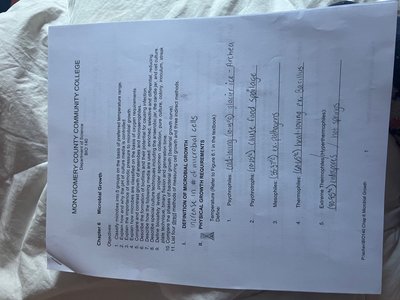
Obligate Aerobe: Requires oxygen for growth.
Obligate Anaerobe: Cannot tolerate oxygen; grows only in its absence.
Facultative Anaerobe: Can grow with or without oxygen, but prefers oxygen.
Microaerophile: Requires low levels of oxygen.
Aerotolerant Anaerobe: Does not use oxygen but can tolerate its presence.
Step-by-Step Guidance
Review the definitions of each oxygen requirement category listed above.
Think about how each type would grow in a test tube of thioglycollate broth, which creates an oxygen gradient.
Consider why obligate aerobes grow at the top, obligate anaerobes at the bottom, and facultative anaerobes throughout but more at the top.
Microaerophiles grow just below the surface, where oxygen is present but not too high.
Try solving on your own before revealing the answer!
Q2. What is the difference between selective and differential media?
Background
Topic: Types of Microbiological Media
This question tests your ability to distinguish between media types used to grow and identify bacteria in the laboratory.
Key Terms:
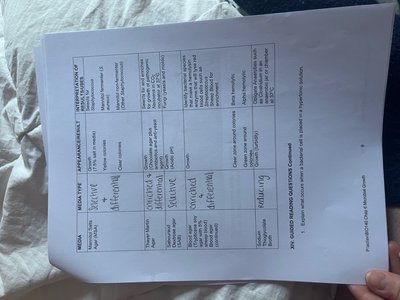
Selective Media: Inhibits growth of some organisms while allowing others to grow.
Differential Media: Allows differentiation of organisms based on biochemical reactions (e.g., color change).
Step-by-Step Guidance
Recall examples of selective media (e.g., MacConkey agar inhibits Gram-positive bacteria).
Recall examples of differential media (e.g., MacConkey agar differentiates lactose fermenters by color change).
Think about how a single medium can be both selective and differential.
Review the table of media types and their functions.
Try solving on your own before revealing the answer!
Q3. What is the purpose of using a closed system versus an open system in bacterial growth experiments?
Background
Topic: Bacterial Growth Systems
This question tests your understanding of how environmental conditions affect bacterial growth and population dynamics.
Key Terms:
Closed System: No addition or removal of nutrients; used to study growth phases.
Open System: Continuous addition/removal of nutrients; maintains bacteria in log phase.
Step-by-Step Guidance
Recall the phases of bacterial growth in a closed system: lag, log, stationary, death.
Think about how an open system (chemostat) keeps bacteria growing continuously.
Consider why researchers might use each system for different experiments.
Review the differences in population dynamics between the two systems.
Try solving on your own before revealing the answer!

Q4. How do bacteria grow in different environmental conditions (temperature, pH, osmotic pressure)?
Background
Topic: Environmental Factors Affecting Bacterial Growth
This question tests your knowledge of how physical and chemical factors influence microbial growth.
Key Terms:
Thermophiles: Grow at high temperatures.
Mesophiles: Grow at moderate temperatures.
Psychrophiles: Grow at low temperatures.
Halophiles: Grow in high salt concentrations.
Acidophiles: Grow in acidic environments.
Step-by-Step Guidance
Review the definitions and examples of each environmental category.
Think about how these adaptations help bacteria survive in extreme conditions.
Consider how laboratory media can be adjusted to select for these organisms.
Review the effects of temperature, pH, and osmotic pressure on enzyme activity and cell structure.
Try solving on your own before revealing the answer!
Q5. What are the phases of bacterial growth in a closed system?
Background
Topic: Bacterial Growth Curve
This question tests your ability to describe and interpret the stages of bacterial population growth in a batch culture.
Key Terms:
Lag Phase: Adjustment period, no growth.
Log (Exponential) Phase: Rapid cell division.
Stationary Phase: Growth rate slows, nutrients deplete.
Death Phase: Cells die off.
Step-by-Step Guidance
Recall the order and characteristics of each phase.
Think about what causes transitions between phases (nutrient depletion, waste accumulation).
Review how these phases are visualized on a growth curve graph.
Consider how experimental conditions affect the length of each phase.
Try solving on your own before revealing the answer!
Final Answer Examples
Q1: Bacteria are classified as obligate aerobes, obligate anaerobes, facultative anaerobes, microaerophiles, or aerotolerant anaerobes based on their oxygen requirements.
Q2: Selective media inhibit certain microbes, while differential media allow you to distinguish between microbes based on observable changes.
Q3: Closed systems show all growth phases; open systems keep bacteria in log phase for continuous study.
Q4: Bacteria adapt to environmental extremes by specialized enzymes and cell structures.
Q5: The phases are lag, log, stationary, and death, each with distinct population dynamics.
