 Back
BackMicrobiology Study Guide: Viruses, Infectious Disease, Immunity, and Pathogenesis
Study Guide - Smart Notes
 Tailored notes based on your materials, expanded with key definitions, examples, and context.
Viruses and Prions
Classification and Structure of Viruses
Viruses are considered nonliving microbes because they lack cellular structure and metabolic processes, relying entirely on host cells for replication. They differ fundamentally from prokaryotic and eukaryotic cells.
Capsid: Protein shell that encases the viral genome.
Envelope: Lipid membrane derived from the host cell, present in some viruses.
Spikes: Glycoproteins used for attachment to host cells.
Genomic variations: Viruses may have DNA or RNA genomes, which can be single- or double-stranded, linear or circular.
Host range: The collection of species a virus can infect.
Tropism: The specific tissues or cells a virus infects within its host.
Bacteriophage Replication Cycles
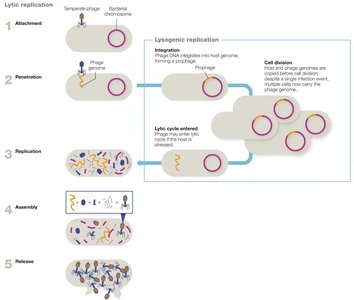
Bacteriophages (viruses that infect bacteria) can undergo lytic or lysogenic replication.
Lytic cycle: Results in destruction of the host cell and release of new phages.
Lysogenic cycle: Phage genome integrates into the host chromosome, forming a prophage and replicating with the host cell.
Phage conversion: Occurs when a prophage alters the phenotype of the host bacterium, often increasing virulence.
Animal Virus Replication Pathways
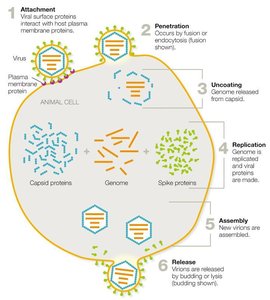
Animal viruses follow a series of steps for replication:
Attachment: Virus binds to host cell surface proteins.
Penetration: Entry via fusion (enveloped viruses) or endocytosis (naked viruses).
Uncoating: Viral capsid is removed, exposing the genome.
Replication: Genome is copied, and viral proteins are synthesized.
Assembly: New virions are assembled.
Release: Enveloped viruses bud from the cell; naked viruses lyse the cell.
Persistent infections: Can be chronic (continuous virus production) or latent (virus remains dormant).
Oncogenic viruses: Cause cancer by stimulating uncontrolled cell division or inhibiting apoptosis.
Example: Human papillomavirus (HPV) is an oncogenic virus linked to cervical cancer.
Principles of Infectious Disease and Epidemiology
Host-Microbe Interactions
Host-microbe relationships can be symbiotic, with three main types:
Parasitism: Host is harmed.
Mutualism: Host is helped.
Commensalism: No perceived benefit or harm to the host.
Normal microbiota: Microbes colonizing the body without causing disease; includes resident and transient microbiota.
Opportunistic pathogens: Normal microbiota can cause disease if host defenses are compromised or if they enter sterile sites.
Terminology and Koch's Postulates
Infectious disease: Illness caused by a pathogen.
Opportunistic pathogens: Cause disease in weakened hosts.
True pathogens: Cause disease in healthy hosts.
Zoonotic diseases: Spread from animals to humans.
Noncommunicable vs. communicable diseases: Noncommunicable do not spread person-to-person; communicable do.
Koch's postulates: Four criteria to identify the causative agent of a disease:
The same organism must be present in every case of the disease.
The organism must be isolated and grown in pure culture.
The cultured organism must cause disease when introduced into a susceptible host.
The organism must be re-isolated from the inoculated host.
Sources, Reservoirs, and Transmission
Reservoir: Natural habitat of the pathogen (animate or inanimate).
Source: Disseminates the pathogen to new hosts.
Modes of transmission: Direct (person-to-person, animal, environmental, vertical) and indirect (airborne, vehicle, vector).
Stages of Infectious Disease
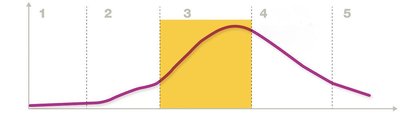
The progression of infectious disease is divided into five stages:
Incubation period
Prodromal phase
Acute phase
Period of decline
Convalescent phase
Host Microbe Interactions and Pathogenesis
Pathogenicity, Virulence, and Virulence Factors
Pathogenicity: Ability of a microbe to cause disease.
Virulence: Degree of severity of disease caused.
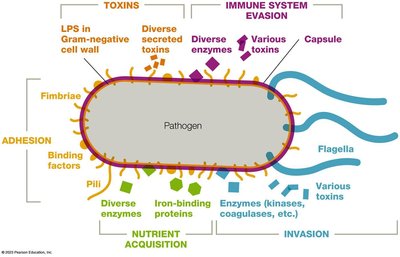
Virulence factors: Mechanisms used by pathogens to cause damage and evade host defenses.
Major groups of virulence factors include:
Adhesion (fimbriae, pili, binding factors)
Invasion (enzymes, toxins, flagella)
Nutrient acquisition (iron-binding proteins, diverse enzymes)
Toxins (LPS, secreted toxins)
Immune system evasion (capsule, antigenic variation)
Five Steps to Infection
Pathogens must complete five tasks to successfully infect a host:
Entry through a portal of entry (skin or mucous membrane)
Adherence (adhesins such as fimbriae, pili, cell wall components)
Invasion and nutrient acquisition (enzymes, toxins)
Evasion of host immune defenses (capsules, antigenic variation, latency)
Transmission to a new host (portal of exit)
Healthcare-Associated Infections (HAIs)
Diseases acquired from healthcare interventions.
Transmit by direct and indirect contact.
Common HAIs: Staphylococcus aureus, Escherichia coli, Clostridioides difficile, Pseudomonas aeruginosa.
Prevention: Surveillance, prevention, and control programs.
Innate Immunity
Overview and First-Line Defenses
The immune system eliminates foreign substances (antigens) through innate and adaptive branches.
Innate immunity: Immediate, non-specific response; present in all eukaryotes.
Adaptive immunity: Specific, slower response; present only in vertebrates.
First-line defenses prevent pathogen entry and include physical barriers, chemical barriers, and normal microbiota.
Normal microbiota: Protects by blocking harmful microbes and educating the immune system.
Second-Line Defenses: Cellular and Molecular
Leukocytes: White blood cells central to second-line defenses.
Complement system: Activated by antibodies bound to antigens in the classical pathway.
Outcomes of complement activation: Opsonization, inflammation, cell lysis.
Inflammation: Main goals are to recruit immune defenses, limit spread of infection, and deliver factors for tissue recovery.
Four cardinal signs: redness, pain, localized heat, swelling.
Phagocytosis
Phagocytic cells engulf targets in a phagosome, which fuses with a lysosome containing hydrolytic enzymes, forming a phagolysosome that destroys the target.
Example: Genetic disorders preventing hydrolytic enzyme production impair pathogen destruction.
Adaptive Immunity
Branches and Stages
Adaptive immunity consists of humoral (B cells, antibodies) and cellular (T cells) branches. The goal is to recognize and remember antigens for faster responses upon re-exposure.
Stages: antigen recognition, lymphocyte activation, effector response, memory cell formation.
T Cells
Cytotoxic T cells (TC): CD8+; kill abnormal cells by releasing perforin and granzymes.
Helper T cells (TH): CD4+; regulate activity of B cells, cytotoxic T cells, and macrophages.
TH1 favors cell-mediated immunity; TH2 favors humoral immunity.
Effector cells: Act immediately to fight infection.
Memory cells: Remain long-term and respond faster upon re-exposure.
B Cells and Humoral Response
Activated B cells differentiate into plasma cells (effector) and memory B cells. Plasma cells produce antibodies (immunoglobulins).
Key antibody functions: neutralization, opsonization, complement activation.
Antibody classes:
IgM: First produced, initial response.
IgG: Most abundant, crosses placenta, long-lasting.
IgA: Found in secretions.
IgE: Allergies, parasitic defense.
IgD: B cell receptor.
Immunological Memory and Types of Immunity
Primary response: First exposure, slower, less antibody production.
Secondary response: Faster, stronger, higher affinity antibodies due to memory B cells.
Types of adaptive immunity:
Naturally acquired active: Infection triggers memory cells and antibodies.
Artificially acquired active: Vaccination triggers immune response.
Naturally acquired passive: Antibodies received non-medically (e.g., breast milk).
Artificially acquired passive: Antibodies received medically (e.g., antiserum).
Active immunity: Long-lasting protection.
Passive immunity: Immediate protection.
Vaccines and Herd Immunity
Vaccine Formulations and Herd Immunity
Herd immunity: Reduced disease spread when a large portion of the population is immunized.
Attenuated vaccines: Mimic natural infection, provide strong humoral and cell-mediated immunity.
Inactivated vaccines: Safer for immunocompromised; require booster doses for memory response.
Example: mRNA vaccines (Pfizer, Moderna) and recombinant vector vaccines (Johnson & Johnson) for SARS-CoV-2.
