 Back
BackMicrobiology Study Notes: Control of Microbial Growth, Genetics, Biotechnology, Classification, and Microbial Diversity
Study Guide - Smart Notes
 Tailored notes based on your materials, expanded with key definitions, examples, and context.
Control of Microbial Growth
Definitions and Methods
Controlling microbial growth is essential in medical, industrial, and food settings. Various terms and methods are used to describe the effectiveness and purpose of microbial control agents.
Virucide: An agent that inactivates viruses.
Germicide: An agent that kills microbes.
Fungicide: An agent that kills yeasts and molds.
Sterilant: An agent that destroys all living microorganisms.
Bacteriostasis: An agent that inhibits, but does not kill, microbes.
Pasteurization
Pasteurization is a process that reduces spoilage organisms and pathogens in milk and juices. It does not sterilize the product, but significantly lowers microbial load to safe levels.
Application: Used in dairy and juice industries to ensure safety and extend shelf life.
Membrane Filtration
Membrane filtration is used for heat-sensitive materials. It physically removes microbes by passing the liquid through a filter with pores small enough to retain microorganisms.
Application: Sterilization of pharmaceuticals, culture media, and other heat-sensitive solutions.
Chemical Agents
Ethylene oxide is a chemical agent used for sterilization. It is effective against all forms of microbes, including spores, and is commonly used for medical equipment.
Application: Sterilization of surgical instruments and other items that cannot withstand high temperatures.
Microbial Genetics
Structure and Function of DNA
Genetic information in microorganisms is stored in DNA, which directs cellular functions and inheritance.
Gene: A segment of DNA that codes for a functional product (usually a protein).
DNA Structure: Double helix with a backbone of deoxyribose-phosphate. Two strands are held together by hydrogen bonds between Adenine-Thymine and Cytosine-Guanine pairs. The strands are antiparallel (oriented in opposite directions).
Key Enzymes in DNA Processes
DNA gyrase: Relaxes supercoiling in DNA ahead of the replication fork.
DNA ligase: Makes covalent bonds to join DNA strands.
DNA polymerase: Synthesizes DNA from a DNA template.
RNA polymerase: Copies RNA from a DNA template.
Transposase: Cuts DNA backbone, leaving single-stranded "sticky ends."
Translation
During translation, mRNA directs the assembly of amino acids into polypeptide chains. The language of mRNA is in the form of codons, and the sequence of codons determines the sequence of amino acids in the protein.
Example: The codon AUG codes for the amino acid methionine, which is often the start signal for protein synthesis.
Biotechnology & DNA Technology
Applications and Tools
Biotechnology uses microorganisms, cells, or cell components to make products such as foods, vaccines, antibiotics, and vitamins.
Restriction enzymes: Enzymes that cut specific sequences of DNA, enabling genetic engineering.
Polymerase Chain Reaction (PCR): Amplifies small, specific sequences of DNA using primers.
Complementary DNA (cDNA): Made from mRNA by reverse transcriptase; used to obtain eukaryotic genes without introns.
Human Genome Project: Sequenced the entire human genome, providing a foundation for genetic research.
Classification of Microorganisms
Domains and Methods
Microorganisms are classified into domains based on cellular structure and genetic characteristics.
Prokaryotes: Domain Bacteria and Domain Archaea.
Eukaryotes: Domain Eukarya, including Kingdom Animalia (multicellular animals that ingest organic matter).
Viruses: Not classified in any domain; not composed of cells and do not fit the definition of living organisms.
Methods of Classification
Biochemical tests: Determine the ability of a microbe to perform specific enzymatic activities.
Serology: Studies serum and immune responses evident in serum.
DNA fingerprinting: Provides information about similarities between nucleotide sequences.
Microbial Diversity: Prokaryotes, Eukaryotes, and Viruses
Prokaryotes
Mycoplasma: Lack a cell wall and are pleomorphic (variable in shape).
Staphylococcus: Appear as grape-like clusters of cocci.
Streptococcus: Appear as spherical cells in chains.
Fungi
Fungi include many species that cause disease, but also many beneficial species that decompose dead plants and provide food and medication. They are chemoheterotrophs and can be aerobic or facultative anaerobic.
Algae
Algae are not a taxonomic group. They are unicellular or filamentous photoautotrophs, lack roots, stems, and leaves, and are mostly aquatic. Water is necessary for their growth and reproduction.
Protozoa
Protozoa are unicellular eukaryotes that inhabit water and soil. Some are normal microbiota in animals, while others cause disease in humans and animals.
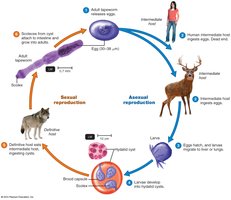
Host Relationships in Parasitic Life Cycles
Definitive host: The host in which the parasite undergoes sexual reproduction (e.g., mosquito for Plasmodium).
Intermediate host: The host in which the parasite undergoes asexual reproduction (e.g., human for Plasmodium).
Example: The life cycle of the tapeworm Echinococcus spp. involves both intermediate and definitive hosts.
Viruses, Viroids, and Prions
Viruses: Obligatory intracellular parasites; require living host cells to multiply; not composed of cells.
Viroid: Infectious piece of RNA without a capsid.
Prion: Infectious protein.
Summary Table: Microbial Classification and Properties
Type | Cell Structure | Domain | Key Properties |
|---|---|---|---|
Bacteria | Prokaryotic | Bacteria | Cell wall, diverse metabolism |
Archaea | Prokaryotic | Archaea | Cell wall, extremophiles |
Fungi | Eukaryotic | Eukarya | Chemoheterotrophs, decomposers |
Algae | Eukaryotic | Eukarya | Photoautotrophs, aquatic |
Protozoa | Eukaryotic | Eukarya | Unicellular, diverse habitats |
Viruses | Non-cellular | None | Obligate intracellular parasites |
Viroids | Non-cellular | None | RNA, no capsid |
Prions | Non-cellular | None | Protein, infectious |
Additional info: Academic context and expanded explanations were added to ensure completeness and clarity for exam preparation.
