 Back
BackMicrobiology Study Notes: Media Types, Staining, and Selective/Differential Agar
Study Guide - Smart Notes
 Tailored notes based on your materials, expanded with key definitions, examples, and context.
Microbial Culture Media
Types of Media and Their Uses
Microbial culture media are essential for growing, isolating, and maintaining microorganisms in the laboratory. The physical form and composition of the media determine their specific applications.
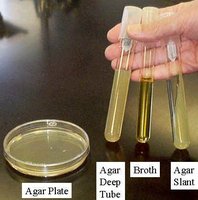
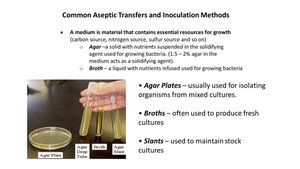
Agar Plates: Solid media in petri dishes, used for isolating organisms from mixed cultures.
Broth: Liquid media, used to produce fresh cultures and support rapid growth.
Agar Slant: Solid media in test tubes with a slanted surface, used to maintain stock cultures.
Agar Deep Tube: Solid media in upright tubes, used to study oxygen requirements and motility.
Example: Agar plates are commonly used to isolate colonies, while broths are used for propagation and slants for long-term storage.
Laboratory Equipment for Microbiology
Essential Tools and Their Functions
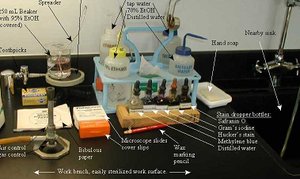
Microbiology labs require specialized equipment for culturing, staining, and observing microorganisms. Proper aseptic technique and equipment handling are crucial for accurate results.
Microscope: Used to observe cell morphology and arrangement.
Staining bottles: Contain dyes for staining cells.
Wash bottles: Used for rinsing slides and equipment.
Work bench: Provides a clean, organized surface for experiments.
Microscopy in Microbiology
Anatomy and Magnification of the Microscope
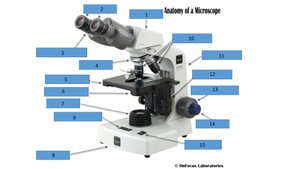
Microscopes are fundamental tools for visualizing microorganisms. Understanding their parts and magnification is essential for accurate observation.
Ocular lens: Provides initial magnification (usually 10x).
Objective lenses: Range from low (4x) to oil immersion (100x).
Total magnification: Calculated by multiplying ocular and objective magnifications.
Example: Using a 10x ocular and 40x objective yields a total magnification of 400x.
Objective | Ocular magnification | Total magnification |
|---|---|---|
4x | 10x | 40x |
10x | 10x | 100x |
40x | 10x | 400x |
100x (oil immersion) | 10x | 1000x |
Staining Techniques
Simple Staining
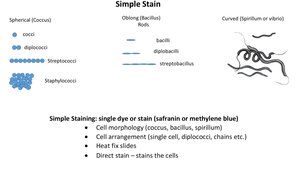
Simple stains use a single dye to highlight cell morphology and arrangement. Common dyes include safranin and methylene blue.
Cell morphology: Cocci (spherical), bacilli (rod-shaped), spirillum (curved).
Cell arrangement: Single, diplococci, chains, clusters.
Direct stain: Stains the cells directly after heat fixing.
Example: Simple staining helps distinguish between cocci and bacilli.
Selective and Differential Media
Definitions and Applications
Selective media contain substances that inhibit the growth of certain organisms, while differential media allow distinction between different microbes based on observable changes.
Selective Medium: Inhibits unwanted organisms (e.g., PEA inhibits Gram-negative bacteria).
Differential Medium: Distinguishes between organisms based on biochemical reactions (e.g., color change).
Enriched Differential: Contains additional nutrients for fastidious organisms (e.g., blood agar).
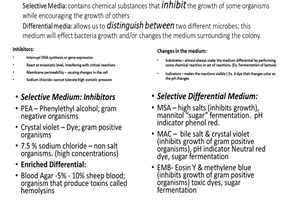
Medium | Inhibitor | Purpose |
|---|---|---|
PEA | Phenylethyl alcohol | Inhibits Gram-negative |
Blood Agar | Sheep blood | Enriched, differential |
MSA | High salt | Selective for Staphylococcus |
MAC | Bile salts, crystal violet | Selective for Gram-negative, differential for lactose fermentation |
EMB | Eosin Y, methylene blue | Selective for Gram-negative, differential for sugar fermentation |
Blood Agar and Hemolysis
Types of Hemolysis
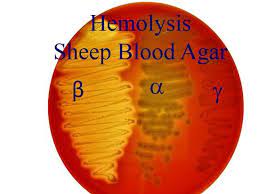
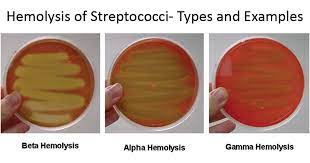
Blood agar is an enriched differential medium used to detect hemolytic activity. Hemolysis refers to the breakdown of red blood cells by bacterial toxins.
Beta hemolysis: Complete destruction of RBCs (clear zone, e.g., Streptococcus pyogenes).
Alpha hemolysis: Partial destruction (greenish zone, e.g., Streptococcus pneumoniae).
Gamma hemolysis: No destruction (no color change, e.g., Streptococcus faecalis).
MacConkey Agar
Selective and Differential Properties
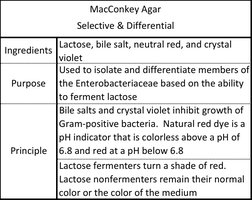
MacConkey agar is used to isolate and differentiate members of the Enterobacteriaceae based on their ability to ferment lactose.
Ingredients: Lactose, bile salts, neutral red, crystal violet.
Selective: Bile salts and crystal violet inhibit Gram-positive bacteria.
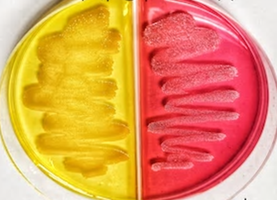
Differential: Lactose fermenters turn red; non-fermenters remain colorless.
Ingredient | Purpose | Principle |
|---|---|---|
Lactose | Differentiation | Fermentation turns colonies red |
Bile salts, crystal violet | Selection | Inhibit Gram-positive |
Neutral red | Indicator | Red below pH 6.8 |

Eosin Methylene Blue (EMB) Agar
Selective and Differential Properties
EMB agar is used for the isolation of fecal coliforms and differentiates bacteria based on sugar fermentation and dye uptake.
Ingredients: Peptone, lactose, sucrose, eosin Y, methylene blue.
Selective: Dyes inhibit Gram-positive organisms.
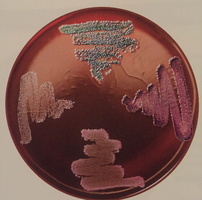
Differential: Metallic green sheen for vigorous fermenters (e.g., E. coli), pink for slow fermenters, colorless for non-fermenters.
Ingredient | Purpose | Principle |
|---|---|---|
Lactose, sucrose | Differentiation | Fermentation produces color changes |
Eosin Y, methylene blue | Selection | Inhibit Gram-positive |
Phenylethyl Alcohol Agar (PEA)
Selective Medium for Gram-Positive Bacteria
PEA agar is an undefined, selective medium that interferes with DNA synthesis in Gram-negative organisms, allowing Gram-positive bacteria to grow.
Inhibitor: Phenylethyl alcohol.
Application: Used to isolate Gram-positive cocci from mixed cultures.
Medium | Type | Inhibitor | Effect |
|---|---|---|---|
PEA | Selective | Phenylethyl alcohol | Inhibits Gram-negative |

Summary Table: Media Types and Their Functions
Medium | Type | Selective Agent | Differential Feature | Application |
|---|---|---|---|---|
Blood Agar | Enriched, Differential | None | Hemolysis | Detect hemolytic bacteria |
MacConkey Agar | Selective, Differential | Bile salts, crystal violet | Lactose fermentation | Isolate Enterobacteriaceae |
EMB Agar | Selective, Differential | Eosin Y, methylene blue | Sugar fermentation | Isolate fecal coliforms |
PEA Agar | Selective | Phenylethyl alcohol | None | Isolate Gram-positive cocci |
