 Back
BackMicrobiology Test 1 Study Guidance: Binomial Nomenclature, Microbial Classification, Viral Life Cycle, and More
Study Guide - Smart Notes
 Tailored notes based on your materials, expanded with key definitions, examples, and context.
Q1. What is the correct way to type the binomial name of a microorganism?
Background
Topic: Binomial Nomenclature
This question tests your understanding of how scientific names are formatted in microbiology. Binomial nomenclature is the system used to name organisms using two terms: the genus and the species.
Key Terms:
Genus: The first part of the scientific name; always capitalized.
Species: The second part; always lowercase.
Formatting: Italicized (typed) or underlined (handwritten).
Step-by-Step Guidance
Identify the genus and species in each option.
Check if the genus is capitalized and the species is lowercase.
Determine if the name is italicized or underlined (if handwritten).
Eliminate options that do not follow these rules.
Try solving on your own before revealing the answer!
Final Answer: D. Staphylococcus aureus
The correct format is Genus (capitalized) + species (lowercase), both italicized or underlined if handwritten.
Q2. Which of the following is an acellular microbe lacking genetic material?
Background
Topic: Microbial Classification
This question tests your knowledge of the types of microbes, specifically those that are acellular and lack DNA or RNA.
Key Terms:
Acellular: Not composed of cells.
Genetic material: DNA or RNA.
Prion: Infectious protein particle lacking genetic material.
Step-by-Step Guidance
Review the characteristics of each option (protozoan, helminth, prion, bacterium, virus).
Identify which are cellular and which are acellular.
Determine which acellular microbe lacks both DNA and RNA.
Recall that viruses have genetic material, but prions do not.
Try solving on your own before revealing the answer!
Final Answer: C. prion
Prions are infectious proteins that lack DNA and RNA, making them unique among acellular microbes.
Q3. Dr. Ignaz Semmelweis was a pioneer in which method to reduce disease in healthcare settings?
Background
Topic: History of Microbiology
This question tests your knowledge of important historical figures and their contributions to infection control.
Key Terms:
Handwashing: The practice of cleaning hands to prevent disease transmission.
Antiseptics: Chemicals used to reduce microbes on skin.
Sterilization: Complete removal of all microbes.
Pasteurization: Heat treatment to kill pathogens.
Step-by-Step Guidance
Recall the historical context of Semmelweis's work in maternity wards.
Identify which method he promoted to reduce infections.
Compare the options and eliminate those not associated with Semmelweis.
Focus on the method that directly involves hygiene practices.
Try solving on your own before revealing the answer!
Final Answer: A. handwashing
Semmelweis demonstrated that handwashing significantly reduced infection rates in hospitals.
Q4. Which element is considered the fundamental element of life due to its superior bonding capabilities?
Background
Topic: Biochemistry of Life
This question tests your understanding of the chemical basis of life and the importance of certain elements in biological molecules.
Key Terms:
Organic molecules: Molecules containing carbon.
Bonding capabilities: Ability to form stable covalent bonds.
Step-by-Step Guidance
Review the bonding properties of each element listed.
Recall which element forms the backbone of organic molecules.
Consider why this element is essential for life.
Eliminate elements that do not form multiple stable bonds.
Try solving on your own before revealing the answer!
Final Answer: E. carbon
Carbon's ability to form four covalent bonds makes it the backbone of organic molecules.
Q5. Which group of macromolecules contains enzymes and antibodies?
Background
Topic: Macromolecules in Cells
This question tests your knowledge of the functions of different macromolecules in biological systems.
Key Terms:
Enzymes: Proteins that catalyze chemical reactions.
Antibodies: Proteins involved in immune defense.
Macromolecules: Large molecules essential for life (proteins, lipids, nucleic acids, carbohydrates).
Step-by-Step Guidance
Recall the functions of each macromolecule group.
Identify which group is responsible for catalysis and immune defense.
Eliminate groups that do not contain enzymes or antibodies.
Focus on the group made of amino acids.
Try solving on your own before revealing the answer!
Final Answer: B. proteins
Proteins are made of amino acids and include both enzymes and antibodies.
Q6. Which type of media lets you grow certain microorganisms while inhibiting the growth of others?
Background
Topic: Microbial Growth Media
This question tests your understanding of different types of media used in microbiology to isolate and grow specific microbes.
Key Terms:
Selective media: Media that inhibits some microbes while allowing others to grow.
Differential media: Media that distinguishes between microbes based on biochemical reactions.
Enriched media: Media with extra nutrients for fastidious organisms.
Complex media: Media with undefined components.
Step-by-Step Guidance
Review the definitions of each type of media.
Identify which media type is designed to "select" for certain microbes.
Eliminate options that do not inhibit growth of other microbes.
Focus on the media that contains inhibitory substances.
Try solving on your own before revealing the answer!
Final Answer: D. selective
Selective media allows only certain microbes to grow by inhibiting others.
Q7. As a major component of gram-negative outer membranes, lipopolysaccharide can stimulate shock and fever. Its lipid portion is referred to as ______.
Background
Topic: Bacterial Cell Structure
This question tests your knowledge of the components of gram-negative bacteria and their effects on human health.
Key Terms:
Lipopolysaccharide (LPS): Molecule found in gram-negative bacterial outer membranes.
Endotoxin: The lipid portion of LPS responsible for toxic effects.
Step-by-Step Guidance
Recall the structure of gram-negative bacterial envelopes.
Identify the role of LPS in causing fever and shock.
Determine which term refers to the toxic lipid portion.
Eliminate options that do not match the description.
Try solving on your own before revealing the answer!
Final Answer: A. endotoxin
The lipid portion of LPS is called endotoxin and is responsible for its toxic effects.
Q8. A unicellular microorganism from a hot spring lacks a nucleus, has a cell wall without peptidoglycan, 70S ribosomes, and membrane lipids with ether linkages. Which group does it belong to?
Background
Topic: Microbial Classification
This question tests your ability to classify microorganisms based on cellular structure and biochemical characteristics.
Key Terms:
Prokaryote: Organism without a nucleus.
Peptidoglycan: Component of bacterial cell walls.
Archaea: Prokaryotes with unique cell wall and membrane lipids.
Step-by-Step Guidance
Review the characteristics of bacteria, archaea, fungi, and protists.
Identify which group lacks peptidoglycan and has ether-linked lipids.
Recall that archaea often live in extreme environments.
Eliminate groups that do not match all the described features.
Try solving on your own before revealing the answer!
Final Answer: D. Archaea
Archaea have cell walls without peptidoglycan and unique membrane lipids.
Q9. Which of the following is not useful to determine whether a clinical isolate is a bacterium, fungus, or protozoan?
Background
Topic: Microbial Identification
This question tests your understanding of the methods used to identify different types of microbes.
Key Terms:
Cell wall: Present in bacteria and fungi, but not protozoa.
Protective structures: Formed by bacteria and protozoa under stress.
Size: Not always reliable for identification.
Step-by-Step Guidance
Review the characteristics used to identify bacteria, fungi, and protozoa.
Consider which features are shared among these groups.
Determine which feature is least useful for distinguishing them.
Eliminate features that provide clear identification.
Try solving on your own before revealing the answer!
Final Answer: A. Its size under a light microscope
Size alone is not sufficient to distinguish between these groups.
Q10. What type of microscope would you use to observe proteins on the surface of a virus?
Background
Topic: Microscopy
This question tests your knowledge of the types of microscopes and their applications in microbiology.
Key Terms:
Light microscope: Used for cells and larger structures.
Electron microscope: Used for viruses and fine surface details.
Scanning electron microscope (SEM): Used to view surface structures.
Transmission electron microscope (TEM): Used to view internal structures.
Step-by-Step Guidance
Recall the size of viruses and the limitations of light microscopes.
Identify which electron microscope is used for surface details.
Eliminate microscopes that cannot resolve viral surface proteins.
Focus on the microscope that provides 3D surface images.
Try solving on your own before revealing the answer!
Final Answer: D. scanning electron microscope
SEM is used to observe surface structures, including viral proteins.
Q11. Select the most accurate statement reflecting the process of transcription.
Background
Topic: Molecular Biology – Transcription
This question tests your understanding of how genetic information is transcribed from DNA to RNA.
Key Terms:
Transcription: The process of making RNA from a DNA template.
RNA polymerase: The enzyme responsible for transcription.
Directionality: RNA is synthesized in the 5' to 3' direction.
Step-by-Step Guidance
Review the role of RNA polymerase in transcription.
Recall where transcription occurs in prokaryotes and eukaryotes.
Identify the direction in which RNA is synthesized.
Eliminate statements that do not accurately describe transcription.
Try solving on your own before revealing the answer!
Final Answer: D. Transcription relies upon the action of RNA polymerase.
RNA polymerase is essential for transcription in all cell types.
Q12. The specific sequence of 3 bases in mRNA that encodes a particular amino acid is the ______, whereas the complementary sequence of 3 bases in tRNA that binds to the mRNA is known as the ______.
Background
Topic: Translation – Genetic Code
This question tests your understanding of the genetic code and the process of translation.
Key Terms:
Codon: Sequence of 3 bases in mRNA.
Anticodon: Sequence of 3 bases in tRNA complementary to the codon.
Step-by-Step Guidance
Recall the role of mRNA in encoding amino acids.
Identify the complementary sequence in tRNA.
Match the correct terms to their definitions.
Eliminate options that do not fit the description.
Try solving on your own before revealing the answer!
Final Answer: A. codon; anticodon
Codons are in mRNA; anticodons are in tRNA and bind to codons during translation.
Q13. What key event occurs during lysogenic replication of bacteriophage that does not occur during lytic replication?
Background
Topic: Viral Replication Cycles
This question tests your understanding of the differences between lysogenic and lytic cycles in bacteriophage replication.
Key Terms:
Lysogenic cycle: Viral DNA integrates into host genome.
Lytic cycle: Virus replicates and lyses the host cell.
Prophage: Integrated viral DNA in host genome.
Step-by-Step Guidance
Review the steps of both lysogenic and lytic cycles.
Identify which event is unique to lysogeny.
Recall that integration of viral DNA is a hallmark of lysogenic replication.
Eliminate events common to both cycles.
Try solving on your own before revealing the answer!
Final Answer: C. integration of the phage DNA into the host cell DNA.
Lysogenic replication involves integration of viral DNA, forming a prophage.
Q14. Order the following steps to reflect the order in which they occur in the life cycle of an animal virus.
Background
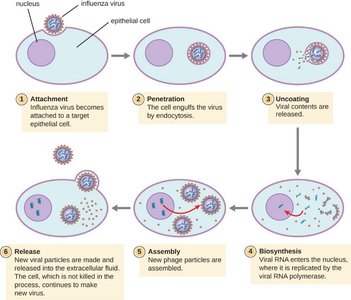
Topic: Viral Life Cycle
This question tests your understanding of the sequence of events in the replication of animal viruses.
Key Terms:
Adsorption: Attachment to host cell.
Penetration and uncoating: Entry and release of viral contents.
Synthesis: Production of viral nucleic acids and proteins.
Assembly: Formation of new viral particles.
Release: Exit of new viruses from the host cell.
Step-by-Step Guidance
Review the general steps in viral replication: attachment, entry, synthesis, assembly, release.
Match each step to its description in the question.
Arrange the steps in logical order based on the viral life cycle.
Check your sequence against diagrams or textbook descriptions.
Try solving on your own before revealing the answer!
Final Answer: 1. Adsorption (attachment), 2. Penetration and uncoating, 3. Synthesis, 4. Assembly, 5. Release
The diagram shows the correct sequence of steps in the animal virus life cycle.
