 Back
BackMicroorganisms and the Environment: Physical, Chemical, and Biological Parameters
Study Guide - Smart Notes
 Tailored notes based on your materials, expanded with key definitions, examples, and context.
Microorganisms and Environmental Parameters
Introduction
Microorganisms are ubiquitous, and their growth and survival are determined by a complex interplay of physical, chemical, and biological parameters in their environment. Understanding these parameters is essential for studying microbial ecology, physiology, and environmental microbiology.
Physical Parameters of the Environment
SI Units and Conversions
Scientific measurements in microbiology require the use of SI (International System of Units) units for consistency and accuracy. Key SI units include meter (m) for length, kilogram (kg) for mass, second (s) for time, kelvin (K) for temperature, and mole (mol) for amount of substance. Derived units such as joule (J) for energy and pascal (Pa) for pressure are also commonly used.
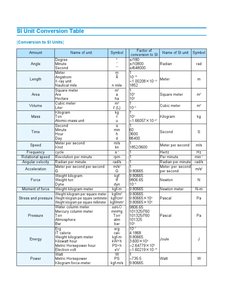
Examples of SI Unit Conversions
Microbiologists often need to convert between units, such as calories to joules or grams to kilograms. For example, the energy content of food can be converted from kcal/g to J/kg using the appropriate conversion factors. Understanding unit conversions is crucial for accurate calculations in experimental and environmental contexts.

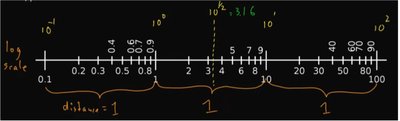
Logarithmic Scale and Order-of-Magnitude Estimation
Microbial populations and environmental concentrations often span several orders of magnitude. Logarithmic scales are used to represent these large ranges, and estimations are made using log-based rounding (e.g., 3.16 as the midpoint between 1 and 10).
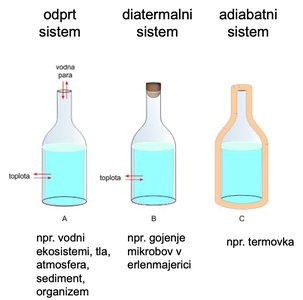
System Types: Open, Closed, and Adiabatic
Environmental systems can be classified as:
Open systems: Exchange both matter and energy with the surroundings (e.g., aquatic ecosystems).
Closed (diathermal) systems: Exchange energy but not matter (e.g., microbial cultures in sealed flasks).
Adiabatic systems: Exchange neither matter nor energy (e.g., thermos flasks).
Soil Texture and Structure
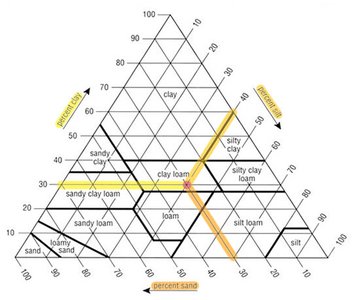
Soil texture (proportion of sand, silt, and clay) and structure (aggregation of particles) influence microbial habitats and nutrient availability. The soil texture triangle is used to classify soils based on these proportions.
Chemical and Biological Parameters
Environmental Extremes and Microbial Adaptations
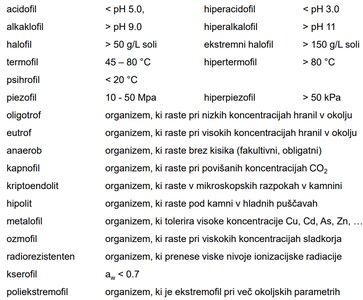
Microorganisms are classified based on their tolerance to environmental extremes:
Acidophiles: Thrive at low pH
Alkaliphiles: Thrive at high pH
Halophiles: Require high salt concentrations
Thermophiles: Grow at high temperatures
Psychrophiles: Grow at low temperatures
Piezophiles: Thrive under high pressure
Oligotrophs/Eutrophs: Adapted to low/high nutrient environments
Other types: Capnophiles, metalophiles, kserophiles, radioresistant, etc.
Key Environmental Conditions for Life
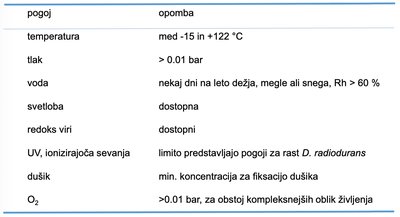
For life to exist, certain environmental conditions must be met, including appropriate temperature, pressure, water availability, light, redox sources, and minimal concentrations of essential elements such as nitrogen and oxygen.
Habitat and Ecological Niche
Definitions and Differences
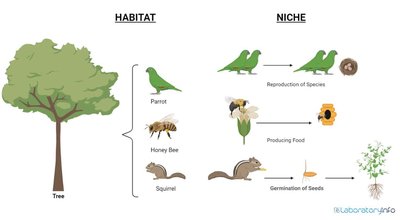
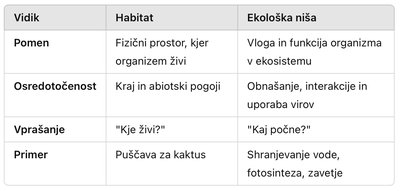
The habitat is the physical space where an organism lives, while the ecological niche encompasses the organism's role, interactions, and use of resources within the ecosystem.
Vidik | Habitat | Ekološka niša |
|---|---|---|
Pomen | Fizični prostor, kjer organizem živi | Vloga in funkcija organizma v ekosistemu |
Osredotočenost | Kraj in abiotski pogoji | Obnašanje, interakcije in uporaba virov |
Vprašanje | Kje živi? | Kaj počne? |
Primer | Puščava za kaktus | Shranjevanje vode, fotosinteza, zavetje |
Fundamental vs. Realized Niche
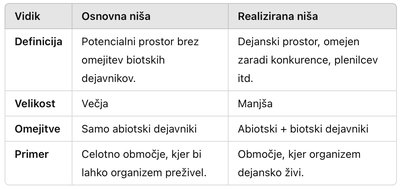
The fundamental niche is the full potential range of environmental conditions an organism can occupy, while the realized niche is the actual range occupied, limited by competition and predation.
Vidik | Osnovna niša | Realizirana niša |
|---|---|---|
Definicija | Potencialni prostor brez omejitev biotskih dejavnikov. | Dejanski prostor, omejen zaradi konkurence, plenilcev itd. |
Velikost | Večja | Manjša |
Omejitve | Samo abiotski dejavniki | Abiotski + biotski dejavniki |
Primer | Celotno območje, kjer bi lahko organizem preživel. | Območje, kjer organizem dejansko živi. |
Environmental Parameters Defining the Niche
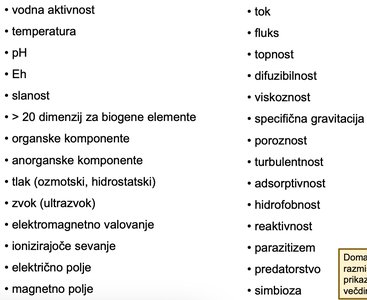
Microbial niches are defined by a multitude of parameters, including water activity, temperature, pH, redox potential (Eh), salinity, nutrient availability, and more. Each parameter represents a dimension in the multidimensional niche space.
Chemical Principles: Water and Molecular Structure
Lewis Structure of Water
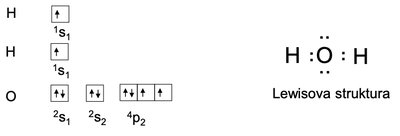
The Lewis structure of water (H2O) illustrates the arrangement of electrons around the oxygen and hydrogen atoms. Water's unique properties arise from its bent molecular geometry and ability to form hydrogen bonds.
Hydrogen bonds give water its high cohesion, surface tension, and solvent properties.
Water acts as a universal solvent, facilitating biochemical reactions and transport in microbial cells.
Summary Table: Key Environmental Parameters and Microbial Adaptations
Parameter | Microbial Adaptation |
|---|---|
pH | Acidophiles, alkaliphiles |
Salinity | Halophiles |
Temperature | Thermophiles, psychrophiles |
Pressure | Piezophiles |
Water activity | Kserophiles, osmophiles |
Heavy metals | Metalophiles |
Radiation | Radioresistant organisms |
Conclusion
Microbial life is shaped by a complex array of environmental parameters. Understanding the physical, chemical, and biological factors that define microbial habitats and niches is fundamental for microbiology, environmental science, and biotechnology.
