 Back
Backlec 04:Microscopy in Microbiology: Tools, Types, and Applications
Study Guide - Smart Notes
 Tailored notes based on your materials, expanded with key definitions, examples, and context.
Microscopy in Microbiology
Introduction to Microscopy
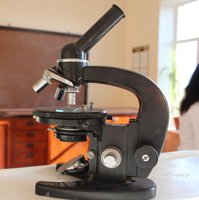
Microscopy is foundational to microbiology, enabling the visualization and study of microorganisms that are otherwise invisible to the naked eye. The invention and continual improvement of microscopes have driven major advances in the field, allowing scientists to observe, describe, and understand the microbial world.
Historical Discovery of Microorganisms
The existence of microorganisms was suspected for centuries, but their discovery was only possible after the invention of the microscope. Early pioneers in microscopy made significant contributions to the field:
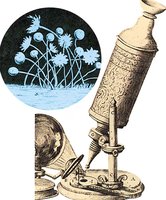
Robert Hooke (1635–1703): Published Micrographia (1665), the first book of microscopic observations, including detailed drawings of mold structures—one of the earliest recorded descriptions of microorganisms.
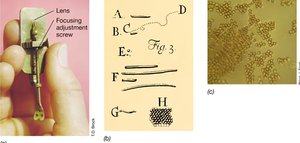
Antoni van Leeuwenhoek (1632–1723): First to observe bacteria using simple single-lens microscopes. In 1676, he described bacteria found in pepper–water infusions, reporting his findings to the Royal Society of London. His microscopes could magnify up to ~266×.
Types of Microscopy
Light Microscopy
Light microscopy (optical microscopy) uses visible light and glass lenses to magnify specimens. It is the most widely used method for observing living cells and tissues in biology. Light microscopes can be used to view stained or unstained samples, and several specialized types exist for different applications.
Principle of Light Microscopy
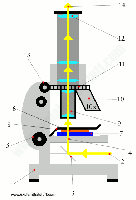
Light microscopes work by shining light on or through a specimen. The light interacts with the sample (by being absorbed, reflected, or scattered), and lenses focus and magnify the resulting image, which is viewed through an eyepiece or recorded with a camera.
Main Types of Light Microscopes
Brightfield/Compound Microscope: The most common type, uses a bright light source and is ideal for stained samples. Offers low contrast for transparent specimens.
Fluorescence Microscope: Uses UV light and fluorescent dyes to highlight specific cellular components.
Phase Contrast Microscope: Enhances contrast to visualize unstained, living cells and internal structures.
Stereo (Dissection) Microscope: Provides low magnification and a 3D view of larger specimens.
Brightfield (Compound) Microscopy
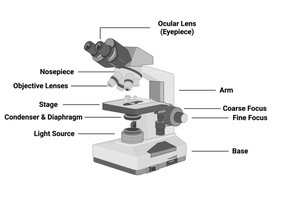
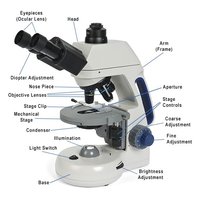
Brightfield microscopy uses visible light to illuminate a sample on a glass slide. The objective lens magnifies the sample, and the image is viewed through an eyepiece or camera. The sample appears darker against a bright background.
Main Parts: Light source, objective lenses, eyepiece/camera, stage, diaphragm, and focusing knobs.
Limitations of Brightfield Microscopy
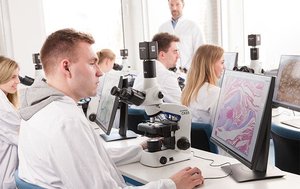
Works best when the sample is stained or naturally contrasts with the background.
Transparent or colorless samples are difficult to see without special preparation.
Fluorescence Microscopy
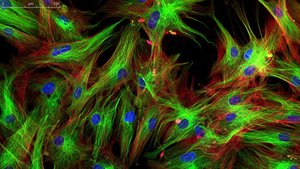
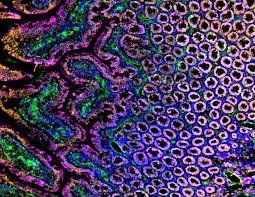
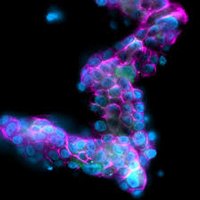
Fluorescence microscopy uses special fluorescent molecules (fluorophores) to label and visualize specific structures within cells. When excited by high-energy light, these molecules emit light at a different wavelength, producing a glowing image of the labeled structures.
How it works: The sample is illuminated with high-energy light (excitation), fluorophores absorb this energy and emit lower-energy light (emission). Filters ensure only the emitted light is seen, resulting in high-contrast images.
Light sources: Lamps, LEDs, or lasers.
Major Applications of Fluorescence Microscopy
Medical Diagnostics: Identifying pathogens, cancer biomarkers, and genetic abnormalities (e.g., FISH).
Cell Biology & Neuroscience: Tracking protein movement, monitoring neuronal activity, and mapping neural circuits.
Drug Discovery: High-content screening to observe drug effects on cells.
Phase Contrast Microscopy
Phase contrast microscopy enhances the contrast of transparent, unstained specimens, such as living cells. It converts subtle differences in the phase of light passing through the specimen into visible differences in brightness, making internal structures more apparent.
Developed by Frits Zernike in the 1930s, who won the 1953 Nobel Prize in Physics for this invention.
Stereo (Dissection) Microscopy
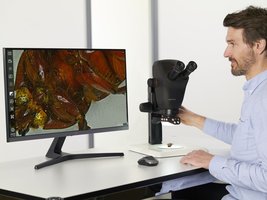
Stereo microscopes, or dissection microscopes, are used for viewing larger, three-dimensional specimens at low magnification. They provide a 3D view and a large working distance, making them ideal for examining insects, plants, or circuit boards.
3D view: Two separate optical paths provide depth perception.
Low magnification: Typically 5×–50×.
Large working space: Allows manipulation of specimens with tools.
Electron Microscopy
Principles of Electron Microscopy
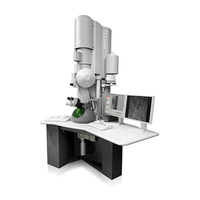
Electron microscopy (EM) uses a beam of electrons instead of light to achieve much higher magnification and resolution. Electrons have much shorter wavelengths than visible light, allowing EM to reveal fine structural details of cells and materials. EM requires a vacuum and uses electromagnetic lenses to focus the electron beam.
How it works: An electron gun generates electrons, which are focused into a beam by electromagnetic lenses. The beam interacts with the specimen, and detectors capture signals to form an image. All processes occur in a vacuum to prevent electron scattering.
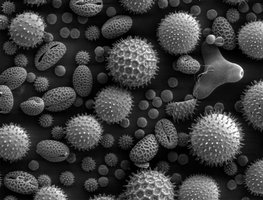
Summary Table: Comparison of Microscopy Types
Microscopy Type | Light Source | Magnification Range | Best For | Key Limitation |
|---|---|---|---|---|
Brightfield | Visible light | 40×–1000× | Stained cells, tissues | Poor contrast for transparent samples |
Fluorescence | UV/laser | Up to 2000× | Labeled cell structures, diagnostics | Requires fluorescent labeling |
Phase Contrast | Visible light | Up to 1000× | Unstained, living cells | Artifacts in thick samples |
Stereo | Visible light | 5×–50× | Large, 3D specimens | Not suitable for single cells |
Electron | Electron beam | Up to 2,000,000× | Ultrastructure, viruses | Requires vacuum, non-living samples |
