 Back
BackMicroscopy in Microbiology: Tools, Types, and Applications
Study Guide - Smart Notes
 Tailored notes based on your materials, expanded with key definitions, examples, and context.
Microscopy: The Foundation of Microbiology
Introduction to Microscopy
Microscopy is the cornerstone of microbiology, enabling scientists to observe microorganisms that are invisible to the naked eye. The invention and continual improvement of microscopes have driven major advances in the field, allowing for the discovery, classification, and study of microbes.
Microscope: An instrument that magnifies small objects, making them visible and analyzable.
Microbiology: The study of microscopic organisms, including bacteria, fungi, viruses, and protozoa.
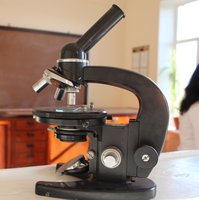
Discovery of Microorganisms
Historical Milestones
The existence of microorganisms was suspected for centuries, but direct observation was only possible after the invention of the microscope. Early pioneers made significant contributions to the field:
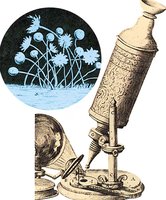
Robert Hooke (1635–1703): Published Micrographia (1665), the first book of microscope observations, including drawings of mold structures.
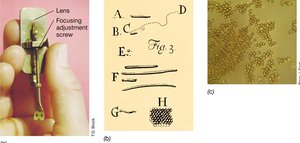
Antoni van Leeuwenhoek (1632–1723): First to observe bacteria using simple single-lens microscopes, reporting his findings in 1676.
Light Microscopy
Principles and Types
Light microscopy uses visible light and optical lenses to magnify specimens. It is widely used for observing living cells and tissues in real time. The main types of light microscopes include:
Brightfield/Compound Microscope: Most common, uses a bright light source; ideal for stained samples but offers low contrast for transparent specimens.
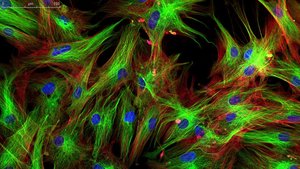
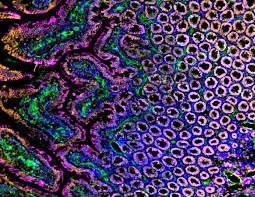
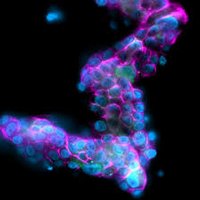
Fluorescence Microscope: Uses UV light and fluorescent dyes to highlight specific cellular components.
Phase Contrast Microscope: Enhances contrast to visualize unstained, living cells and internal structures.
Stereo (Dissection) Microscope: Provides lower magnification and a 3D view of larger specimens.
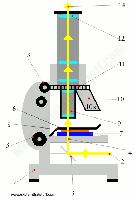
How Light Microscopes Work
Light microscopes function by shining light on or through a specimen. Lenses focus and enlarge the light after it interacts with the sample, producing a magnified image that can be viewed or recorded.
Brightfield Microscopy
Structure and Function
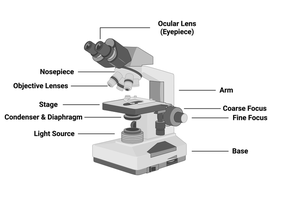
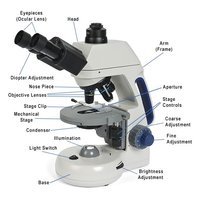
Brightfield microscopy, also known as compound light microscopy, uses visible light to illuminate a sample on a glass slide. The sample appears darker against a bright background. Key components include:
Light Source: Provides illumination.
Objective Lenses: Magnify the specimen.
Eyepiece/Camera: Allows viewing or recording the image.
Stage: Holds the slide.
Diaphragm: Controls light intensity.
Focusing Knobs: Sharpen the image.
Limitations of Brightfield Microscopy
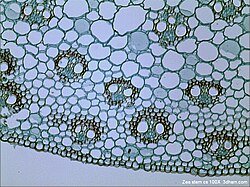
Brightfield microscopy is most effective when the sample contrasts with the background. Transparent or similarly colored samples are difficult to visualize without proper staining.
Fluorescence Microscopy
Principles and Applications
Fluorescence microscopy uses fluorophores—molecules that emit light when excited by high-energy light—to illuminate specific structures within cells. Filters ensure only the emitted light is seen, resulting in high-contrast images.
Excitation: High-energy light stimulates fluorophores.
Emission: Fluorophores release lower-energy light, creating a glow.
Filters: Block excitation light, allowing only emitted light to reach the detector.
Major Applications
Medical Diagnostics: Identifying pathogens, cancer biomarkers, and genetic abnormalities (e.g., FISH).
Cell Biology & Neuroscience: Tracking protein movement, monitoring neuronal activity, mapping neural circuits.
Drug Discovery: High-content screening for drug effects on cell morphology and molecular interactions.
Phase Contrast Microscopy
Principles and Advantages
Phase contrast microscopy enhances the visibility of unstained, living cells by converting phase shifts in light passing through the specimen into differences in brightness. This technique allows for detailed observation without the need for toxic stains.
Phase Shifts: Changes in light speed as it passes through different parts of the sample.
Contrast Enhancement: Phase shifts are transformed into visible contrast.
Stereomicroscope (Dissection Microscope)
Features and Uses
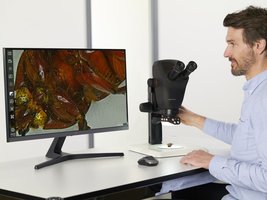
Stereomicroscopes provide a three-dimensional view of larger specimens at low magnification. They are ideal for examining insects, plants, fossils, and circuit boards.
3D View: Two light paths for depth perception.
Low Magnification: Typically 5×–50×.
Large Working Space: Allows manipulation of specimens.
Upright Image: Natural orientation for specimen handling.
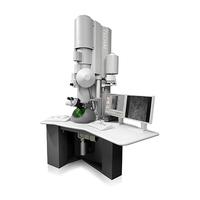
Electron Microscopy
Principles and Applications
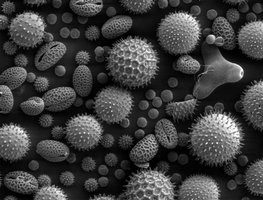
Electron microscopy (EM) uses a beam of electrons instead of light to achieve extremely high magnification and resolution. Electrons have much shorter wavelengths than visible light, allowing for detailed imaging of cellular structures and surfaces.
Electron Gun: Generates electrons.
Electromagnetic Lenses: Focus the electron beam.
Vacuum Environment: Prevents electron scattering.
Image Formation: Signals from electron interactions are detected and used to form images.
Key Equation: Resolution Limit
The resolution of a microscope is determined by the wavelength of the illuminating radiation:
d: Minimum resolvable distance
\lambda: Wavelength of light or electrons
NA: Numerical aperture of the lens
Additional info: Electron microscopes can resolve structures as small as 0.1 nm, far surpassing the capabilities of light microscopes (typically 200 nm).
