 Back
BackMMBS111 Unit 2 Study Guide: Biochemistry, Genetics, and Viruses in Microbiology
Study Guide - Smart Notes
 Tailored notes based on your materials, expanded with key definitions, examples, and context.
Chapter 2: Biochemistry Basics
Major Groups of Biomolecules: Structure and Function
Biomolecules are essential for cellular structure and function. The four main groups are carbohydrates, lipids, nucleic acids, and proteins. Each group has unique building blocks, bonds, and biological roles.
Biomolecule | Building Blocks | Bond Type | Major Example | Function |
|---|---|---|---|---|
Carbohydrates | Simple sugars (monosaccharides) | Glycosidic bonds | Starch, glycogen, cellulose | Energy storage, structural support |
Lipids | Fatty acids, glycerol | Ester bonds | Triglycerides, phospholipids, steroids | Energy storage, membrane structure, signaling |
Nucleic Acids | Nucleotides | Phosphodiester bonds | DNA, RNA | Genetic information storage and transfer |
Proteins | Amino acids | Peptide bonds | Enzymes, antibodies, structural proteins | Catalysis, structure, transport, regulation |
Primary structure: Linear sequence of amino acids in a polypeptide chain.
Secondary structure: Local folding into alpha-helices or beta-sheets via hydrogen bonding.
Tertiary structure: Overall 3D folding of a single polypeptide chain.
Quaternary structure: Association of multiple folded polypeptide chains.
Example: Hemoglobin is a protein with quaternary structure, composed of four polypeptide subunits.
Chapter 5: Genetics
Genotype and Phenotype
Genotype refers to the genetic makeup of an organism, while phenotype is the observable physical and functional traits resulting from gene expression.
Genotype: DNA sequence of an organism.
Phenotype: Observable characteristics, such as morphology or metabolism.
Example: The presence of a gene for antibiotic resistance (genotype) results in the ability to survive antibiotic treatment (phenotype).
Prokaryotic vs. Eukaryotic Genomes
Genomes differ between prokaryotes and eukaryotes in complexity, structure, and organization.
Feature | Prokaryotes | Eukaryotes |
|---|---|---|
Complexity | Simpler | More complex |
Genome location | Nucleoid region | Nucleus |
Chromosome structure | Circular DNA, plasmids | Linear chromosomes |
Histone proteins | Absent | Present |
Chapter 5: Structure of DNA and RNA Nucleotides
Components of a Nucleotide
Nucleotides are the building blocks of nucleic acids, consisting of a phosphate group, a five-carbon sugar, and a nitrogenous base.
DNA: Deoxyribose sugar, bases A, T, C, G
RNA: Ribose sugar, bases A, U, C, G
Feature | DNA | RNA |
|---|---|---|
Sugar | Deoxyribose | Ribose |
Bases | Adenine, Thymine, Cytosine, Guanine | Adenine, Uracil, Cytosine, Guanine |
Strands | Double-stranded | Single-stranded |
Directionality | 5' to 3' | 5' to 3' |
Complementary and Antiparallel Strands
DNA strands are complementary (A pairs with T, C pairs with G) and run antiparallel (one strand 5' to 3', the other 3' to 5').
Chapter 5: DNA Replication in Prokaryotes
Steps of DNA Replication
DNA replication is a semi-conservative process involving several enzymes:
Unwinding of the DNA double helix
Stabilization of single strands
Synthesis of RNA primers
Elongation by DNA polymerase
Replacement of RNA primers with DNA
Joining of Okazaki fragments
Enzyme | Function |
|---|---|
Helicase | Unwinds DNA at the origin of replication |
Primase | Synthesizes RNA primers |
DNA polymerase | Adds nucleotides to the growing DNA strand |
Ligase | Joins Okazaki fragments on the lagging strand |
Chapter 5: RNA Types and Transcription
Types of RNA
Type | Function |
|---|---|
mRNA (messenger RNA) | Carries genetic code from DNA to ribosome |
tRNA (transfer RNA) | Brings correct amino acid to ribosome during translation |
rRNA (ribosomal RNA) | Forms part of the ribosome structure and catalyzes peptide bond formation |
Transcription and Translation
Transcription is the synthesis of RNA from a DNA template. Translation is the process by which ribosomes use mRNA to synthesize proteins.
Initiation: RNA polymerase binds to promoter region.
Elongation: RNA strand is synthesized.
Termination: RNA polymerase detaches at terminator sequence.
Chapter 5: Horizontal Gene Transfer in Prokaryotes
Mechanisms of Horizontal Gene Transfer
Process | Description |
|---|---|
Conjugation | Transfer of DNA via direct cell-to-cell contact |
Transformation | Uptake of free DNA from the environment |
Transduction | Transfer of DNA by bacteriophages (viruses) |
Transposons | Mobile genetic elements that can move within the genome |
Chapter 6: Viruses and Prions
Viruses as Nonliving Microbes
Viruses lack cellular structure and metabolism, and cannot reproduce independently. They require a host cell for replication, so they are not considered alive.
Characteristic | Viruses | Prokaryotes | Eukaryotes |
|---|---|---|---|
Cells | No | Yes | Yes |
Genome | DNA or RNA | DNA | DNA |
Reproduction | Requires host cell | Binary fission | Mitosis/meiosis |
Metabolism | No | Yes | Yes |
Structure of Viruses
Viruses consist of a nucleic acid genome (DNA or RNA), a protein capsid, and sometimes a lipid envelope derived from the host cell membrane.
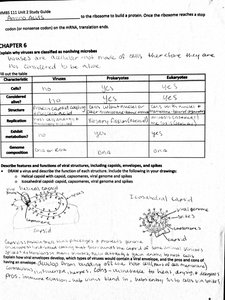
Viral Genetic Material and Replication
Viruses can have DNA or RNA genomes, which may be single- or double-stranded. Replication involves attachment, penetration, biosynthesis, assembly, and release.
Genetic Reassortment and Recombination in Viruses
Genetic reassortment occurs when viruses with segmented genomes exchange segments during co-infection, leading to new viral strains. Recombination involves exchange of genetic material between different viral genomes.
Chapter 6: Host Range and Pathogenesis
Host Range
Host range refers to the spectrum of host species or cell types a virus or pathogen can infect. Determined by specific interactions between viral surface proteins and host cell receptors.
Transmission and Life Cycles
Viruses can be transmitted via direct contact, vectors, or environmental routes. Bacteriophages may undergo lytic or lysogenic cycles.
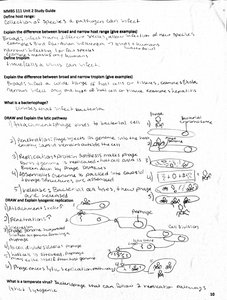
Generalized Replication in Animal Viruses
Attachment to host cell
Penetration and uncoating
Biosynthesis of viral components
Assembly of new virions
Release from host cell
Acute, Latent, and Chronic Infections
Acute infection: Rapid onset, short duration (e.g., influenza)
Latent infection: Virus remains dormant, can reactivate (e.g., herpesvirus)
Chronic infection: Persistent infection with ongoing viral production (e.g., hepatitis B)
Additional info: These notes cover foundational concepts in biochemistry, genetics, and virology relevant to introductory microbiology courses, including molecular structure, gene expression, and viral replication.
