 Back
Molecular Aspects of Microbial Growth: Cell Cycle, Division, and Biofilm Formation
Study Guide - Smart Notes
 Tailored notes based on your materials, expanded with key definitions, examples, and context.
Molecular Aspects of Microbial Growth
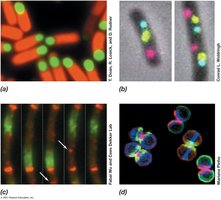
Reporter Genes and Visualization of Growth
Reporter genes are essential tools in microbiology for visualizing and studying molecular aspects of microbial growth. They encode proteins that produce detectable signals, such as fluorescence, allowing researchers to monitor gene expression and cellular processes in real time.
GFP (Green Fluorescent Protein) and RFP (Red Fluorescent Protein) fusions are commonly used to track specific sigma factors (e.g., σF and σE) and chromosomal regions (e.g., OriC).
Applications: Visualizing cell cycle events, protein localization, and gene regulation.
Bacterial Cell Cycle
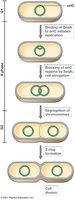
The bacterial cell cycle is tightly regulated to ensure accurate chromosome replication and segregation. Proper regulation prevents errors such as incomplete replication or improper distribution of genetic material to daughter cells.
Key Requirements: Chromosome must be fully replicated, replicated only once per cycle, and properly segregated.
Stages: Initiation, replication, segregation, and cell division.
Regulation of Replication Initiation
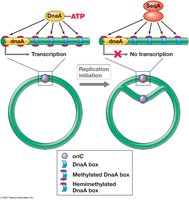
Replication initiation is controlled by specific proteins and DNA sequences to ensure that DNA replication occurs only once per cell cycle. The DnaA protein binds to the origin of replication (oriC) and initiates DNA synthesis.
Regulatory Mechanisms: DnaA activity is modulated by ATP binding and methylation status of DNA.
SeqA: Binds hemimethylated DNA to prevent premature re-initiation.
Replication Time vs. Generation Time
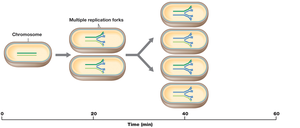
In rapidly growing bacteria such as E. coli, the time required for DNA replication can exceed the generation time. This is achieved by initiating new rounds of replication before the previous round is complete, resulting in multiple replication forks.
Generation Time: The interval between cell divisions (e.g., 20 minutes in E. coli).
Multiple Replication Forks: Allow cells to divide faster than the time needed to replicate the entire chromosome.
Chromosome Partitioning and Decatenation
The Par system and structural maintenance of chromosome (SMC) complexes ensure equal distribution of chromosomes to daughter cells. Decatenation refers to the separation of sister chromosomes after replication.
Par System: Actively partitions chromosomes during cell division.
SMC Complex: Maintains chromosome structure and facilitates segregation.
Decatenation: Enzymatic separation of intertwined chromosomes.
Cell Division and Fts Proteins
Cell division in bacteria is orchestrated by a set of proteins known as Fts (Filamentous temperature-sensitive) proteins. The FtsZ protein forms a ring at the future site of division, recruiting other division proteins and initiating septum formation.
FtsZ: Tubulin-like protein that forms the division ring.
Other Fts Proteins: Coordinate cell wall synthesis and membrane invagination.
Cell Morphology: MreB and Crescentin
Cell shape in bacteria is determined by cytoskeletal proteins such as MreB (actin-like) and Crescentin (intermediate filament-like). These proteins guide cell wall synthesis and maintain rod or curved shapes.
MreB: Maintains rod shape by directing peptidoglycan synthesis.
Crescentin: Imparts curvature to cells.
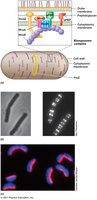
Peptidoglycan Biosynthesis
Peptidoglycan is a critical component of the bacterial cell wall, providing structural integrity. Its synthesis involves severing preexisting peptidoglycan and inserting new material, a process regulated by various enzymes.
Rod-shaped Cells: Cell wall grows at multiple points along the cell.
Cocci: Cell wall grows outward from the FtsZ ring.
Bactoprenol: Lipid carrier that transports peptidoglycan precursors across the membrane.
Transpeptidation: Crosslinking of peptidoglycan strands for strength.
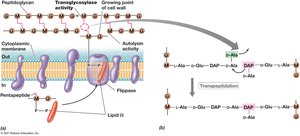
Morphology and Peptidoglycan Synthesis
Penicillin-binding proteins (PBPs) are enzymes involved in peptidoglycan synthesis. Class A PBPs are bifunctional, possessing both transpeptidase and transglycosylase activities, while class B PBPs specialize in peptide cross-link formation. Alternative SEDS proteins (e.g., RodA, MreB) also contribute to cell wall formation.
Class A PBPs: Bifunctional, catalyze glycan strand formation and peptide cross-linking.
Class B PBPs: Specialize in peptide cross-linking.
SEDS Proteins: Alternative enzymes for cell wall synthesis.
Regulation of Endospore Formation and Germination
Endospore formation is a survival strategy in certain bacteria, regulated by environmental signals and gene expression. Germination is triggered by specific molecules (germinants) binding to receptors, leading to activation of cortex lytic enzymes and metabolic activity.
Activation: Germinants bind to germinosome receptors.
Germination: Cortex lytic enzymes degrade spore cortex, allowing hydration and metabolic reactivation.
Outgrowth: Increased expression of peptidoglycan and teichoic acid biosynthetic enzymes, FtsZ.
Biofilm Formation and Regulation
Biofilms are structured microbial communities attached to surfaces, formed in stages and regulated by signaling molecules. Cyclic di-GMP (c-di-GMP) is a key regulator in biofilm formation, promoting extracellular polysaccharide production and reducing motility.
Stages: Attachment, microcolony formation, maturation, and dispersal.
c-di-GMP: Signaling molecule that initiates biofilm formation.
Quorum Sensing: Cell-to-cell communication (e.g., AHLs in Pseudomonas aeruginosa).
Pathogenicity: Biofilms increase resistance to antibiotics and host defenses.
Biofilms in Archaea
Archaeal biofilm formation shares similarities with bacterial processes but involves distinct signaling molecules. In Sulfolobus acidocaldarius, phosphorylation of AbfR1 activates biofilm formation, increasing adhesion and pili gene expression while decreasing motility.
Signaling: Archaea produce c-di-AMP instead of c-di-GMP.
Environmental Response: Biofilm formation is triggered by pH or temperature changes.
Summary Table: Key Proteins and Functions in Microbial Growth
Protein/Complex | Function | Role in Cell Cycle |
|---|---|---|
DnaA | Initiates DNA replication | Replication initiation |
SeqA | Inhibits re-initiation | Replication regulation |
FtsZ | Forms division ring | Cell division |
MreB | Maintains rod shape | Cell morphology |
Crescentin | Imparts curvature | Cell morphology |
Par System | Chromosome partitioning | Segregation |
SMC Complex | Chromosome maintenance | Segregation |
Bactoprenol | Transports precursors | Cell wall synthesis |
PBPs | Peptidoglycan synthesis | Cell wall formation |
c-di-GMP | Biofilm regulation | Biofilm formation |
AbfR1 | Biofilm regulation (archaea) | Biofilm formation |
Additional info: Expanded explanations and context were added to clarify molecular mechanisms and regulatory pathways, as well as to make the notes self-contained for exam preparation.
