 Back
BackMolecular Information Flow and Protein Processing in Microorganisms
Study Guide - Smart Notes
 Tailored notes based on your materials, expanded with key definitions, examples, and context.
Molecular Information Flow: From DNA to Protein
Key Processes Involving Genetic Information
The central dogma of molecular biology describes the flow of genetic information within a biological system. It involves three main processes: DNA replication, transcription, and translation.
Replication: The process of making a copy of DNA.
Transcription: The synthesis of RNA from a DNA template.
Translation: The synthesis of proteins from mRNA.
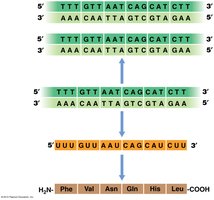
Transcription: RNA Synthesis
Types of RNA
Transcription produces several types of RNA, each with a specific function in the cell:
Messenger RNA (mRNA): Encodes the information for protein synthesis; translated into protein.
Transfer RNA (tRNA): Carries amino acids to the ribosome for incorporation into proteins.
Ribosomal RNA (rRNA): Forms the core of the ribosome's structure and catalyzes protein synthesis.
All three types are transcribed from DNA templates.
Key Elements of Transcription
Transcription involves several key DNA elements and proteins:
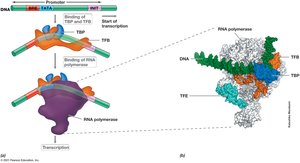
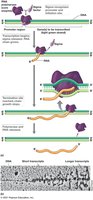
Promoter: A DNA sequence upstream of the transcription start site where RNA polymerase binds to initiate transcription.
Transcription Start Site: The location where RNA polymerase begins synthesizing RNA.
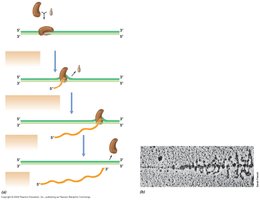
RNA Polymerase: The enzyme that adds ribonucleotides complementary to the DNA template, synthesizing a single-stranded RNA molecule.
Terminator: A DNA sequence signaling the end of transcription.
Transcription in Eukaryotes
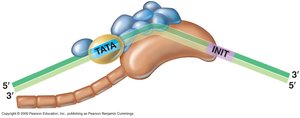
Eukaryotes have three distinct RNA polymerases, each responsible for transcribing different types of genes:
RNA Polymerase I: Synthesizes rRNA.
RNA Polymerase II: Synthesizes mRNA.
RNA Polymerase III: Synthesizes tRNA.
Transcription factors are required to help RNA polymerase bind to the promoter, as eukaryotes do not use sigma factors.
Transcription in Bacteria
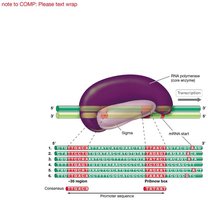
In bacteria, a sigma factor binds to the promoter, enabling RNA polymerase to recognize the correct initiation site for transcription.
Transcription in Progress
During transcription, RNA polymerase synthesizes RNA by adding ribonucleotides complementary to the DNA template. Short and long transcripts can be observed as the process continues.
Gene Structure: Introns and Exons
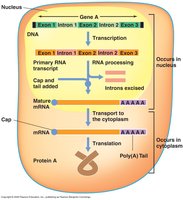
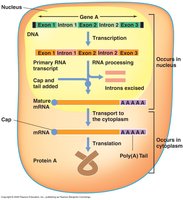
In eukaryotes, genes are often interrupted by noncoding sequences called introns, which are removed during RNA processing, leaving only the coding sequences (exons) in the mature mRNA.
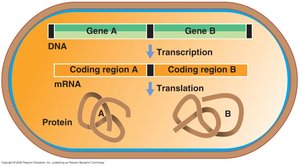
Prokaryotic genes typically lack introns, resulting in continuous coding sequences.
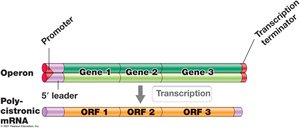
Polycistronic mRNA and Operons
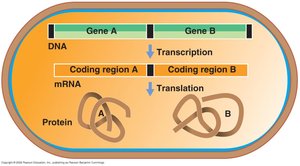
In prokaryotes, multiple genes can be transcribed together as a single polycistronic mRNA, often organized in operons. This allows coordinated expression of genes encoding proteins with related functions.
Termination of Transcription
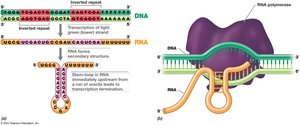
Transcription termination in bacteria can occur via two main mechanisms:
Rho-dependent termination: The Rho protein binds to the RNA and moves toward the RNA polymerase-DNA complex, causing dissociation at the termination site.
Intrinsic (Rho-independent) termination: Relies on inverted repeats in the DNA that form a stem-loop structure in the RNA, causing RNA polymerase to dissociate.
Translation: Protein Synthesis
Overview of Translation
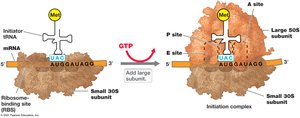
Translation is the process by which the genetic code carried by mRNA is decoded to produce a specific sequence of amino acids, resulting in a functional protein. The main components involved are mRNA, tRNAs, and ribosomes.
The Open Reading Frame (ORF) and the Genetic Code
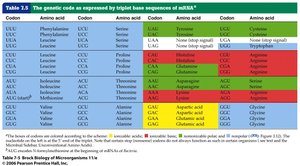
An open reading frame (ORF) is the sequence of codons in mRNA from a start codon (AUG) to a stop codon (UAA, UAG, UGA). The genetic code is expressed in terms of mRNA codons, with most amino acids encoded by more than one codon (degeneracy).
Aminoacyl tRNA and the Ribosome
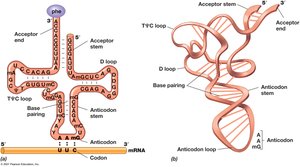
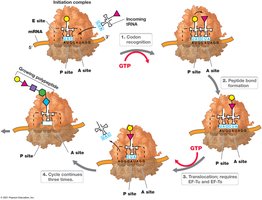
tRNAs have an anticodon sequence that base pairs with the mRNA codon and are charged with the corresponding amino acid. The ribosome brings together mRNA and aminoacyl tRNAs, facilitating the synthesis of the polypeptide chain.
Initiation, Elongation, and Termination of Translation
Translation proceeds through three main stages:
Initiation: The ribosome assembles at the start codon with the initiator tRNA.
Elongation: Amino acids are added one by one as the ribosome moves along the mRNA.
Termination: The process ends when a stop codon is reached, releasing the completed polypeptide.
Polysomes
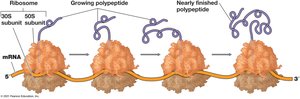
Multiple ribosomes can simultaneously translate a single mRNA molecule, forming a structure known as a polysome. This increases the efficiency of protein synthesis.
Gene Expression in Prokaryotes vs. Eukaryotes
In prokaryotes, one or more genes can be transcribed into a single mRNA, and each gene encodes a separate protein. In eukaryotes, each gene is typically transcribed into a single mRNA, which encodes one protein.
Protein Folding and Chaperones
Assisted Protein Folding
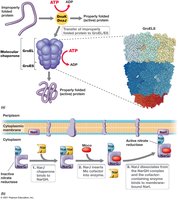
Chaperone proteins assist in the proper folding of newly synthesized proteins, refolding of partially denatured proteins, and assembly of protein complexes. Heat shock and cold shock proteins are specialized chaperones that respond to temperature stress.
Protein Secretion Systems
Overview of Protein Secretion
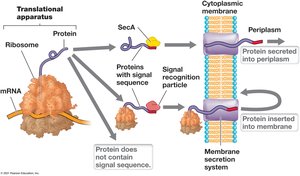
Some proteins must be transported outside the cytoplasmic membrane or inserted into cellular membranes. This process often requires energy (ATP, GTP, or proton motive force) and specialized translocase systems.
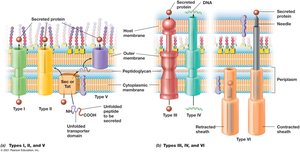
Sec translocase: Exports unfolded proteins and inserts integral membrane proteins.
Tat translocase: Transports folded proteins with specific signal sequences.
Type I-VI secretion systems: Found in Gram-negative bacteria, these systems transport proteins or effectors across membranes.
Signal Sequences
Proteins destined for export contain an N-terminal signal sequence, typically 15–20 residues long, which directs them to the appropriate translocase and prevents premature folding.
Applications and Importance
Protein secretion is essential for processes such as toxin release, enzyme export, biofilm formation, and symbiosis.
Understanding these systems is crucial for biotechnology and the development of antimicrobial strategies.
