 Back
BackMolecular Information Flow, Genetic Elements, and Viral Diversity in Microbiology
Study Guide - Smart Notes
 Tailored notes based on your materials, expanded with key definitions, examples, and context.
Molecular Information Flow and Protein Processing
/ DNA and Genetic Information Flow
The flow of genetic information in microorganisms is governed by the central dogma, which describes the transfer of information from DNA to RNA to protein. The functional unit of genetic information is the gene, which is part of larger genetic elements such as chromosomes and plasmids. The genome encompasses all genetic elements within a cell.
DNA: Serves as the genetic blueprint.
RNA: Product of transcription; messenger RNA (mRNA) is translated into protein.
Informational macromolecules: Nucleic acids (DNA, RNA) and proteins.

Size, Shape, and Supercoiling of DNA
DNA size is measured in base pairs: 1 kilobase pair (kbp) = 1000 base pairs; 1 megabase pair (Mbp) = 1,000,000 base pairs.
Example: E. coli genome is 4.64 Mbp.
Supercoiling compacts DNA, allowing it to fit within the cell.
Enzymes called topoisomerases insert and remove supercoils; DNA gyrase introduces negative supercoils.
Negative supercoiling is common in most cells; positive supercoiling helps prevent DNA melting at high temperatures (e.g., in some Archaea).
Genes and Steps in Biological Information Flow
Gene expression involves three main stages: replication, transcription, and translation.
Replication: DNA is duplicated by DNA polymerase.
Transcription: Information from DNA is transferred to RNA by RNA polymerase.
Translation: Information in mRNA is used to build polypeptides on the ribosome.
Three main RNA classes involved in protein synthesis:
mRNA: Carries information to the ribosome.
tRNA: Converts mRNA information to amino acid sequence.
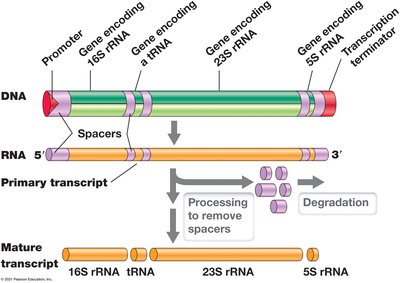
rRNA: Catalytic and structural ribosome components.
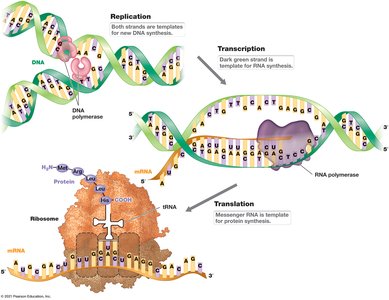
Prokaryotes vs. Eukaryotes
In eukaryotes, each gene is transcribed individually into a single mRNA; replication and transcription occur in the nucleus, and RNAs must be exported for translation.
In prokaryotes, multiple genes may be transcribed in one mRNA; transcription and translation are coupled, producing proteins at maximal rate.

Genetic Elements: Chromosomes and Plasmids
Types of Genetic Elements
Genetic elements include chromosomes, plasmids, virus genomes, organellar genomes, and transposable elements.
Organism | Element | Type of Nucleic Acid | Description |
|---|---|---|---|
Virus | Virus genome | Single- or double-stranded DNA or RNA | Relatively short, circular or linear |
Bacteria, Archaea | Chromosome | Double-stranded DNA | Extremely long, usually circular |
Eukarya | Chromosome | Double-stranded DNA | Extremely long, linear |
Mitochondrion or chloroplast | Organellar genome | Double-stranded DNA | Medium length, usually circular |
All organisms | Plasmid | Double-stranded DNA | Relatively short, circular or linear, extrachromosomal |
All organisms | Transposable element | Double-stranded DNA | Always found inserted into another DNA molecule |
Chromosomal Gene Arrangements
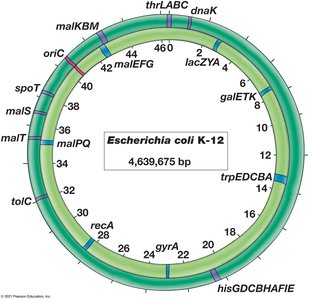
Most Bacteria and Archaea have a single circular chromosome carrying all or most genes. Eukaryotes have two or more linear chromosomes. In Escherichia coli K-12, about 5 Mbp in size, nearly 4300 protein-encoding genes make up 88% of the genome. Genes encoding enzymes of a single pathway may be clustered into operons, but many are not.
Plasmids
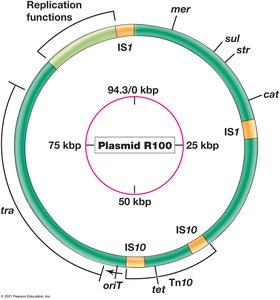
Plasmids are extrachromosomal genetic elements found in many Bacteria and Archaea. They are mostly nonessential, nearly all double-stranded DNA, and typically less than 5% the size of the chromosome. Plasmids may influence host cell physiology, such as survival under certain conditions.
R plasmids: Confer resistance to antibiotics or other growth inhibitors; several resistance genes can be encoded on one plasmid.
Virulence factors: Some plasmids encode factors for attachment or toxin production.
Bacteriocins: Proteins that inhibit or kill closely related species or strains.
Metabolic functions: Plasmids may encode functions for nitrogen fixation or hydrocarbon degradation.
Conjugation: Important for horizontal gene transfer.
/
Transposable Elements
Transposable elements are segments of DNA that can move from one site to another within or between DNA molecules. They are found in both prokaryotes and eukaryotes and play a role in genetic diversity and evolution.
Transcription in Bacteria
Units of Transcription and Polycistronic mRNA
Transcriptional units are DNA segments transcribed into one RNA molecule, bounded by initiation and termination sites. Operons are transcribed into a single mRNA called polycistronic mRNA, which contains multiple open reading frames encoding amino acids.


Microbial Regulatory Systems: Cell-to-Cell Signaling
Quorum Sensing
Prokaryotes communicate through production of small extracellular molecules, leading to coordinated group behaviors such as biofilm formation. Quorum sensing is a regulatory mechanism by which Bacteria and some Archaea assess their population density.
Ensures sufficient cell numbers before initiating activities requiring high density (e.g., toxin production).
Each species produces a specific autoinducer signaling molecule, which diffuses freely and accumulates inside cells.
Autoinducers bind to activator proteins or sensor kinases, triggering transcription of specific genes.
Classes of Autoinducers
Acyl homoserine lactone (AHL): Found in gram-negative bacteria.
Autoinducer 2 (AI-2): Common among many gram-negative species, allows interspecies communication.
Short peptides: Used as autoinducers by gram-positives and Archaea.
Quorum Sensing and Virulence Factors
Quorum sensing regulates virulence factors in pathogens such as Escherichia coli O157:H7 and Staphylococcus aureus. Disruptors of quorum sensing could be potential drugs for dispersing biofilms and preventing virulence gene expression.
Molecular Aspects of Microbial Growth: Cell Division and Biofilm Formation
Cell Division and Fts Proteins
Cell division in bacteria is orchestrated by the divisome, a complex of essential proteins called Fts proteins. FtsZ is crucial in binary fission and is related to tubulin in eukaryotes.
FtsZ forms a ring at the cell center, marking the division plane.
Other proteins such as ZipA and FtsA anchor and recruit FtsZ and other divisome proteins.
FtsK mediates chromosome separation; FtsZ depolymerizes to trigger septum formation.
FtsI is a penicillin-binding protein involved in peptidoglycan synthesis.
Biofilm Formation
Biofilm formation occurs in four stages: attachment, colonization, development, and dispersal. Attachment is facilitated by flagella, pili, or cell surface proteins and triggers expression of biofilm-specific genes.
Biofilm growth is regulated by cyclic di-guanosine monophosphate (c-di-GMP), which guides bacteria in transitioning from planktonic to biofilm growth. Elevated c-di-GMP initiates extracellular polysaccharide production and decreases flagellar function.
Antibiotic Targets and Resistance
Antibiotic Targets
Antibiotics are antimicrobials produced by microbes that kill or inhibit bacterial growth by targeting essential molecular processes.
Quinolones: Target DNA gyrase.
Rifampin: Binds RNA polymerase, blocking RNA synthesis.
Puromycin: Binds to the A site on the 70S ribosome, inducing chain termination.
Daptomycin: Binds to phosphatidylglycerol residues, causing pore formation and cell death.
β-lactams: Interfere with transpeptidation in cell wall synthesis.
Antibiotic Resistance Mechanisms
Modification of drug target (e.g., spontaneous mutations).
Enzymatic inactivation (e.g., β-lactamase).
Removal via efflux pumps (e.g., AcrAB-TolC in E. coli).
Metabolic bypasses (e.g., MRSA synthesizes MecA, an alternative penicillin-binding protein).
Genetics of Bacteria and Archaea
Mutations and Mutants
Mutation is a heritable change in the genome, which can lead to changes in organism properties. Mutations and genetic exchange fuel evolution.
Wild-type strain: Isolated from nature.
Mutant: Derived from wild type, carries a genotype change.
Selectable mutations confer an advantage (e.g., antibiotic resistance).
Nonselectable mutations require screening (e.g., color loss).
Phenotype | Nature of Change | Detection |
|---|---|---|
Auxotroph | Loss of enzyme in biosynthetic pathway | Inability to grow on medium lacking nutrient |
Drug-resistant | Detoxification or altered target/permeability | Growth on medium with drug |
Pigmentless | Loss of pigment biosynthesis | Lack of color |
Nonmotile | Loss of flagella | Lack of motility |
Molecular Basis of Mutation
Spontaneous mutations: Occur without external intervention.
Induced mutations: Caused by environmental factors or chemicals.
Point mutations: Change only one base pair; can be silent, missense, or nonsense.
Frameshift mutations: Insertions or deletions that shift the reading frame.
Gene Transfer in Bacteria
Horizontal gene transfer allows gene movement between cells not direct descendants, fueling metabolic diversity. Three mechanisms: transformation, transduction, conjugation.
Transformation: Uptake of free DNA by competent cells.
Transduction: Transfer of DNA by bacteriophages.
Conjugation: Cell-to-cell contact, plasmid-encoded.
Mobile DNA: Transposable Elements
Insertion sequences (ISs): Simplest transposable elements, encode transposase.
Transposons: Larger, contain additional genes (e.g., antibiotic resistance).
Transposition can be conservative (copy number constant) or replicative (copy number doubles).
Viruses and Their Multiplication
Nature and Structure of Viruses
A virus is a genetic element that can multiply only in a living host cell. Viruses are obligate intracellular parasites and are not considered living organisms. The virion is the extracellular form of a virus, facilitating transmission between host cells.
Capsid: Protein shell surrounding the genome.
Naked viruses: No other layers.
Enveloped viruses: Have a phospholipid bilayer and viral proteins.
Virion surface proteins are important for host cell attachment.


Viral Replication Cycle
Attachment (adsorption) of the virion.
Penetration (entry, injection) of the virion nucleic acid.
Synthesis of virus nucleic acid and protein by host cell.
Assembly of capsids and packaging of viral genomes.
Release of new virions from host cell.

Viral Genomics and Diversity
Viral genomes vary greatly in size and structure, from small circoviruses to large Pandoraviruses. The Baltimore classification scheme categorizes viruses based on their genome and relationship to mRNA.
Seven Baltimore classes: dsDNA, ssDNA, dsRNA, ss(+)RNA, ss(-)RNA, retroviruses, dsDNA with RNA intermediate.
Only certain classes infect specific domains of life.
Subviral Agents: Viroids and Prions
Viroids: Infectious RNA molecules lacking a protein component; cause plant diseases.
Prions: Infectious proteins with no nucleic acid; cause animal diseases such as scrapie and mad cow disease.
Example: Prion diseases result from protein conformational changes, leading to aggregation and destruction of nervous tissue.
*Additional info: Academic context and explanations have been expanded for clarity and completeness, including definitions, examples, and tables where appropriate.*
