 Back
BackObserving Microorganisms Through a Microscope: Units, Lenses, and Resolution
Study Guide - Smart Notes
 Tailored notes based on your materials, expanded with key definitions, examples, and context.
Observing Microorganisms Through a Microscope
Units of Measurement in Microscopy
Understanding the units of measurement is essential for accurately describing the size of microorganisms. The metric system is used universally in science, and microscopy relies on very small units to measure cells and their components.
Meter (m): The basic metric unit of length.
Kilometer (km): 1 km = 1000 m.
Decimeter (dm): 1 dm = 1/10 m = 0.1 m = m.
Centimeter (cm): 1 cm = 1/100 m = 0.01 m = m.
Millimeter (mm): 1 mm = 1/1000 m = 0.001 m = m.
Micrometer (μm): 1 μm = 1/1,000,000 m = 0.000001 m = m.
Nanometer (nm): 1 nm = 1/1,000,000,000 m = 0.000000001 m = m.
Example: Most bacteria are measured in micrometers, while viruses are often measured in nanometers.




Difference Between Micrometer and Nanometer
The micrometer (μm) is 1,000 times larger than the nanometer (nm). This distinction is important for differentiating between the sizes of cells and viruses.

Lenses in Microscopy
Lenses are fundamental components of microscopes, enabling the magnification and visualization of microorganisms. Their properties determine the quality and clarity of the image produced.
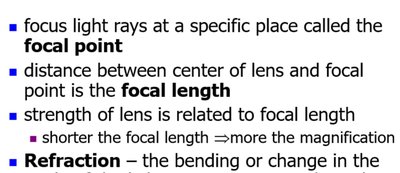
Focal Point: The specific place where light rays are focused by the lens.
Focal Length: The distance between the center of the lens and the focal point. The strength of the lens is related to its focal length; shorter focal length results in higher magnification.
Refraction: The bending or change in angle of light rays as they pass through a medium such as a lens.


Lenses and the Bending of Light
Light is refracted (bent) when it passes from one medium to another. The degree of bending is determined by the refractive index of each medium.
Refractive Index: A measure of how greatly a substance slows the velocity of light, or its light-bending ability.
The direction and magnitude of bending depend on the refractive indexes of the two media forming the interface.
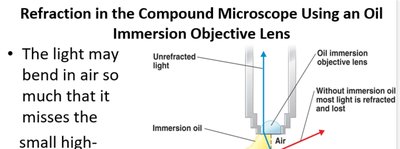
To achieve high magnification, the objective lens must be small, but this can result in loss of bending light. Immersion oil is used to match the refractive index of glass, preventing further bending and loss of light.





Example of Refraction
When light passes from air to water, it bends due to the difference in refractive index. This principle is illustrated by the apparent position of a fish observed from above water.


Refraction in the Compound Microscope Using an Oil Immersion Objective Lens
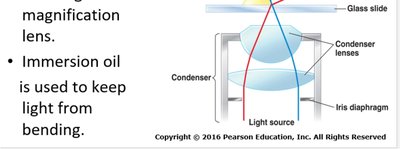
In microscopy, light may bend in air so much that it misses the small high-magnification lens. Immersion oil is used to keep light from bending, ensuring maximum resolution and clarity.

Microscope Resolution or Resolving Power
Resolution is the ability of a lens to separate or distinguish small objects that are close together, showing detail. It is a critical factor in microscopy, determining the shortest distance between two points that can still be distinguished as distinct objects.
Wavelength of Light: The major factor in resolution; shorter wavelengths provide greater resolution.
White light has a long wavelength and cannot resolve structures less than 0.18 μm apart.
Resolution of Leeuwenhoek’s microscope was 1 μm.
Resolving Power Formula:
Numerical Aperture: A function of the diameter of the objective lens in relation to its focal length. It indicates the ability of the lens to gather light and resolve a point at a fixed distance from the lens.





Example: Modern light microscopes can resolve objects as close as 0.2 μm apart, allowing visualization of most bacteria but not viruses.
