 Back
BackOrganic Macromolecules: Structure, Function, and Relevance in Microbiology
Study Guide - Smart Notes
 Tailored notes based on your materials, expanded with key definitions, examples, and context.
Organic Macromolecules in Microbiology
Introduction
Organic macromolecules are essential to all living organisms, including microbes. They include carbohydrates, lipids, proteins, and nucleic acids. Each class of macromolecule plays a critical role in cellular structure, metabolism, genetic information storage, and regulation. Understanding their structure and function is foundational for microbiology students.
Lipids
Structure and Types of Lipids
Lipids are organic molecules composed mainly of carbon (C), hydrogen (H), and oxygen (O), but unlike carbohydrates, they do not have a fixed ratio of these elements. Lipids are not polymers and are generally hydrophobic. The four main groups of lipids are:
Fats (Triglycerides): Formed by the combination of glycerol and three fatty acids via ester bonds. They serve as energy storage molecules.
Phospholipids: Contain a glycerol backbone, two fatty acids, and a phosphate group. They are key components of cellular membranes.
Waxes: Composed of long-chain fatty acids bonded to long-chain alcohols or carbon rings. They provide protection and waterproofing.
Steroids: Characterized by four fused carbon rings. Cholesterol is a common steroid in animal cells; other examples include ergosterol in fungi and phytosterols in plants.
Functions of Lipids:
Energy storage
Insulation and protection
Membrane structure
Chemical messengers (e.g., hormones and steroids)
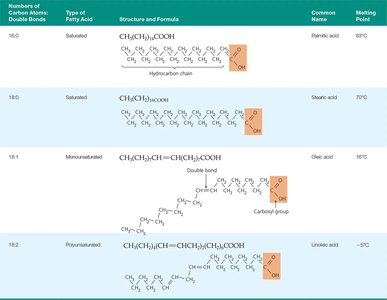
Fatty Acids: Saturated, Unsaturated, and Trans Fats
Fatty acids can be classified based on the presence and configuration of double bonds:
Saturated fatty acids: No double bonds; typically solid at room temperature (e.g., butter).
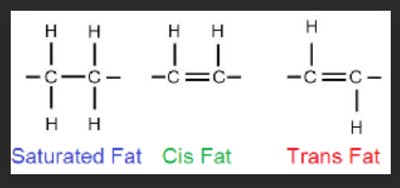
Unsaturated fatty acids: One or more double bonds; usually liquid at room temperature (e.g., olive oil). Can be further divided into cis and trans configurations.
Trans fats: Unsaturated fats with trans double bonds, often artificially produced and associated with health risks.
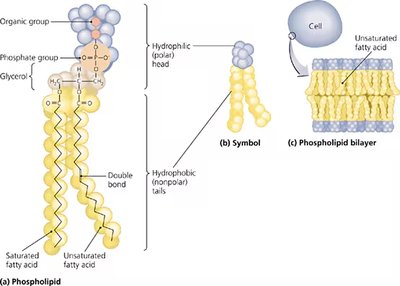
Phospholipids and Membrane Structure
Phospholipids are amphipathic molecules with hydrophilic (polar) heads and hydrophobic (nonpolar) tails. This property allows them to form bilayers, which are the fundamental structure of cellular membranes. In eukaryotes, cholesterol and related sterols modulate membrane fluidity.
Animal cells: Cholesterol
Bacteria: Sterols are rare
Fungi: Ergosterol
Plants: Phytosterols
Proteins
Amino Acids and Peptide Bonds
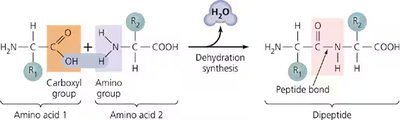
Proteins are polymers of amino acids, which are organic molecules containing an amino group, a carboxyl group, a hydrogen atom, and a variable side chain (R group) attached to a central carbon. Most organisms use 21 amino acids in protein synthesis. Amino acids are linked by covalent peptide bonds formed through dehydration synthesis.
Functions of proteins: Structure, enzymatic catalysis, regulation, transport, defense, and offense.
Levels of Protein Structure
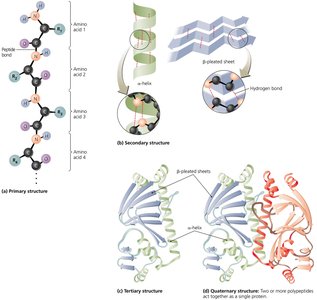
Proteins have four levels of structure:
Primary structure: Linear sequence of amino acids.
Secondary structure: Local folding into α-helices and β-pleated sheets stabilized by hydrogen bonds.
Tertiary structure: Overall three-dimensional shape of a single polypeptide chain.
Quaternary structure: Association of multiple polypeptide chains.
Chirality in Amino Acids
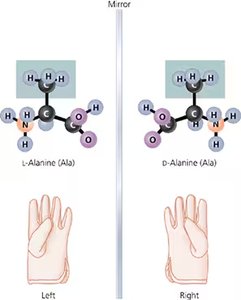
Amino acids (except glycine) exist as mirror-image isomers (L- and D- forms). Most biological proteins are composed of L-amino acids.
Nucleic Acids
Structure and Types
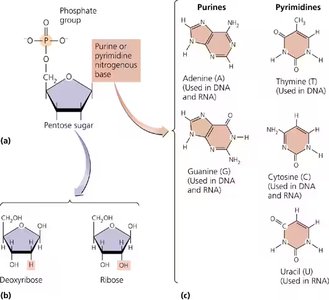
Nucleic acids, including DNA and RNA, are polymers of nucleotides. Each nucleotide consists of a phosphate group, a pentose sugar (deoxyribose in DNA, ribose in RNA), and a nitrogenous base (adenine, guanine, cytosine, thymine in DNA, uracil in RNA).
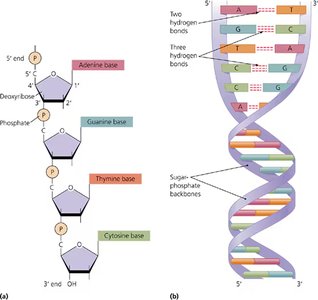
DNA: Double-stranded in most cells and viruses; strands are complementary and antiparallel.
RNA: Single-stranded; functions as genetic material in some viruses and as an enzyme and structural molecule in cells.
Base Pairing and Structure
Base pairing in DNA involves hydrogen bonds: three between cytosine (C) and guanine (G), and two between adenine (A) and thymine (T). In RNA, uracil (U) replaces thymine.
Purines: Adenine (A), Guanine (G)
Pyrimidines: Cytosine (C), Thymine (T), Uracil (U)
Functions of Nucleic Acids
DNA stores genetic information and directs the synthesis of RNA and proteins. RNA plays roles in protein synthesis, gene regulation, and as genetic material in some viruses.
Characteristic | DNA | RNA |
|---|---|---|
Sugar | Deoxyribose | Ribose |
Pyrimidine nucleotides | T and C | U and C |
Number of strands | Double stranded in cells and most DNA viruses; single stranded in some viruses | Single stranded in cells and most RNA viruses; double stranded in some viruses |
Function | Genetic material of all cells and DNA viruses | Protein synthesis in all cells; genetic material of RNA viruses |

Adenosine Triphosphate (ATP)
Structure and Function
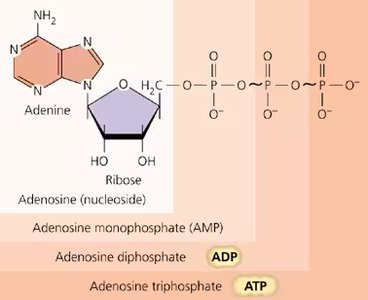
ATP is a nucleotide composed of adenine, ribose, and three phosphate groups. It is the primary energy carrier in cells. The hydrolysis of ATP to ADP and inorganic phosphate releases energy for cellular processes.
Summary Table: Functional Groups in Biological Molecules
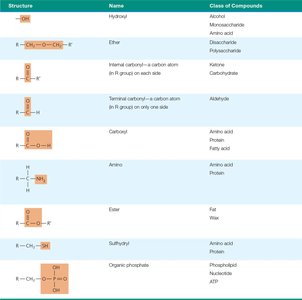
Functional groups are specific groups of atoms within molecules that are responsible for the characteristic chemical reactions of those molecules. The table below summarizes common functional groups found in biological macromolecules:
Structure | Name | Class of Compounds |
|---|---|---|
-OH | Hydroxyl | Alcohol, Monosaccharide |
-O- | Ether | Disaccharide, Polysaccharide |
-CHO | Aldehyde | Amino acid, Protein |
-COOH | Carboxyl | Amino acid, Protein, Fatty acid |
-NH2 | Amino | Amino acid, Protein |
-S- | Sulfhydryl | Amino acid, Protein |
-PO4 | Organic phosphate | Phospholipid, Nucleotide, ATP |
Additional info: This summary integrates foundational concepts from Chapter 2 (The Chemistry of Microbiology) and supports understanding for subsequent chapters on cell structure, metabolism, and genetics.
