 Back
BackParasitic Protozoa, Helminths, and Arthropod Vectors: Key Human Pathogens and Their Diseases
Study Guide - Smart Notes
 Tailored notes based on your materials, expanded with key definitions, examples, and context.
Parasitic Protozoa, Helminths, and Arthropod Vectors
Overview
This section covers major protozoan parasites, their life cycles, modes of transmission, clinical manifestations, diagnostic methods, and prevention strategies. The focus is on vector-borne protozoan diseases, including Chagas' disease, African sleeping sickness, leishmaniasis, and malaria, as well as a comparative table of key protozoan pathogens.
Trypanosoma cruzi and Chagas' Disease
Biology and Transmission
Trypanosoma cruzi is a flagellated protozoan responsible for Chagas' disease, endemic in Central and South America. The primary reservoirs are opossums and armadillos. Transmission occurs via the bite of insects in the genus Triatoma ("kissing bugs"), which feed preferentially from blood vessels in the lips. Infective trypomastigotes are deposited in feces near the bite wound, and scratching introduces them into the bloodstream.
Reservoirs: Opossums, armadillos
Vector: Triatoma (kissing bug)
Transmission: Contamination of bite wound with infected feces
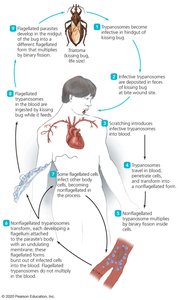
Clinical Manifestations
Chagas' disease progresses through four stages:
Acute stage: Characterized by chagomas (localized swelling at infection site)
Generalized stage: Systemic symptoms
Chronic asymptomatic stage: No symptoms, but parasite persists
Symptomatic stage: Congestive heart failure due to pseudocyst formation; leading cause of death in Latin America
Diagnosis and Treatment
Diagnosis: Identification of trypomastigotes or their antigens in clinical specimens; xenodiagnosis (allowing uninfected bugs to feed and checking for parasites in their hindgut)
Treatment: Early disease treated with benzonidazole or nifurtimox; late stages are untreatable
Prevention: Limiting contact with kissing bugs
Trypanosoma brucei and African Sleeping Sickness
Biology and Transmission
Trypanosoma brucei causes African sleeping sickness (African trypanosomiasis). The vector is the tsetse fly (Glossina), and various animals serve as reservoirs. There are two variants:
T. brucei gambiense: Western and central Africa
T. brucei rhodesiense: Eastern and southern Africa
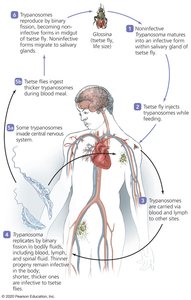
Clinical Manifestations
African sleeping sickness progresses through three stages if untreated:
Stage 1: Lesion at bite site with dead tissue
Stage 2: Parasites in blood cause fever, lymph node swelling, headaches
Stage 3: Meningoencephalitis (central nervous system involvement)
Death: Can occur within months
Cyclical waves of parasitemia: Due to antigenic variation (surface glycoprotein changes)

Diagnosis, Treatment, and Prevention
Diagnosis: Presence of trypanosomes in clinical specimens
Treatment: Early stages: pentamidine or suramin; CNS infection: melarsoprol
Prevention: Personal insecticides, netting, long clothing, release of sterile male flies, habitat clearing
Leishmania and Leishmaniasis
Biology and Transmission
Leishmania causes leishmaniasis, endemic in parts of the tropics and subtropics. Wild and domestic dogs and small rodents are common hosts. Leishmania has two developmental stages:
Amastigotes: Nonflagellated, multiply in host's macrophages and monocytes
Promastigotes: Flagellated, develop extracellularly within vector's gut
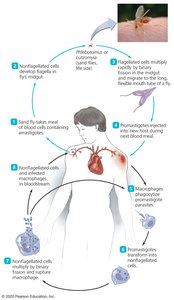
Clinical Manifestations
Three clinical forms of leishmaniasis:
Cutaneous: Large painless skin ulcers at bite wounds
Mucocutaneous: Skin lesions enlarge to encompass mucous membranes
Visceral: Macrophages carry parasite to liver, spleen, bone marrow, lymph nodes; fatal in 95% of untreated cases
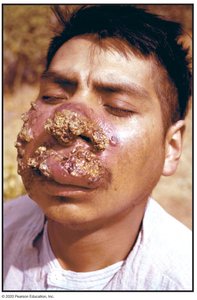
Diagnosis, Treatment, and Prevention
Diagnosis: Identification of trypanosomes in patient samples; immunoassays
Treatment: Cutaneous/mucocutaneous forms often heal without treatment; visceral form treated with paromomycin, sodium stibogluconate, or amphotericin B
Prevention: Reducing exposure to reservoir and vector
Plasmodium and Malaria
Biology and Transmission
Plasmodium is an apicomplexan protozoan and the causative agent of malaria. Anopheles mosquitoes are the vectors. Malaria is endemic throughout the tropics and subtropics. Four main species cause most infections:
P. falciparum
P. vivax
P. ovale
P. malariae
P. knowlesi: Emerging human pathogen

Virulence Factors and Pathogenesis
Immune evasion: Parasite hidden in red blood cells
Malaria secretome: Releases toxins and enzymes
Adhesins: Help avoid clearance in spleen
Merozoites: Avoid immune cells in liver
Dormant hypnozoites: Some species form these
Induce "bite me" signals: Attract mosquitoes
Key Features of Protozoan Parasites of Humans
Comparative Table
The following table summarizes key features of major protozoan parasites, including their primary diseases, geographical distribution, transmission modes, and host organisms.
Group | Organism | Primary Diseases | Geographical Distribution | Mode of Transmission | Host Organisms |
|---|---|---|---|---|---|
Ciliates | Balantidium coli | Balantidiasis, dysentery | Worldwide | Fecal-oral | Pigs, rodents, primates, humans |
Amoebas | Entamoeba histolytica | Luminal amebiasis, amebic dysentery, invasive extraintestinal amebiasis | Worldwide | Fecal-oral | Humans |
Amoebas | Acanthamoeba spp. | Ulcerative keratitis, amebic encephalitis | Worldwide | Contact | Humans |
Amoebas | Naegleria | Amebic meningoencephalitis | Worldwide | Inhalation | Humans |
Flagellates | Trypanosoma cruzi | Chagas’ disease | Central and South America | Kissing bug (Triatoma) | Opossums, armadillos, humans |
Flagellates | Trypanosoma brucei | African trypanosomiasis (sleeping sickness) | Africa | Tsetse fly (Glossina) | Wild game, cattle, sheep, humans |
Flagellates | Leishmania spp. | Cutaneous, mucocutaneous, visceral leishmaniasis | Tropics, subtropics | Sand flies (Phlebotomus, Lutzomyia) | Canines, rodents, humans |
Flagellates | Giardia intestinalis | Giardiasis | Worldwide | Fecal-oral | Humans, wild animals |
Flagellates | Trichomonas vaginalis | Vaginosis | Developed nations | Sexual contact | Humans |
Apicomplexans | Plasmodium spp. | Malaria | Tropics, subtropics | Mosquitoes (Anopheles) | Humans |
Apicomplexans | Toxoplasma gondii | Toxoplasmosis | Worldwide | Fecal-oral | Cats, livestock, humans |
Apicomplexans | Cryptosporidium parvum | Cryptosporidiosis | Worldwide | Fecal-oral | Livestock, poultry, humans |
Apicomplexans | Cyclospora cayetanensis | Cyclosporiasis, gastrointestinal disorders | North, Central, South America | Fecal-oral | Humans |
Protozoan Pathogen Mechanisms and Quiz Review
Immune Evasion in Trypanosoma brucei
Once infected with Trypanosoma brucei, the patient’s immune system cannot clear the infection or develop immunity because the parasite constantly changes its glycoprotein surface antigens during replication. This antigenic variation prevents effective immune response.
Transmission of Trypanosoma cruzi
Trypanosoma cruzi is introduced into the body by feces containing trypomastigotes contaminating a bite wound, not directly by the bite itself.
Apicomplexan Protozoans
The protozoans known as apicomplexans are intracellular pathogens and reproduce by schizogony, a form of asexual reproduction involving multiple nuclear divisions before cell division.
Summary
This guide provides a comprehensive overview of vector-borne protozoan diseases, their life cycles, clinical features, diagnostic methods, and prevention strategies. Understanding these pathogens is essential for recognizing their impact on human health and for developing effective control measures.
