 Back
BackParasitic Protozoa of Humans: Morphology, Life Cycles, and Clinical Significance
Study Guide - Smart Notes
 Tailored notes based on your materials, expanded with key definitions, examples, and context.
Parasitic Protozoa, Helminths, and Arthropod Vectors
Introduction to Parasitic Protozoa
Parasitic protozoa are unicellular eukaryotic organisms that can cause significant diseases in humans. They are transmitted through various routes and exhibit complex life cycles, often involving multiple morphological forms. Understanding their biology is essential for diagnosis, treatment, and prevention of protozoan diseases.
Major Routes of Parasitic Infection
Transmission Pathways
Humans acquire parasitic infections through several major routes, including ingestion, inhalation, vector-borne transmission, sexual contact, and direct penetration of the skin or eyes. Each route is associated with specific protozoan species and clinical syndromes.
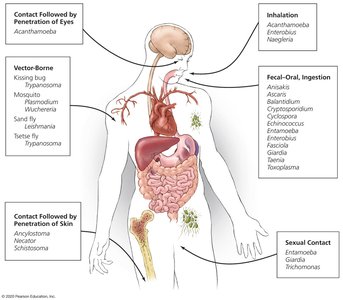
Fecal-Oral/Ingestion: Ingestion of contaminated food or water containing cysts or oocysts (e.g., Entamoeba histolytica, Giardia intestinalis, Cyclospora cayetanensis).
Sexual Contact: Transmission of trophozoites during sexual activity (e.g., Trichomonas vaginalis).
Inhalation: Entry of cysts or trophozoites via the respiratory tract (e.g., Acanthamoeba, Naegleria).
Vector-Borne: Transmission by arthropod vectors (e.g., Trypanosoma via kissing bug).
Direct Penetration: Parasites penetrate skin or eyes (e.g., Acanthamoeba through the eye).
General Morphology and Life Cycle of Protozoa
Trophozoite and Cyst Forms
Many protozoa alternate between two main morphological forms:
Trophozoite: The active, feeding, and reproducing stage within the host.
Cyst: The dormant, environmentally resistant, and infective stage. Cysts are ingested and undergo excystment in the host, releasing trophozoites. Before leaving the host, trophozoites encyst to survive outside the body.
Intestinal Protozoa
Key Species
Several protozoa infect the human intestinal tract, causing a range of diseases from mild to severe.
Entamoeba histolytica
Giardia intestinalis
Cyclospora cayetanensis
Balantidium coli
Cryptosporidium parvum
Cystoisospora belli
Entamoeba histolytica
Entamoeba histolytica is the causative agent of amebiasis, a disease with no animal reservoir. It is carried asymptomatically in many individuals, especially in less-developed countries. Infection typically occurs via ingestion of contaminated water. Excystment occurs in the small intestine, and trophozoites migrate to the large intestine.
Luminal amebiasis: Asymptomatic infection in healthy individuals.
Invasive amebic dysentery: Severe diarrhea, colitis, and ulceration of the intestinal mucosa.
Invasive extraintestinal amebiasis: Trophozoites spread via the bloodstream, potentially causing fatal disease.
Giardia intestinalis
Giardia intestinalis is a flagellated protozoan responsible for giardiasis, a common gastrointestinal disease in the United States. Infection occurs by ingesting cysts from contaminated food, water, or hands. Symptoms range from asymptomatic to severe gastrointestinal distress, including diarrhea, pain, bloating, nausea, vomiting, and fever.

Cryptosporidium parvum
Cryptosporidium parvum is an apicomplexan protozoan causing cryptosporidiosis, primarily transmitted via contaminated water. It can be carried asymptomatically but often causes severe diarrhea, headache, muscle pain, cramping, and weight loss. Chronic infection is a marker for AIDS in HIV-positive individuals. Diagnosis is challenging and often requires microscopic examination or fluorescent-labeled antibodies. Treatment includes paromomycin, azithromycin, or nitazoxanide, combined with oral rehydration therapy. Prevention relies on water filtration and good hygiene.


Balantidium coli
Balantidium coli is the only ciliate protozoan known to infect humans. It is commonly found in animal intestinal tracts, and humans are infected by ingesting food or water contaminated with cysts. Trophozoites attach to the mucosal epithelium of the intestine. Infections are usually asymptomatic but can cause persistent diarrhea, abdominal pain, and weight loss in immunocompromised individuals. Severe cases may result in dysentery and ulceration. Diagnosis is by detection of trophozoites in stool, and treatment is with tetracycline. Prevention involves good hygiene and water sanitation.

Cyclospora cayetanensis
Cyclospora cayetanensis is an apicomplexan protozoan causing cyclosporiasis. Infection occurs from ingesting contaminated food or water, with outbreaks linked to imported produce such as raspberries. Symptoms include cramps, watery diarrhea, myalgia, and fever. Disease can be severe in AIDS patients. Diagnosis uses DNA probes, and treatment is with trimethoprim and sulfamethoxazole. Prevention includes thorough washing of fruits and vegetables.

Sexually Transmitted Protozoa
Trichomonas vaginalis
Trichomonas vaginalis is a flagellated protozoan causing trichomoniasis, a common sexually transmitted infection. In women, it causes vaginosis with odorous discharge, lesions, abdominal pain, and painful urination or intercourse. Men are typically asymptomatic. Diagnosis is by detection of trophozoites in vaginal or urethral secretions. Treatment is with nitroimidazole drugs, and prevention involves abstinence and safe sex practices.
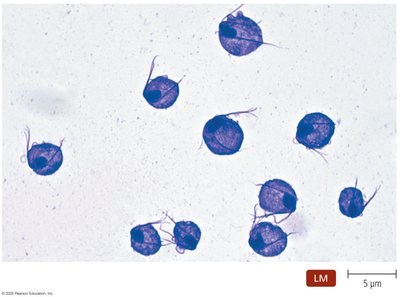
Meningitis-Causing Amoebas
Acanthamoeba and Naegleria
Acanthamoeba and Naegleria are free-living amoebas that can cause rare but usually fatal brain infections. They inhabit natural and artificial water systems. Acanthamoeba can cause keratitis (eye infection) and amoebic encephalitis, leading to neurological symptoms and death. Naegleria causes primary amoebic meningoencephalitis, characterized by hemorrhage, coma, and rapid death.

Significant Infectious Agents in AIDS Patients
Toxoplasma gondii
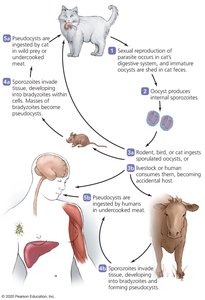
Toxoplasma gondii is an apicomplexan protozoan and the causative agent of toxoplasmosis, one of the most widely distributed parasites globally. Cats are the definitive host, while mammals and birds serve as reservoirs. Humans are infected by consuming undercooked meat or by ingesting or inhaling contaminated soil. Most infections are asymptomatic, but toxoplasmosis can cause fever and other symptoms, especially in AIDS patients and fetuses. Transplacental infection can result in abortion, stillbirth, or birth defects. Diagnosis is primarily serological, and treatment for symptomatic cases includes pyrimethamine with sulfadiazine or clindamycin. Prevention involves cooking meat thoroughly and avoiding cat feces, especially for pregnant women.
Summary Table: Key Intestinal Protozoa
Organism | Transmission | Clinical Features | Diagnosis | Treatment | Prevention |
|---|---|---|---|---|---|
Entamoeba histolytica | Fecal-oral (water/food) | Amebiasis: diarrhea, dysentery, extraintestinal disease | Stool microscopy | Metronidazole | Water sanitation |
Giardia intestinalis | Fecal-oral (water/food) | Giardiasis: diarrhea, bloating, nausea | Stool microscopy | Metronidazole | Water sanitation |
Cryptosporidium parvum | Fecal-oral (water) | Cryptosporidiosis: severe diarrhea | Oocyst detection, fluorescent antibody | Nitazoxanide, rehydration | Water filtration, hygiene |
Balantidium coli | Fecal-oral (water/food) | Balantidiasis: diarrhea, dysentery | Stool microscopy | Tetracycline | Water sanitation |
Cyclospora cayetanensis | Fecal-oral (food/water) | Cyclosporiasis: watery diarrhea, cramps | DNA probes | Trimethoprim-sulfamethoxazole | Wash produce |
Review Questions
Which of the following is a ciliated pathogen of the intestinal tract? Answer: Balantidium
Which organism can invade the nasal mucosa and enter the brain to cause meningoencephalitis? Answer: Naegleria
What is the most common parasitic disease in industrialized countries? Answer: Trichomonas infection
