 Back
BackPathogenic RNA Viruses: Retroviridae and HIV/AIDS
Study Guide - Smart Notes
 Tailored notes based on your materials, expanded with key definitions, examples, and context.
Pathogenic RNA Viruses
Overview of Retroviridae
Retroviridae are enveloped, positive-sense single-stranded RNA (+ssRNA) viruses that possess the unique enzyme reverse transcriptase. This family is extensively studied due to its medical significance, particularly in oncogenesis and immunosuppression.
Structure: Polyhedral capsids with spiked envelopes.
Genome: Two identical molecules of +ssRNA.
Replication: Do not follow the central dogma; instead, they use reverse transcriptase to synthesize double-stranded DNA (dsDNA) from their RNA genome.
Types: Oncogenic retroviruses and immunosuppressive retroviruses.
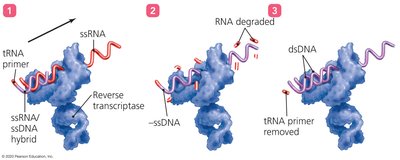
Figure: The action of reverse transcriptase, showing the conversion of ssRNA to dsDNA in three steps.
Oncogenic Retroviruses (Deltaretrovirus)
Human T-lymphotrophic Viruses (HTLV)
Oncogenic retroviruses are primarily associated with the development of certain cancers in humans.
HTLV-1: Linked to adult acute T-cell lymphocytic leukemia; Tax protein activates cell growth genes in helper T cells.
HTLV-2: Causes hairy-cell leukemia, a rare cancer.
HTLV-5: Not linked to cancer.
Transmission: Sexual intercourse, blood transfusion, contaminated needles.
Treatment: No specific antiviral treatment; infections are chronic with poor long-term prognosis.
Prevention: Behavioral changes similar to those for HIV prevention.
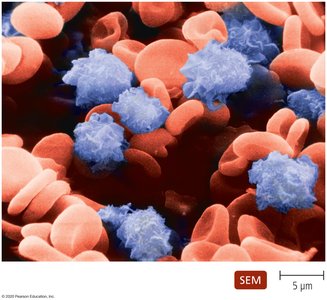
Figure: Characteristic extensions of the cytoplasmic membrane in hairy cell leukemia.
Immunosuppressive Retroviruses (Lentivirus) and Acquired Immunodeficiency Syndrome (AIDS)
Definition and Types of HIV
AIDS is a syndrome defined by the presence of certain opportunistic or rare infections, a severe decrease in helper T cells, and a positive test for HIV. There are two major types of HIV:
HIV-1: Prevalent in the United States and Europe.
HIV-2: Prevalent in West Africa.
Opportunistic Infections and Tumors in AIDS
AIDS patients are susceptible to a variety of opportunistic infections and tumors due to immunosuppression.
Type | Manifestations |
|---|---|
Bacterial Infections | Tuberculosis (Mycobacterium), rectal gonorrhea (Neisseria), recurrent fever and septicemia (Salmonella, Haemophilus, Streptococcus) |
Fungal Infections | Pneumocystis pneumonia, thrush (Candida), histoplasmosis (Histoplasma) |
Protozoal Infections | Toxoplasmosis (Toxoplasma), chronic diarrhea (Cryptosporidium, Isospora) |
Viral-Induced Tumors | Kaposi’s sarcoma (HHV-8), lymphoma (Epstein-Barr virus) |
Viral Infections | Cytomegalovirus, human herpesvirus 1 and 2, progressive multifocal leukoencephalopathy (JC virus), oral hairy leukoplakia (Epstein-Barr virus) |
Others | Wasting disease, dementia |
Structure of HIV
HIV contains two major antigenic glycoproteins in its envelope:
gp120: Primary attachment molecule, highly antigenically variable.
gp41: Promotes fusion of the viral envelope with the target cell membrane.
Viral characteristics such as antigenic variation and latency impede immune clearance.
Origin of HIV
HIV likely originated from a mutation of simian immunodeficiency virus (SIV) and may have emerged in humans in the 1920s. The relationship between HIV-1 and HIV-2 and their SIV ancestors remains under investigation.
Replication Cycle of HIV
The replication cycle of HIV involves several key steps:
Attachment to CD4 receptors on host cells via gp120.
Entry by endocytosis and uncoating of the viral capsid.
Reverse transcription of viral RNA to dsDNA by reverse transcriptase.
Integration of viral DNA into the host genome by integrase.
Transcription and translation of viral proteins.
Assembly, maturation, and release of new virions.
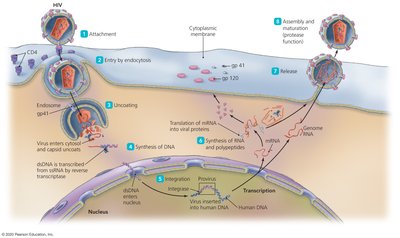
Figure: The replication cycle of HIV, showing attachment, entry, reverse transcription, integration, and release.
Attachment and Entry of HIV
HIV attaches to and enters host cells through a multi-step process involving gp120 binding to CD4 and a co-receptor, followed by fusion mediated by gp41.
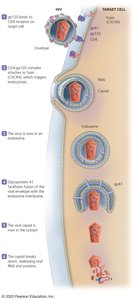
Figure: The process by which HIV attaches to and enters a host cell.
Synthesis, Latency, and Reservoirs
Reverse transcriptase introduces errors, resulting in antigenic variants.
dsDNA provirus integrates into the host genome and can remain dormant for years.
Macrophages and monocytes serve as major reservoirs and distributors of HIV.
Release, Assembly, and Maturation
HIV exits the cell at lipid rafts, which become part of the viral envelope.
Capsomeres form immature capsids outside the cell; viral protease processes proteins to produce mature virions.
Protease inhibitors are used in HIV treatment.
Pathogenesis of AIDS
HIV infection leads to the destruction of the immune system, primarily by depleting CD4+ helper T cells. Only humans are known to replicate HIV.
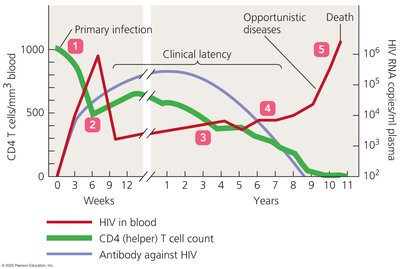
Figure: The progression of AIDS follows the decline in helper T cell count.
Epidemiology of AIDS
AIDS was first recognized in young male homosexuals in the United States but is now a global pandemic.
HIV is present in blood, semen, vaginal secretions, and breast milk; blood and semen are most infectious.
Transmission requires infected fluid to contact a tear or lesion in skin or mucous membranes.
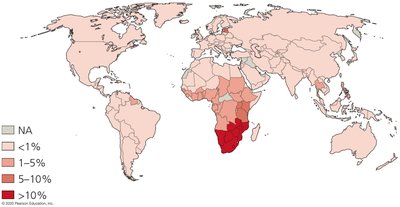
Figure: Global distribution of HIV/AIDS, with highest prevalence in sub-Saharan Africa.
Diagnosis, Treatment, and Prevention of HIV/AIDS
Diagnosis: Based on symptoms, low CD4+ lymphocyte count, and presence of antibodies against HIV (detected by ELISA or immunoblot). PCR can detect HIV RNA directly.
Treatment: Antiretroviral therapy (ART) is used to reduce viral replication. ART is a combination of antiviral drugs but does not cure the infection.
Prevention: Behavioral changes (abstinence, safe sex), use of clean needles, screening blood products, use of tenofovir gel, protective wear, and providing antiviral drugs to infected pregnant women.
Quiz Review
Which enzyme allows retroviruses to transcribe DNA from RNA? Answer: Reverse transcriptase.
What is the first step in the synthesis of DNA from +ssRNA by reverse transcriptase? Answer: Synthesis of negative ssDNA.
Which cells are a major reservoir for and distributor of HIV? Answer: Monocytes and macrophages.
