 Back
BackPathogenic RNA Viruses: Structure, Transmission, and Disease Manifestations
Study Guide - Smart Notes
 Tailored notes based on your materials, expanded with key definitions, examples, and context.
Pathogenic RNA Viruses
Overview of RNA Viruses
RNA viruses are unique infectious agents that store their genetic information in RNA molecules. They are classified based on genomic structure, presence of an envelope, and capsid size and shape. There are four main types:
Positive single-stranded RNA (+ssRNA)
Retroviruses
Negative single-stranded RNA (-ssRNA)
Double-stranded RNA (dsRNA)
Positive RNA can be directly translated by ribosomes, while negative RNA must first be transcribed into mRNA.
Naked, Positive RNA Viruses
These viruses lack an envelope and include several important human pathogens:
Picornaviridae: Smallest animal viruses, includes Rhinovirus, Enterovirus, and Hepatovirus.
Caliciviridae, Astroviridae, Hepeviridae: Larger than picornaviruses, cause gastrointestinal diseases.
Common Colds Caused by Rhinoviruses
Rhinoviruses are the most frequent cause of the common cold, limited to the upper respiratory tract. Transmission occurs via aerosols, fomites, and hand-to-hand contact. Immunity develops against specific serotypes, and infection rates decrease with age.
Diagnosis: Based on clinical symptoms.
Treatment: Pleconaril may reduce severity and duration.
Prevention: Handwashing is most effective.
Manifestations of Respiratory Infections
Respiratory infections caused by viruses and bacteria present with overlapping symptoms. The following table summarizes key manifestations:
Ailment | Manifestations |
|---|---|
Common Cold (viral) | Sneezing, rhinorrhea, congestion, sore throat, headache, malaise, cough. No fever |
Influenza (viral) | Fever, rhinorrhea, headache, body aches, fatigue, dry cough, pharyngitis, congestion |
“Strep” Throat (bacterial) | Fever, red and sore throat, swollen lymph nodes in neck |
Viral Pneumonia | Fever, chills, mucus-producing cough, headache, body aches, fatigue |
Bacterial Pneumonia | Fever, chills, congestion, cough, chest pain, rapid breathing, nausea, vomiting |
Bronchitis (viral or bacterial) | Mucus-producing cough, wheezing |
Inhalation Anthrax (bacterial) | Fever, malaise, cough, chest discomfort, vomiting |
Severe Acute Respiratory Syndrome (SARS) | High fever (>38°C), chills, shaking, headache, malaise, myalgia |
Middle East Respiratory Syndrome (MERS) | Fever, cough, shortness of breath |
Enteroviruses
Enteroviruses are transmitted via the fecal-oral route, infecting the pharynx and intestine, and spreading through the bloodstream. They kill host cells and include polioviruses, coxsackieviruses, and echoviruses.
Poliomyelitis: Four conditions: asymptomatic, minor polio, nonparalytic polio, paralytic polio. Can cause bulbar poliomyelitis.
Postpolio Syndrome: Crippling deterioration in polio-affected muscles. Near elimination due to vaccines: IPV (inactivated polio vaccine) and OPV (oral polio vaccine).
Comparison of Polio Vaccines
Vaccine | Advantages | Disadvantages |
|---|---|---|
Salk Vaccine (IPV) | Effective, inexpensive, stable, no risk of vaccine-related disease | Requires booster, injected, painful, needs high community immunization rate |
Sabin Vaccine (OPV) | Induces secretory antibody response, easy to administer, herd immunity | Requires boosters, more expensive, less stable, risk of mutation, not for immunocompromised |
Other Diseases of Enterovirus
Coxsackie A Virus: Self-limiting lesions, fever, herpangina, hand-foot-and-mouth disease, acute hemorrhagic conjunctivitis.
Coxsackie B Virus: Myocarditis, pericardial infections, pleurodynia, can cross placenta, cause meningitis.
Echoviruses: Acquired intestinally, cause colds and meningitis.
Enteroviruses are worldwide, often in areas with poor sewage treatment. Most infections are mild; hygiene and vaccines prevent disease.
Hepatitis A and E
Hepatitis A is resistant to disinfectants, transmitted via fecal-oral route, does not cause chronic liver disease, and has a vaccine. Hepatitis E is transmitted via food, drink, or blood transfusion, causes jaundice and abdominal pain, and is fatal in pregnant women.
Comparison of Hepatitis Viruses
Feature | Hepatitis A | Hepatitis B | Hepatitis C | Hepatitis D | Hepatitis E |
|---|---|---|---|---|---|
Common Names | Infectious hepatitis | Serum hepatitis | Non-A, non-B hepatitis; chronic hepatitis | Delta agent hepatitis | Hepatitis E, enteric hepatitis |
Virus Family | Picornaviridae | Hepadnaviridae | Flaviviridae | Arenaviridae | Hepeviridae |
Genome | +ssRNA | dsDNA | +ssRNA | -ssRNA | +ssRNA |
Envelope? | Naked | Enveloped | Enveloped | Enveloped | Naked |
Transmission | Fecal-oral | Needles; sex | Needles; sex | Needles; sex | Fecal-oral |
Severity | Mild (<0.5%) | Occasionally severe (1–2%) | Usually subclinical (0.5–4%) | Requires coinfection with HBV; may be severe (high) | Mild (1–2%), fatal in pregnant women (20%) |
Chronic Carrier State? | No | Yes | Yes | No | No |
Other Disease Associations | — | Hepatic cancer | Hepatic cancer | Liver damage; hepatic cancer (with HBV) | — |
Acute Gastroenteritis
Caliciviruses and astroviruses cause acute gastroenteritis, often in outbreaks. Norovirus is the most common cause. Symptoms include diarrhea, nausea, and vomiting. Prevention relies on hygiene and water treatment.
Enveloped, Positive RNA Viruses
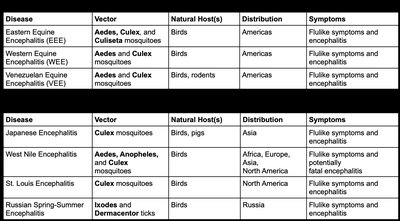
Includes Togaviridae, Flaviviridae, and Coronaviridae. Arboviruses are transmitted by arthropods and cause zoonoses, with humans as dead-end hosts. Most infections are mild but can progress to encephalitis, dengue, or yellow fever.
Arbovirus-Associated Encephalitis
Arboviruses cause encephalitis in humans and animals. The following table summarizes key arboviral encephalitis diseases:
Dengue, Yellow, and Zika Fevers
Dengue Fever: Flavivirus, transmitted by Aedes mosquitoes, two-phase disease, can cause hemorrhagic fever.
Yellow Fever: Causes degeneration of liver, kidneys, heart; controlled by vaccination.
Zika Fever: Transmitted by Aedes mosquitoes, can cause microcephaly in fetuses, prevention relies on mosquito avoidance.
Diagnosis, Treatment, and Prevention of Arbovirus Infections
Diagnosis: Serological tests.
Treatment: Supportive care.
Prevention: Vaccines for some arboviruses, mosquito control.
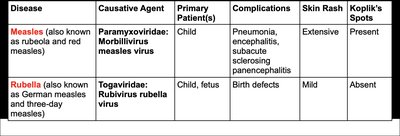
Rubella
Rubella (German measles) is caused by Rubivirus and produces mild skin lesions. Infection in pregnant women can cause congenital defects. Vaccination is effective.
Comparison: Measles vs. Rubella
Coronaviruses
Coronaviruses are enveloped, helical RNA viruses named for their corona-like envelope. They are transmitted via respiratory droplets and are the second most common cause of colds. SARS and MERS cause severe respiratory distress; no treatment or vaccine is available.
Enveloped, Positive RNA Viruses with Reverse Transcriptase
Retroviruses transcribe DNA from RNA using reverse transcriptase. They are divided into oncogenic and immunosuppressive types.
Oncogenic Retroviruses: Human T Lymphotropic Virus (HTLV) causes leukemia and other cancers.
Immunosuppressive Retroviruses: Lentivirus (HIV) causes AIDS.
HIV and AIDS
AIDS is defined by opportunistic infections and a severe decrease in helper T cells. HIV-1 is prevalent in North America and Europe; HIV-2 in West Africa. HIV integrates into host chromosomes and can remain dormant. Transmission occurs via blood, semen, vaginal secretions, and breast milk.
Diagnosis: Symptoms, low CD4 lymphocytes, ELISA, immunoblot, PCR.
Treatment: Antiretroviral therapy (ART), protease inhibitors.
Prevention: Safe sex, clean needles, screening blood products, circumcision, tenofovir gel.
Opportunistic Infections and Tumors of AIDS
Type | Manifestations |
|---|---|
Bacterial Infections | Tuberculosis, rectal gonorrhea, recurrent fever, septicemia |
Fungal Infections | Pneumocystis pneumonia, thrush, histoplasmosis |
Protozoal Infections | Toxoplasmosis, chronic diarrhea |
Viral-Induced Tumors | Kaposi’s sarcoma, lymphoma |
Viral Infections | Cytomegalovirus, herpesvirus, progressive multifocal leukoencephalopathy, oral hairy leukoplakia |
Others | Wasting disease, dementia |
Structure and Challenges of HIV
Envelope glycoproteins: gp120 and gp41
Origin: Mutation of simian immunodeficiency virus
Challenges: Genetic variation, permanent infection of immune cells, antigenic variability, syncytia formation
Enveloped, Unsegmented Negative RNA Viruses
Includes Paramyxoviridae (measles, mumps, RSV), Rhabdoviridae (rabies), and Filoviridae (Ebola, Marburg). These viruses cause a range of diseases, often with severe complications.
Measles
Measles is highly contagious, spread via respiratory droplets, and causes Koplik's spots and extensive skin rash. Complications include pneumonia and encephalitis. Prevention is through vaccination.
Parainfluenza Virus
Causes respiratory tract disease, especially in children. Most recover within two days; intubation may be needed if airways are occluded.
Mumps
Transmitted via respiratory secretions, causes parotitis, orchitis, meningitis, and pancreatitis. Vaccine has nearly eradicated mumps in industrialized countries.
RSV (Respiratory Syncytial Virus)
Causes lower respiratory tract infections and syncytia formation in the lungs. Can be fatal in infants and children. Prevention relies on handwashing.
Rabies
Rabies virus attaches to nerve cells, travels to CNS, and causes neurological symptoms. Transmission is usually via animal bites. Prevention is through vaccination of domestic animals.
Filoviruses (Ebola, Marburg)
Cause hemorrhagic fevers, transmitted via body fluids. Diagnosis by ELISA or PCR. Treatment is supportive; prevention involves protective gear and limiting contact.
Enveloped, Segmented Negative RNA Viruses
Capsids contain segmented genomes. Includes Orthomyxoviridae (influenza), Bunyaviridae, and Arenaviridae.
Influenza
Caused by types A and B, genome has eight RNA segments. Envelope glycoproteins (neuraminidase and hemagglutinin) are important for attachment. Mutations lead to new strains. Treatment includes oseltamivir and zanamivir; prevention is through vaccination.
Bunyaviruses and Arenaviruses
Bunyaviruses are zoonotic, transmitted by arthropods, and have three RNA segments. Arenaviruses have two RNA segments and a sandy appearance. Both cause hemorrhagic fevers and encephalitis.

Hepatitis D
Transmitted via body fluids, requires hepatitis B for virulence, and plays a role in liver cancer. Prevention is through hepatitis B vaccination.
Reoviridae and Rotavirus
Reoviridae are naked, icosahedral viruses with double-stranded RNA genomes. Rotavirus is a major cause of infantile gastroenteritis, especially in developing countries. Prevention relies on hygiene and sewage treatment.
Additional info: Academic context and expanded explanations were added to ensure completeness and clarity for microbiology students.
