 Back
BackPhylogenetic and Metabolic Diversity of Bacteria: Focus on Proteobacteria and Major Bacterial Phyla
Study Guide - Smart Notes
 Tailored notes based on your materials, expanded with key definitions, examples, and context.
Phylogenetic Diversity of Bacteria
Overview of Bacterial Phyla
Bacteria exhibit extensive phylogenetic diversity, with over 80 phyla identified to date. However, only 29 phyla have at least one cultured representative, and the majority of described species are concentrated in a few major phyla. Understanding the relationships among these groups is essential for microbiology students, as it provides context for microbial evolution, ecology, and physiology.
Phylum: A major taxonomic group within the domain Bacteria, representing a large evolutionary lineage.
Over 12,000 bacterial species have been described, but 90% of cultured species belong to just four phyla.
The four dominant phyla are Proteobacteria, Firmicutes, Bacteroidetes, and Actinobacteria.
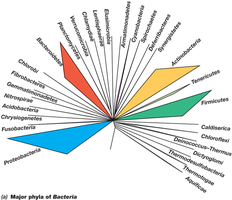
Figure: Phylogenetic tree showing the major phyla of Bacteria. Colored regions highlight the four most abundant phyla among cultured species.
Cultured vs. Uncultured Bacterial Diversity
Many bacterial phyla are known only from gene sequences (e.g., 16S rRNA), and have not been cultured in the laboratory. This distinction is important for understanding the limits of our current knowledge and the potential for discovering new microbial functions.
Cultured representatives: Bacteria that have been grown and studied in laboratory conditions.
Phylotypes: Bacterial groups identified solely by genetic sequencing, not by cultivation.
Some phyla are represented almost entirely by uncultured phylotypes.
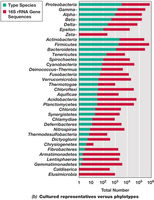
Figure: Comparison of the number of cultured type species and 16S rRNA gene sequences (phylotypes) across major bacterial phyla. Note the dominance of a few phyla and the prevalence of uncultured diversity.
Taxonomic Nomenclature and the 'Candidatus' Designation
Taxonomic classification in microbiology is dynamic, with ongoing changes in nomenclature and the introduction of provisional names for uncultured or incompletely described organisms.
"Candidatus" is prefixed to a genus-species name when an organism is well-characterized but not yet cultured, or not in pure culture.
Example: Candidatus Pelagibacter ubique (abundant marine bacterium).
When "Candidatus" is used, the genus-species name is not italicized.
Recent Changes in Bacterial Phylum Names
In 2021, several major bacterial phyla were renamed to better reflect phylogenetic relationships. While the new names are important to recognize, the traditional names remain widely used in the literature.
Old Name | New Name |
|---|---|
Firmicutes | Bacillota |
Proteobacteria | Pseudomonadota |
Actinobacteria | Actinomycetota |
Bacteroidetes | Bacteroidota |
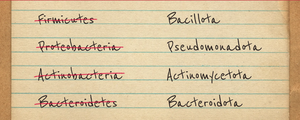
Figure: Table summarizing the recent renaming of major bacterial phyla.
Proteobacteria: The Largest and Most Diverse Bacterial Phylum
General Characteristics
Proteobacteria (recently renamed Pseudomonadota) is the largest and most metabolically diverse bacterial phylum. It includes a wide range of morphologies, metabolic strategies, and ecological roles, and is especially notable for its medical, industrial, and agricultural importance.
Comprises over one-third of all characterized bacterial species.
Exhibits extensive horizontal gene flow, contributing to metabolic diversity.
Contains six major classes: Gamma-, Alpha-, Beta-, Delta-, Epsilon-, and Zeta-Proteobacteria (in descending order of size).
Phylogenetic Structure of Proteobacteria
The phylum is divided into several classes, each with distinct metabolic and ecological characteristics. The largest class is Gamma-Proteobacteria, followed by Alpha-, Beta-, Delta-, Epsilon-, and Zeta-Proteobacteria.
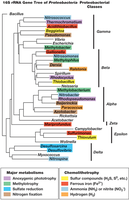
Figure: 16S rRNA gene tree showing the relationships among major classes and orders of Proteobacteria. Major metabolic types are indicated by color.
Metabolic Diversity in Proteobacteria
Proteobacteria display a wide range of metabolic strategies, including aerobic and anaerobic respiration, fermentation, phototrophy, and chemolithotrophy. Some groups are notable for their ability to use unusual electron acceptors or donors.
Sulfate-reducing bacteria: Use sulfate (SO42−) as a terminal electron acceptor in anaerobic respiration, producing hydrogen sulfide (H2S).
Iron-oxidizing bacteria: Such as Mariprofundus ferrooxydans, oxidize iron in marine environments.
Gamma-Proteobacteria
General Features
Gamma-Proteobacteria is the largest and most diverse class within Proteobacteria, containing nearly 50% of all characterized species in the phylum. This class includes many medically, industrially, and ecologically important genera.
Metabolic diversity: phototrophs, chemoorganotrophs, chemolithotrophs.
Respiratory and fermentative metabolisms are both present.
Key genera: Enterobacter, Escherichia, Klebsiella, Proteus, Salmonella, Serratia, Shigella.
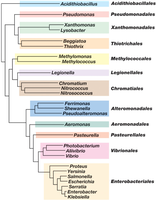
Figure: Phylogenetic relationships among major orders and genera of Gamma-Proteobacteria.
Enterobacteriales: Key Features and Medical Importance
The order Enterobacteriales includes many well-known human pathogens and industrially important bacteria. Members are typically facultative aerobes, gram-negative rods, and may be motile by peritrichous flagella.
Oxidase (–) and Catalase (+) tests are used for identification.
Ferment sugars to a variety of end products.
Includes Escherichia coli, Salmonella, Shigella, Proteus, Yersinia, Enterobacter, Klebsiella, Serratia.
Fermentation Patterns in Enteric Bacteria
Enteric bacteria can be classified by their fermentation end products:
Mixed-acid fermentation: Produces acetic, lactic, and succinic acids, ethanol, CO2, and H2 in equal amounts. (e.g., Escherichia, Salmonella, Shigella, Proteus, Yersinia)
2,3-butanediol fermentation: Main products are butanediol, ethanol, and more CO2 than H2, with smaller amounts of acids. (e.g., Enterobacter, Klebsiella, Serratia)
Other Orders in Gamma-Proteobacteria
Pseudomonadales: Aerobic respiratory chemoorganotrophs.
Vibrionales: Facultatively aerobic rods and curved rods that ferment.
Medically Relevant Gamma-Proteobacteria
Escherichia coli: Diarrhea, UTIs, meningitis, sepsis, pneumonia.
Salmonella spp.: Sepsis, gastroenteritis, typhoid fever (S. typhi).
Shigella spp.: Dysentery (Shiga toxin).
Yersinia pestis: Bubonic plague.
Klebsiella pneumoniae: Pneumonia.
Proteus mirabilis: UTIs, nosocomial infections.
Serratia spp.: UTIs, wound infections, pneumonia.
Legionella pneumophila: Legionnaires’ disease, Pontiac fever.
Pseudomonas aeruginosa: Nosocomial infections (pneumonia, UTIs, wound, intravenous line infections).
Vibrio cholerae: Cholera.
Alpha-Proteobacteria
General Features
Alpha-Proteobacteria are highly diverse, with nearly 1000 described species. Most are obligate or facultative aerobes, and many are oligotrophic, thriving in low-nutrient environments. This class includes important plant symbionts, pathogens, and free-living bacteria.
Major orders: Rhizobiales, Rickettsiales, Rhodobacterales, Rhodospirillales, Caulobacterales, Sphingomonadales.
Notable genera: Agrobacterium, Methylobacterium, Pelagibacter, Wolbachia, Bartonella, Brucella, Rickettsia.
Iconic Genera and Species
Agrobacterium tumefaciens: Causes crown gall disease in plants; used in genetic engineering of plants.
Methylobacterium: Common on plant surfaces and in soil; forms pink colonies.
Pelagibacter ubique: Most abundant bacterial species in the ocean’s surface waters.
Wolbachia: Intracellular parasite of arthropods and nematodes; infects up to 75% of insects.
Bartonella henselae: Cat-scratch disease.
Brucella: Causes brucellosis; zoonotic pathogen.
Rickettsia rickettsii: Rocky Mountain spotted fever.
Rickettsia prowazekii: Epidemic typhus.
Beta-, Delta-, and Epsilon-Proteobacteria
Beta-Proteobacteria
Beta-Proteobacteria include a variety of medically and environmentally important genera. Many are involved in nitrogen and sulfur cycling, and some are notable human pathogens.
Bordetella pertussis: Whooping cough.
Burkholderia cepacia: Nosocomial lung infections.
Neisseria gonorrhoeae: Gonorrhea.
Neisseria meningitidis: Meningitis.
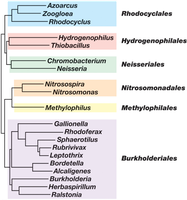
Figure: Phylogenetic relationships among major orders and genera of Beta-Proteobacteria.
Delta-Proteobacteria
Delta-Proteobacteria are known for their unique metabolic capabilities, including predation and the reduction of sulfur compounds. Some are important in the cycling of sulfur in the environment.
Includes predatory bacteria and sulfate-reducing bacteria.
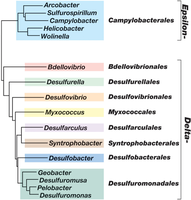
Figure: Phylogenetic relationships among major orders and genera of Delta- and Epsilon-Proteobacteria.
Epsilon-Proteobacteria
Epsilon-Proteobacteria include several important human pathogens and environmental bacteria. Many are capable of oxidizing hydrogen sulfide and fixing carbon dioxide via the reverse TCA cycle.
Campylobacter jejuni: Causes bloody diarrhea; major foodborne pathogen.
Helicobacter pylori: Causes duodenal ulcers and gastritis.
Additional info: The above notes integrate content from lecture slides, textbook figures, and academic context to provide a comprehensive overview of the phylogenetic and metabolic diversity of major bacterial phyla, with a focus on Proteobacteria and its medically relevant members. The included images and tables are directly relevant to the explanation of bacterial diversity, taxonomy, and clinical importance.
