 Back
BackPractical Applications of Immunology: Vaccines and Diagnostic Immunology
Study Guide - Smart Notes
 Tailored notes based on your materials, expanded with key definitions, examples, and context.
Practical Applications of Immunology
Introduction
This chapter explores the principles and applications of immunology in the prevention, diagnosis, and treatment of infectious diseases. It focuses on vaccines, their types, production, and safety, as well as immunologic diagnostic techniques essential for microbiology and clinical practice.
Vaccines: Principles and Applications
Definition and Historical Context
Vaccine: A suspension of organisms or fractions of organisms that induce immunity against disease.
Variolation: Early method of smallpox prevention by inoculating material from smallpox scabs (practiced in China, 1400s–1700s).
Vaccination: Introduced by Jenner (1798) using cowpox to prevent smallpox; term derived from vacca (Latin for cow).
Principles and Effects of Vaccination
Provokes a primary immune response, leading to antibody and memory cell formation.
Enables a rapid, intense secondary response upon future exposure.
Herd immunity: When most of the population is immune, outbreaks are sporadic due to lack of susceptible individuals.
Types of Vaccines and Their Characteristics
Attenuated vaccines: Contain weakened pathogens; closely mimic natural infection, confer lifelong immunity, but not for immunocompromised patients due to risk of reversion to virulence.
Inactivated vaccines: Contain killed microbes; safer but require boosters and induce mainly humoral immunity.
Subunit vaccines: Use antigenic fragments; includes recombinant vaccines (e.g., Hepatitis B), toxoids (inactivated toxins), and virus-like particle (VLP) vaccines (e.g., HPV).
Polysaccharide vaccines: Made from capsule molecules; not very immunogenic.
Conjugated vaccines: Polysaccharide antigen attached to a protein carrier, making them effective in young children.
DNA vaccines: Injected DNA encodes antigen, stimulating both humoral and cellular immunity.
mRNA vaccines: mRNA in lipid nanoparticles encodes antigen (e.g., COVID-19 vaccines).
Recombinant vector vaccines: Genetically modified avirulent viruses or bacteria deliver DNA coding for antigens.
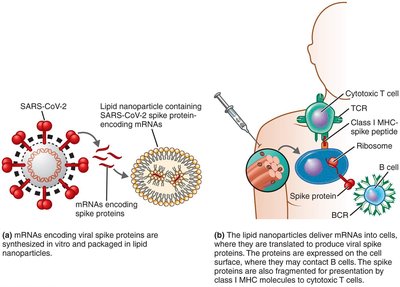
Vaccine Production, Administration, and Safety
Production: Modern vaccines (DNA, mRNA, recombinant vector) do not require animal hosts; plants are being explored as production systems.
Adjuvants: Additives (e.g., alum, monophosphoryl lipid A) that enhance vaccine effectiveness by stimulating innate immunity.
Administration: Oral, nasal, skin patch, and combination vaccines are used for ease and effectiveness.
Safety: Vaccines are among the safest and most effective public health tools; rare adverse events can occur, but there is no scientific link between MMR vaccines and autism.
CDC-Recommended Vaccines
Vaccines are recommended for various bacterial and viral diseases. The following tables summarize key vaccines, their recommendations, and booster requirements.
Disease(s) | Vaccine | Recommendation | Booster |
|---|---|---|---|
H. influenzae type b meningitis | Polysaccharide from H. influenzae type b | Children 2–18 months | None |
Meningococcal ACWY meningitis | Purified polysaccharide from N. meningitidis | Age 11–12 years | At 16 years; outbreak settings |
Pneumococcal pneumonia | Polysaccharide from S. pneumoniae | Adults with chronic diseases; children 2–18 months | None if first dose ≥24 months |
Tetanus, diphtheria, pertussis | DTaP, Tdap, Td | Children 2–18 months; adults | Every 10 years |
Disease(s) | Vaccine | Recommendation | Booster |
|---|---|---|---|
Chickenpox (varicella) | Attenuated virus | Infants 12 months | Unknown |
COVID-19 | mRNA | Two dose series | Recommended |
Hepatitis B | Virus antigen in yeast | Infants, children, adults at risk | At least 7 years; uncertain |
Influenza | Inactivated/attenuated virus | Everyone over 6 months | Annual |
Diagnostic Immunology
Key Concepts
Sensitivity: Probability that a test is reactive if the specimen is a true positive.
Specificity: Probability that a positive test will not be reactive if a specimen is a true negative.
Immunologic tests rely on interactions between antibodies and antigens to detect pathogens or immune responses.
Monoclonal Antibodies (Mabs)
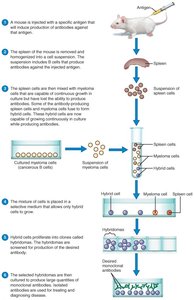
Produced by hybridomas (fusion of myeloma and antibody-producing B cells).
Uniform, highly specific, and produced in large quantities.
Applications: diagnostics, therapy (e.g., cancer, autoimmune diseases, COVID-19).
Types: chimeric, humanized, and fully human antibodies.
Precipitation Reactions
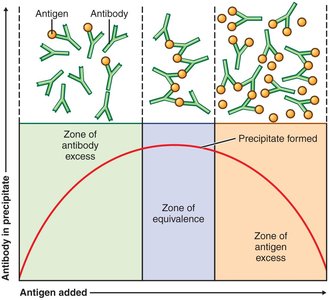
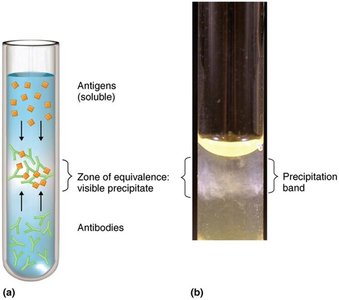
Soluble antigens react with IgG or IgM to form visible precipitates (lattices) at optimal antigen-antibody ratios (zone of equivalence).
Immunodiffusion and immunoelectrophoresis are related techniques.
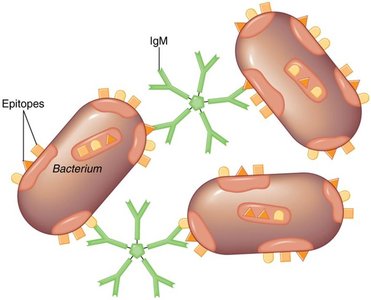
Agglutination Reactions
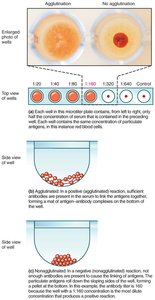
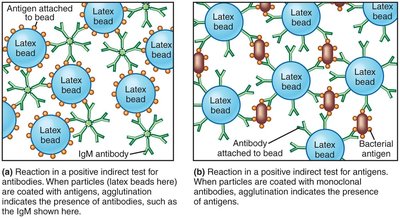
Particulate antigens bind to antibodies, forming visible aggregates.
Direct agglutination: Detects antibodies against large cellular antigens; measures titer.
Indirect (passive) agglutination: Uses particles coated with antigen or antibody (e.g., latex agglutination).
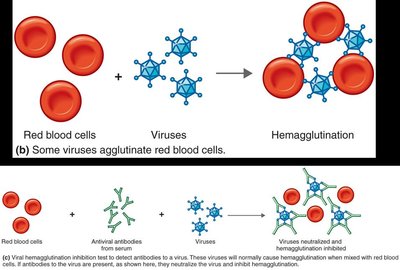
Hemagglutination: Agglutination of RBCs, used in blood typing.
Neutralization Reactions
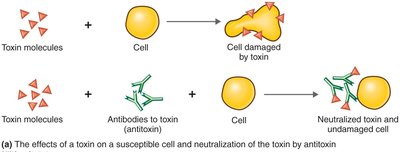
Antibodies block harmful effects of toxins or viruses.
Virus neutralization tests detect antibodies by their ability to prevent cytopathic effects.
Viral hemagglutination inhibition tests are used for subtyping viruses.
Complement-Fixation Reactions
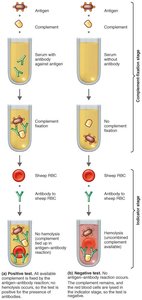
Detects small amounts of antibody by binding complement to antigen–antibody complexes.
Used for diagnosing certain viral, fungal, and rickettsial diseases.
Fluorescent-Antibody Techniques
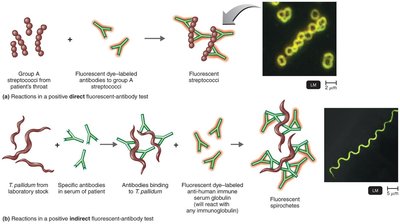
Antibodies labeled with fluorescent dyes identify microorganisms or antibodies in samples.
Direct FA test: Identifies microorganisms in clinical specimens.
Indirect FA test: Detects specific antibodies in serum.
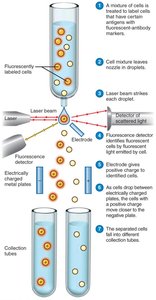
FACS (Fluorescence-Activated Cell Sorter): Sorts and counts cells labeled with fluorescent antibodies (e.g., CD4+ T cells in AIDS).
Enzyme-Linked Immunosorbent Assay (ELISA)
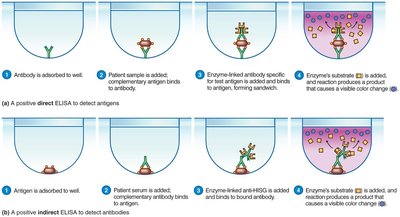
Direct ELISA: Detects antigens using enzyme-linked antibodies and a colorimetric substrate.
Indirect ELISA: Detects antibodies using antigen-coated wells and enzyme-linked anti-human antibodies.
Western Blotting (Immunoblotting)
Proteins are separated by electrophoresis, transferred to a membrane, and detected with enzyme-linked antibodies.
Used for confirming HIV infection and other diagnostic applications.
Rapid Antigen Tests
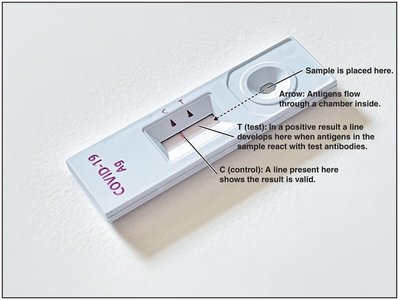
Lateral flow assays (e.g., SARS-CoV-2 rapid antigen test) use antibody-labeled strips to detect antigens in samples, producing a visible line if positive.
Impact and Future of Immunology
Vaccine-Preventable Diseases
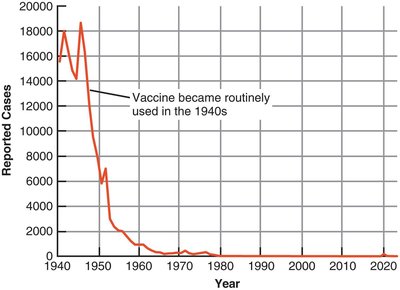
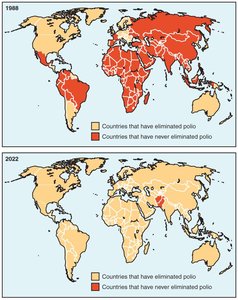
Immunization campaigns have dramatically reduced diseases like diphtheria and polio.
Challenges remain due to poverty, infrastructure, booster needs, and vaccine hesitancy.
Global initiatives aim to eliminate diseases such as measles, rubella, and polio.
Future Directions
Automation and rapid, inexpensive diagnostic tests are priorities, especially for developing countries.
Monoclonal antibodies continue to revolutionize diagnostics and therapeutics.
