 Back
BackPrinciples of Disease and Epidemiology: Microbiology Study Notes
Study Guide - Smart Notes
 Tailored notes based on your materials, expanded with key definitions, examples, and context.
Principles of Disease and Epidemiology
Pathology, Infection, and Disease
Pathology is the scientific study of disease, focusing on its causes, development, and effects. Understanding the distinctions between infection and disease is fundamental in microbiology.
Pathology: Study of disease.
Etiology: The cause of a disease.
Pathogenesis: The manner in which a disease develops.
Infection: Invasion or colonization of the body by pathogens.
Infectious disease: Occurs when an infection results in any change in the state of health.
Disease: May result when a microorganism locates in a part of the body where it is not normally found.
The Human Microbiome
The human microbiome consists of the collection of microorganisms that inhabit various regions of the human body. These microbes play essential roles in health and disease.
Establishment: Begins in utero; placental microbiome includes Enterobacteriaceae and Propionibacterium.
Colonization: Lactobacilli colonize neonates during vaginal birth; more microbes acquired from food, people, and pets.
Normal microbiota (flora): Permanently colonize the host and do not cause disease under normal conditions.
Transient microbiota: Present for days, weeks, or months, then disappear.
Human Microbiome Project: Analyzes relationships between microbial communities and human health.
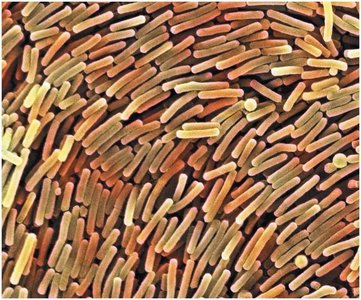
Factors Influencing the Normal Microbiota
The distribution and composition of normal microbiota are determined by numerous factors, including environmental and host-related variables.
Nutrients: Availability affects microbial growth.
Physical and chemical factors: pH, temperature, moisture, etc.
Mechanical factors: Movement of fluids, chewing, blinking.
Body’s defenses: Immune system activity.
Other factors: Age, diet, geography, hygiene, occupation, lifestyle.
Representative Normal Microbiota by Body Region
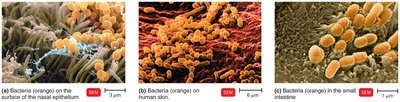
Normal microbiota vary by body region, each with unique environmental conditions and microbial populations.
Region | Principal Components | Comments |
|---|---|---|
Skin | Propionibacterium, Staphylococcus, Corynebacterium, Micrococcus, Acinetobacter, Brevibacterium, Candida, Malassezia | Secretions inhibit microbes; keratin is a barrier; low pH and moisture |
Eyes (Conjunctiva) | Staphylococcus epidermidis, S. aureus, diphtheroids, Propionibacterium, Corynebacterium, streptococci, Micrococcus | Tears and blinking remove/inhibit microbes; lysozyme present |
Nose and Throat | S. aureus, S. epidermidis, diphtheroids, Streptococcus pneumoniae, Haemophilus, Neisseria | Microbial antagonism; mucus and ciliary action remove microbes |
Mouth | Streptococcus, Lactobacillus, Actinomyces, Bacteroides, Veillonella, Neisseria, Haemophilus, Fusobacterium, Treponema, Staphylococcus, Corynebacterium, Candida | Moisture, warmth, food support diverse microbes; saliva dislodges microbes |
Large Intestine | E. coli, Bacteroides, Fusobacterium, Lactobacillus, Enterococcus, Bifidobacterium, Enterobacter, Citrobacter, Proteus, Klebsiella, Candida | Largest numbers; microbial antagonism; mucus and shedding prevent attachment |
Urinary and Genital Systems | Staphylococcus, Micrococcus, Enterococcus, Lactobacillus, Bacteroides, diphtheroids, Pseudomonas, Klebsiella, Proteus, Clostridium, Candida albicans, Trichomonas vaginalis | Acid-tolerant; urine flow removes microbes; acidity inhibits/kills microbes |
Exploring the Microbiome: Birth and Health Conditions
The mode of birth influences the initial microbiome composition, which can affect health outcomes.
Vaginal birth: Lactobacillus and Bacteroides are prevalent.
Cesarean birth: Microbiome resembles human skin; Staphylococcus aureus is common.
Relationships Between the Normal Microbiota and the Host
Normal microbiota interact with the host in various ways, including protection and symbiosis.
Microbial antagonism (competitive exclusion): Normal microbiota protect the host by competing for nutrients, producing harmful substances, and affecting pH and oxygen.
Clostridium difficile: Causes severe intestinal infections if normal microbiota are reduced by antibiotics; fecal microbial transfer (FMT) can treat infections.
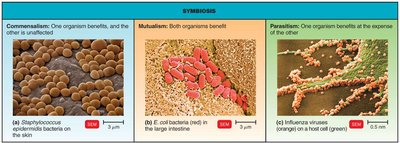
Types of Symbiosis
Commensalism: One organism benefits, the other is unaffected.
Mutualism: Both organisms benefit.
Parasitism: One organism benefits at the expense of the other; many pathogens are parasites.
Opportunistic pathogens: Normal microbiota that can cause disease under certain conditions.
Koch’s Postulates
Establishing Disease Causation
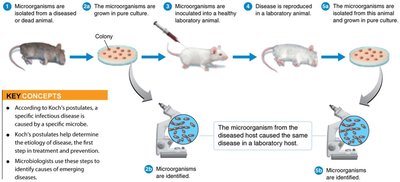
Koch’s postulates are a set of criteria used to prove the cause of an infectious disease.
The same pathogen must be present in every case of the disease.
The pathogen must be isolated from the diseased host and grown in pure culture.
The pathogen from the pure culture must cause the disease when inoculated into a healthy, susceptible laboratory animal.
The pathogen must be isolated from the inoculated animal and shown to be the original organism.
Exceptions: Some pathogens cause multiple diseases, only infect humans, or cannot be cultured. Multiple pathogens may cause similar symptoms.
Classifying Infectious Diseases
Symptoms, Signs, and Syndromes
Diseases are classified based on their transmission, symptoms, and signs.
Symptoms: Subjective changes felt by the patient.
Signs: Objective changes measurable or observable.
Syndrome: Specific group of signs and symptoms accompanying a disease.
Types of Diseases
Communicable disease: Spread from one host to another (e.g., COVID-19, influenza).
Contagious disease: Easily and rapidly spread.
Noncommunicable disease: Not spread from host to host (e.g., tetanus).
Occurrence of Disease
Incidence and prevalence are key epidemiological measures.
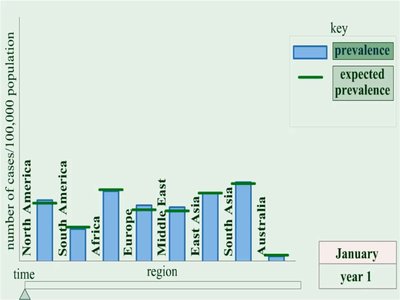
Incidence: Number of new cases during a specific time period.
Prevalence: Total number of cases at a specified time, including old and new cases.
Patterns of Disease Occurrence
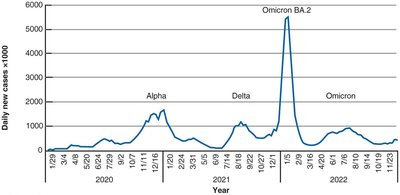
Sporadic disease: Occurs occasionally.
Endemic disease: Constantly present in a population.
Epidemic disease: Acquired by many people in a short time.
Pandemic disease: Worldwide epidemic.
Severity and Duration of Disease
Classification by Duration
Acute disease: Rapid onset, short duration.
Chronic disease: Slow development, long duration.
Subacute disease: Intermediate between acute and chronic.
Latent disease: Inactive for a time, then activates.
Herd immunity: Immunity in most of a population.
Classification by Severity
Asymptomatic: No signs or symptoms.
Mild: Fever, dry cough, tiredness, muscle pain, sore throat.
Moderate: Breathlessness, tachycardia, persistent cough, higher fever.
Severe: Pneumonia, extreme breathlessness, chest pain, high temperature, bluish lips/face.
Critical: Severe acute respiratory syndrome (SARS), inflamed alveoli, may require ventilator.
Sepsis: Extreme inflammatory syndrome in response to severe infection.
Fatality Ratios
Infection fatality ratio (IFR):
Case fatality ratio (CFR):
Extent of Host Involvement
Types of Infection
Local infection: Pathogens limited to a small area.
Systemic infection: Spread throughout the body via blood and lymph.
Focal infection: Systemic infection that began as a local infection.
Blood-related Conditions
Sepsis: Toxic inflammatory condition from spread of microbes or toxins.
Bacteremia: Bacteria in the blood.
Septicemia: Growth of bacteria in the blood.
Toxemia: Toxins in the blood.
Viremia: Viruses in the blood.
Infection Progression
Primary infection: Acute infection causing initial illness.
Secondary infection: Opportunistic infection after a primary infection.
Subclinical infection: No noticeable signs or symptoms.
Predisposing Factors
Nutrition, sex, genetic inheritance, climate, environment, vaccination, age, lifestyle, compromised host.
Development of Disease
Stages of Disease
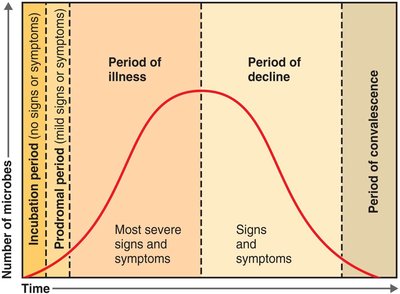
The progression of disease follows distinct stages, from initial infection to recovery.
Incubation period: Interval between infection and first signs/symptoms.
Prodromal period: Early, mild, nonspecific symptoms.
Period of illness: Disease is most severe.
Period of decline: Signs and symptoms subside.
Period of convalescence: Recovery; body returns to prediseased state.
Reservoirs of Infection
Types of Reservoirs
Reservoirs are continual sources of infection, classified as human, animal, or nonliving.
Human reservoirs: People with symptoms or carriers (asymptomatic, incubating, convalescent, chronic, passive).
Animal reservoirs: Zoonoses are diseases primarily in animals that can be transmitted to humans.
Nonliving reservoirs: Soil, water, foods.
Selected Zoonoses
Disease | Reservoir | Causative Agent | Transmission |
|---|---|---|---|
Influenza | Swine, birds | Alphainfluenzavirus | Direct contact |
Rabies | Bats, skunks, foxes, dogs, raccoons | Lyssavirus | Direct contact (bite) |
West Nile encephalitis | Horses, birds | Flavivirus | Mosquito bite |
Anthrax | Domestic livestock | Bacillus anthracis | Contact with contaminated hides/animals, air, food |
Ringworm | Domestic mammals | Trichophyton, Microsporum, Epidermophyton | Direct contact, fomites |
Malaria | Monkeys | Plasmodium spp. | Mosquito bite |
Tapeworm (pork) | Pigs | Taenia solium | Ingestion of undercooked pork |
Transmission of Disease
Contact Transmission
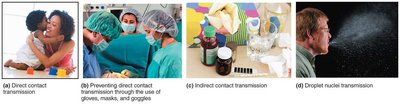
Contact transmission involves direct or indirect transfer of pathogens between hosts.
Direct contact: Close association between infected and susceptible host.
Congenital transmission: From mother to fetus/newborn at birth.
Indirect contact: Via nonliving object (fomite).
Droplet transmission: Airborne droplets less than 1 meter.
Vehicle Transmission
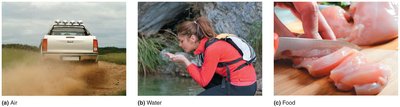
Vehicle transmission occurs via inanimate reservoirs such as air, water, or food.
Airborne: Pathogens carried by dust or droplets.
Waterborne: Pathogens spread through contaminated water.
Foodborne: Pathogens spread through contaminated food; cross-contamination possible.
Vector Transmission
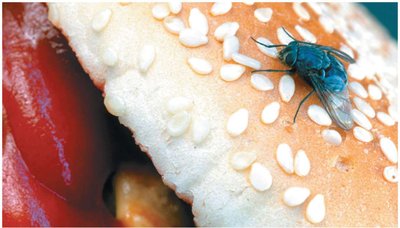
Vectors, primarily arthropods, transmit disease by mechanical or biological means.
Mechanical transmission: Pathogen carried on vector's body parts.
Biological transmission: Pathogen reproduces in vector; transmitted via bites or feces.
Representative Arthropod Vectors and Diseases
Arthropod Vector | Causative Agent | Disease |
|---|---|---|
Anopheles (mosquito) | Plasmodium spp. | Malaria |
Glossina (tsetse fly) | Trypanosoma brucei | African trypanosomiasis |
Triatoma (kissing bug) | T. cruzi | Chagas' disease |
Aedes (mosquito) | Flavivirus yellow fever virus | Yellow fever |
Ixodes spp. (tick) | Ehrlichia spp. | Ehrlichiosis |
Xenopsylla cheopis (rat flea) | Yersinia pestis | Plague |
