 Back
Principles of Disease and Epidemiology: Microbiology Study Notes
Study Guide - Smart Notes
 Tailored notes based on your materials, expanded with key definitions, examples, and context.
Principles of Disease and Epidemiology
Pathology, Infection, and Disease
Understanding the principles of disease and epidemiology is fundamental in microbiology. This section introduces key terms and concepts related to the study of diseases caused by microorganisms.
Pathology: The scientific study of disease, including its causes, development, and effects on the body.
Etiology: The identification of the cause of a disease.
Pathogenesis: The process by which a disease develops in the body.
Infection: The invasion or colonization of the body by pathogenic microorganisms.
Disease: An abnormal state in which the body is not functioning normally.
The Human Microbiome
Establishment and Composition
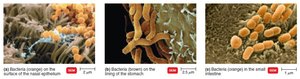
The human microbiome consists of all the microorganisms that reside on and within the human body. These microbes begin to establish before birth and are influenced by various factors throughout life.
Microbiome establishment begins in utero and continues through contact with food, people, and pets.
Normal microbiota: Microorganisms that permanently colonize the host without causing disease under normal conditions.
Transient microbiota: Microorganisms that are present temporarily.
Factors Affecting Microbiota
Nutrient availability
Physical and chemical environmental factors
Host immune defenses
Mechanical factors (e.g., movement of fluids)
Microbiota-Host Relationships
Normal microbiota interact with the host in various ways, often providing protection against pathogens.
Microbial antagonism (competitive exclusion): Normal microbiota compete with pathogens for nutrients and space, produce substances harmful to invaders, and alter local pH and oxygen levels.
Probiotics: Live beneficial microbes administered to promote health.
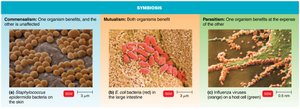
Types of Symbiosis
Symbiosis describes the relationship between normal microbiota and the host.
Commensalism: One organism benefits, the other is unaffected.
Mutualism: Both organisms benefit.
Parasitism: One organism benefits at the expense of the other.
Some normal microbiota can become opportunistic pathogens under certain conditions.
Koch’s Postulates
Establishing Disease Causation
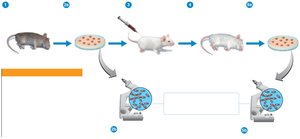
Koch’s postulates are a set of criteria used to establish a causative relationship between a microbe and a disease.
The same pathogen must be present in every case of the disease.
The pathogen must be isolated from the diseased host and grown in pure culture.
The cultured pathogen must cause the disease when introduced into a healthy, susceptible host.
The pathogen must be re-isolated from the experimentally infected host and shown to be the original organism.
Exceptions: Some pathogens cause multiple diseases, only infect humans, or cannot be cultured in the lab.
Classifying Infectious Diseases
Definitions and Types
Symptoms: Subjective changes felt by the patient (e.g., pain, fatigue).
Signs: Objective changes that can be measured or observed (e.g., fever, rash).
Syndrome: A group of signs and symptoms that characterize a disease.
Communicable disease: Can be spread from person to person (e.g., tuberculosis).
Contagious disease: Easily and rapidly spread (e.g., measles).
Noncommunicable disease: Not spread between hosts (e.g., tetanus).
Occurrence of Disease
Incidence and Prevalence
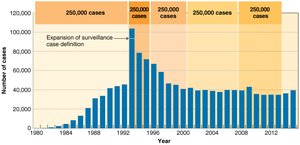
Incidence: Number of new cases in a specific time period.
Prevalence: Total number of cases (new and existing) at a given time.
Frequency and Patterns
Sporadic disease: Occurs occasionally (e.g., typhoid fever).
Endemic disease: Constantly present in a population (e.g., common cold).
Epidemic disease: Many people acquire in a short time (e.g., influenza).
Pandemic disease: Worldwide epidemic (e.g., COVID-19).
Herd immunity: Immunity in most of a population reduces disease spread.
Severity and Duration of Disease
Acute disease: Rapid onset, short duration (e.g., flu).
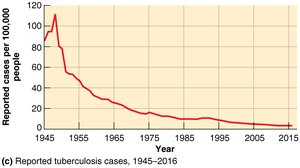
Chronic disease: Develops slowly, persists (e.g., tuberculosis).
Subacute disease: Intermediate between acute and chronic.
Latent disease: Pathogen inactive for a time, then reactivates (e.g., shingles from varicella virus).
Extent of Host Involvement
Local infection: Confined to a small area (e.g., boils).
Systemic infection: Spread throughout the body (e.g., measles).
Focal infection: Starts local, spreads to other areas (e.g., endocarditis from Streptococcus).
Sepsis: Toxic inflammatory response from spread of microbes or toxins.
Bacteremia: Bacteria in the blood.
Septicemia: Growth of bacteria in the blood (blood poisoning).
Toxemia: Toxins in the blood.
Viremia: Viruses in the blood.
Primary infection: Initial acute infection (e.g., HIV/AIDS).
Secondary infection: Opportunistic infection after primary (e.g., Pneumocystis pneumonia after AIDS).
Subclinical disease: No noticeable symptoms (e.g., Hepatitis A).
Patterns and Development of Disease
Sequence of Events
Reservoir of infection
Susceptible host
Transmission (direct, indirect, vector)
Invasion and multiplication
Pathogenesis (host injury)
Predisposing Factors
Gender, inherited traits, climate, lack of vaccination, fatigue, age, lifestyle, nutrition, chemotherapy
Stages of Disease
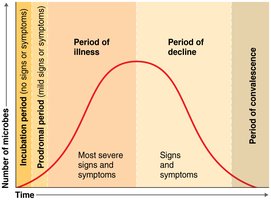
Incubation period: Time between infection and first symptoms.
Prodromal period: Early, mild symptoms.
Period of illness: Most severe symptoms.
Period of decline: Symptoms subside.
Period of convalescence: Recovery and return to normal.
Reservoirs and Transmission of Infection
Reservoirs of Infection
Human reservoirs: People with active or latent infections (e.g., AIDS, Typhoid Mary).
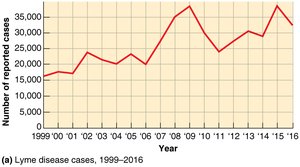
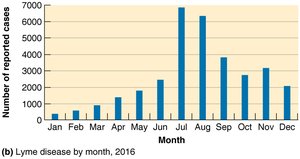
Animal reservoirs: Zoonoses (e.g., rabies, Lyme disease).
Nonliving reservoirs: Soil and water (e.g., gastrointestinal diseases).
Modes of Transmission
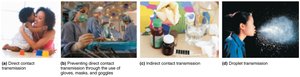
Contact transmission: Direct (person-to-person), indirect (via fomites), droplet (airborne droplets <1 meter).
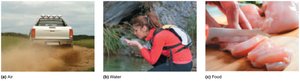
Vehicle transmission: Via inanimate reservoirs (air, water, food).
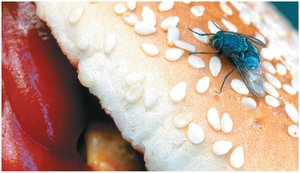
Vector transmission: Arthropods (fleas, ticks, mosquitoes) transmit pathogens mechanically (on body) or biologically (pathogen reproduces in vector).
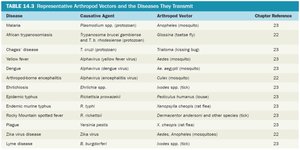
Representative Arthropod Vectors
Arthropods are important vectors for many infectious diseases.
Disease | Causative Agent | Arthropod Vector |
|---|---|---|
Malaria | Plasmodium spp. (protozoan) | Anopheles (mosquito) |
Chagas' disease | Trypanosoma cruzi (protozoan) | Triatoma (kissing bug) |
Lyme disease | Borrelia burgdorferi (bacterium) | Ixodes spp. (tick) |
Dengue | Dengue virus | Aedes (mosquito) |
Rocky Mountain spotted fever | Rickettsia rickettsii | Dermacentor (tick) |
West Nile virus | West Nile virus | Culex (mosquito) |
Zika virus disease | Zika virus | Aedes (mosquito) |
Plague | Yersinia pestis | Xenopsylla (rat flea) |
Healthcare-Associated Infections (HAIs)
Overview and Causes
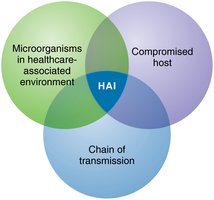
HAIs, also known as nosocomial infections, are acquired during medical care. They are a significant cause of morbidity and mortality.
Result from microorganisms in healthcare environments, compromised hosts, and chains of transmission.
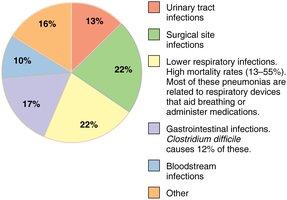
Common sites: urinary tract, surgical sites, respiratory tract, gastrointestinal tract, bloodstream.
Microorganisms Involved in HAIs
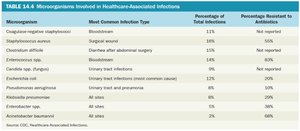
Microorganism | Most Common Infection Type | % of Total Infections | % Resistant to Antibiotics |
|---|---|---|---|
Coagulase-negative staphylococci | Bloodstream | 15% | Not reported |
Staphylococcus aureus | Surgical wound | 18% | 55% |
Enterococcus spp. | Diarrhea after abdominal surgery | 14% | 83% |
Clostridium difficile | Gastrointestinal | 12% | Not reported |
Escherichia coli | Urinary tract | 10% | 20% |
Pseudomonas aeruginosa | Urinary tract, pneumonia | 8% | 29% |
Klebsiella pneumoniae | All sites | 8% | 31% |
Acinetobacter baumannii | All sites | 2% | 66% |
Control of HAIs
Universal and standard precautions (handwashing, disinfection, use of disposable equipment).
Transmission-based precautions for known or suspected infections (contact, droplet, airborne).
Infection control committees monitor and enforce protocols.
Emerging Infectious Diseases
Definition and Contributing Factors
Emerging infectious diseases are new or increasing in incidence, often zoonotic and vector-borne.
Genetic recombination and evolution of new strains (e.g., E. coli O157, avian influenza H5N1).
Antibiotic resistance due to overuse of antibiotics and pesticides.
Changes in weather, modern transportation, ecological disruption, and public health failures.
Examples: Zika virus, West Nile virus, Lyme disease, Coccidioidomycosis.
Epidemiology
Principles and Methods
Epidemiology is the study of disease occurrence and transmission in populations. Epidemiologists identify causes, track spread, and develop control methods.
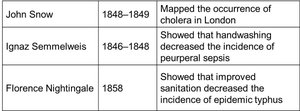
Descriptive epidemiology: Collects and analyzes data (e.g., John Snow's cholera mapping).
Analytical epidemiology: Determines probable cause (e.g., Florence Nightingale's sanitation studies).
Experimental epidemiology: Uses controlled experiments (e.g., Semmelweis's handwashing trials).
Clinical trial: Compares test and control groups.
Scientist | Years | Contribution |
|---|---|---|
John Snow | 1848–1849 | Mapped cholera in London |
Ignaz Semmelweis | 1846–1848 | Showed handwashing reduced puerperal sepsis |
Florence Nightingale | 1858 | Improved sanitation reduced epidemic typhus |
CDC and Disease Reporting
The Centers for Disease Control and Prevention (CDC) collects and analyzes epidemiological data in the U.S.
Publishes the Morbidity and Mortality Weekly Report (MMWR).
Morbidity: Incidence of a specific notifiable disease.
Mortality: Deaths from notifiable diseases.
Morbidity rate:
Mortality rate:
