 Back
BackPrinciples of Disease and Epidemiology: Microbiology Study Notes
Study Guide - Smart Notes
 Tailored notes based on your materials, expanded with key definitions, examples, and context.
Principles of Disease and Epidemiology
Pathology, Infection, and Disease
Pathology is the scientific study of disease, focusing on the cause (etiology), development (pathogenesis), and the structural and functional changes in the body. Infection refers to the invasion or colonization of the body by pathogenic microorganisms, while disease is the abnormal state resulting from infection, where normal body functions are disrupted.
Normal Microbiota
Establishment and Distribution
Humans are generally free of microbes in utero, but at birth, normal microbiota begin to establish. The first exposure is often to Lactobacillus from the mother's vagina, which colonizes the newborn's intestines. Microbiota are then acquired from the environment and remain throughout life. The human body contains about 10 times more bacterial cells than human cells.
Normal microbiota (normal flora): Permanent residents that do not cause disease under normal conditions.
Transient microbiota: Present temporarily and then disappear.
Distribution and composition are influenced by nutrients, physical and chemical factors (temperature, pH, O2, CO2, salinity, sunlight), host defenses, and mechanical factors (chewing, GI flow, urine flushing). Other factors include age, diet, health, hygiene, and lifestyle.
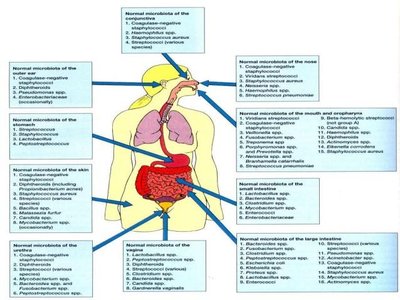
Relationships Between Normal Microbiota and the Host
Microbial antagonism (competitive exclusion): Normal microbiota prevent overgrowth of harmful organisms by competing for nutrients, producing inhibitory substances, and altering environmental conditions.
Symbiosis: Relationship between two organisms where at least one benefits.
Commensalism: One benefits, the other is unaffected (e.g., Staphylococcus epidermidis).
Mutualism: Both benefit (e.g., Escherichia coli in the intestine synthesizes vitamins for the host).
Parasitism: One benefits at the expense of the other (many pathogens).
Opportunistic microorganisms: Normally harmless but can cause disease in altered environments or immunocompromised hosts.
Etiology of Infectious Diseases
Koch’s Postulates
Robert Koch established criteria to identify the causative agent of infectious diseases:
The same pathogen must be present in every case of the disease.
The pathogen must be isolated and grown in pure culture.
The cultured pathogen must cause disease in a healthy host.
The pathogen must be re-isolated from the experimentally infected host.
Exceptions include pathogens with unique culture requirements, diseases caused by multiple organisms, pathogens causing multiple diseases, and ethical limitations (e.g., HIV).
Classifying Infectious Diseases
Symptoms, Signs, and Syndromes
Symptoms: Subjective changes (e.g., pain, malaise).
Signs: Objective, measurable changes (e.g., fever, swelling).
Syndrome: Specific group of signs and symptoms associated with a disease.
Communicability
Communicable disease: Spreads from host to host (e.g., chickenpox, tuberculosis).
Contagious disease: Easily spread (e.g., measles).
Noncommunicable disease: Not spread between hosts (e.g., tetanus).
Occurrence of Disease
Incidence: Number of new cases in a time period (indicator of spread).
Prevalence: Total number of cases at a given time (indicator of how widespread and long-lasting).
Classification by Frequency
Sporadic: Occurs occasionally (e.g., typhoid fever).
Endemic: Constantly present (e.g., common cold).
Epidemic: Many cases in a short period (e.g., influenza).
Pandemic: Worldwide epidemic (e.g., AIDS, COVID-19).
Severity or Duration
Acute: Rapid onset, short duration (e.g., influenza).
Chronic: Slow development, long duration (e.g., tuberculosis).
Subacute: Intermediate between acute and chronic.
Latent: Inactive for a time, then active (e.g., shingles).
Population immunity (herd immunity) can limit disease spread, especially through vaccination.
Extent of Host Involvement
Local infection: Limited to a small area (e.g., boils).
Systemic infection: Spread throughout the body (e.g., measles).
Focal infection: Local infection spreads to other areas.
Sepsis: Toxic inflammatory condition from spread of microbes or toxins.
Septicemia: Pathogens multiplying in blood (blood poisoning).
Bacteremia: Bacteria in blood.
Toxemia: Toxins in blood.
Viremia: Viruses in blood.
Primary infection: Initial acute infection.
Secondary infection: Caused by opportunists after primary infection weakens defenses.
Subclinical infection: No noticeable illness.
Patterns and Development of Disease
Sequence of Disease Development
Infectious diseases follow a sequence: reservoir, transmission, invasion, pathogenesis, and host resistance. Predisposing factors (e.g., age, nutrition, genetics, environment) can increase susceptibility.
Stages of Disease
Incubation period: Time between infection and first symptoms; depends on organism, virulence, dose, and host resistance.
Prodromal period: Short period with mild, general symptoms.
Period of illness: Most severe signs and symptoms; immune response is critical.
Period of decline: Signs and symptoms subside; risk of secondary infection.
Period of convalescence: Recovery and return to normal; pathogen may still be spread.
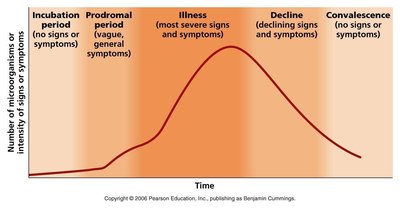
Spread of Infection
Reservoirs of Infection
Human reservoirs: People with disease or carriers (e.g., AIDS, hepatitis).
Animal reservoirs: Zoonoses are diseases transmitted from animals to humans (e.g., rabies, Lyme disease).
Nonliving reservoirs: Soil (e.g., Clostridium), water (e.g., Vibrio cholerae), and food.
Transmission of Disease
Contact transmission: Direct (person-to-person), indirect (via fomites), or droplet (short-range airborne).
Vehicle transmission: Via water, food, air, blood, or other fluids.
Vector transmission: Arthropods (e.g., insects) transmit pathogens mechanically (on body) or biologically (bite and pathogen development in vector).
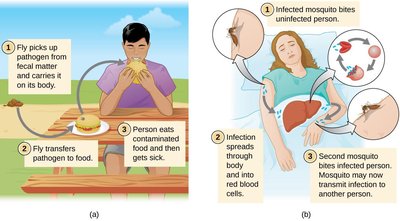
Nosocomial (Hospital-Acquired) Infections
Overview and Risk Factors
Nosocomial infections (now called healthcare-associated infections, HAIs) are acquired in healthcare settings. They result from the interaction of microorganisms in the hospital, compromised hosts, and transmission chains.
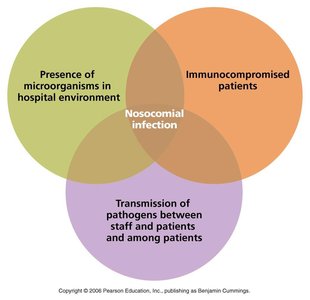
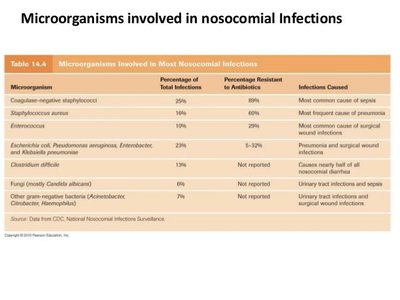
Microorganisms Involved
Microorganism | Percentage of Total Infections | Percentage Resistant to Antibiotics | Infections Caused |
|---|---|---|---|
Coagulase-negative staphylococci | 15% | 89% | Sepsis |
Staphylococcus aureus | 15% | 60% | Surgical wound infections |
Enterococcus | 10% | 29% | Surgical wound and urinary tract infections |
Escherichia coli, Pseudomonas aeruginosa, Enterobacter, Klebsiella | 23% | 3-32% | Surgical wound and urinary tract infections |
Clostridium difficile | 13% | Not reported | Diarrhea |
Fungi (mainly Candida albicans) | 6% | Not reported | Urinary tract infections and sepsis |
Other gram-negative bacteria (Acinetobacter, Citrobacter, Haemophilus) | 7% | Not reported | Urinary tract and wound infections |
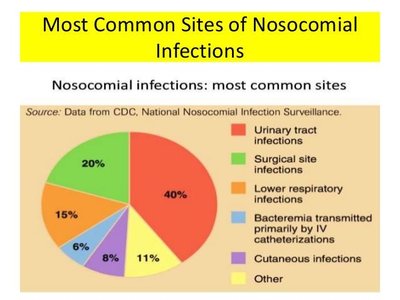
Most Common Sites of Nosocomial Infections
Site | Percentage |
|---|---|
Urinary tract infections | 40% |
Surgical site infections | 20% |
Lower respiratory infections | 15% |
Bacteremia (IV catheterization) | 11% |
Cutaneous infections | 8% |
Other | 6% |
Control of Nosocomial Infections
Use aseptic techniques and handle contaminated materials carefully.
Frequent and thorough handwashing is the most important preventive measure.
Educate staff, use isolation rooms, and reduce patient exposure to pathogens.
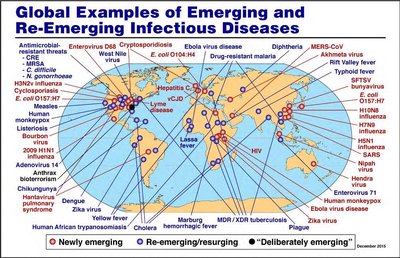
Emerging Infectious Diseases (EIDs)
EIDs are new or changing diseases with increasing incidence or potential to increase. About 75% are zoonotic, mainly viral. Examples include Ebola, MERS-CoV, and drug-resistant tuberculosis.
Epidemiology
Epidemiology is the science of when, where, and how diseases occur and are transmitted in populations.
Descriptive epidemiology: Collects data on disease occurrence.
Analytical epidemiology: Determines probable cause of disease.
Experimental epidemiology: Tests hypotheses about disease causes through controlled experiments.
