 Back
BackPrinciples of Disease and Epidemiology: Study Notes
Study Guide - Smart Notes
 Tailored notes based on your materials, expanded with key definitions, examples, and context.
Principles of Disease and Epidemiology
Pathology, Infection, and Disease
Pathology is the scientific study of disease, focusing on its causes, development, and effects on the body. Understanding the distinctions between infection and disease is crucial in microbiology.
Pathology: Study of disease, including its causes and effects.
Etiology: The cause of a disease (e.g., a specific microorganism).
Pathogenesis: The manner in which a disease develops in the host.
Infection: Invasion or colonization of the body by pathogenic microorganisms.
Infectious disease: A disease in which an infection results in a change from a healthy state.
An infection may exist without causing detectable disease.
Disease can result when microorganisms colonize areas of the body where they are not normally found.
The Human Microbiome
The human microbiome consists of all the microorganisms that reside on and within the human body. These microbes play essential roles in health and disease.
Begins to establish before birth (in utero).
Placental microbiome includes Enterobacteriaceae and Propionibacterium.
Lactobacilli colonize the neonate's intestine during vaginal birth.
Microorganisms are acquired from food, people, and pets throughout life.
Microbiome size: ~3x10¹³ human cells vs. ~4x10¹³ bacterial cells.
The Human Microbiome Project studies t00he relationship between microbial communities and human health.
Normal microbiota (flora): Permanently colonize the host without causing disease under normal conditions.
Transient microbiota: Present temporarily and then disappear.
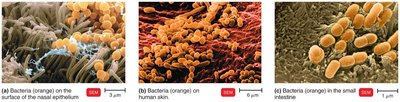
Distribution and Role of Normal Microbiota
The composition and distribution of normal microbiota are influenced by various factors and play a significant role in immune system development.
Factors: Nutrients, physical/chemical factors, mechanical factors, body defenses, age, diet, hygiene, geography, lifestyle.
Normal microbiota help develop the immune system.
Birth, Microbiome, and Health Conditions
The mode of birth affects the initial microbiome and may influence long-term health outcomes.
Vaginal birth: I0
Cesarean birth: Microbiome resembles skin flora, such as Staphylococcus aureus.
Associations with increased risk of type 1 diabetes, asthma, and obesity.
Relationships Between Normal Microbiota and the Host
Normal microbiota interact with the host in various ways, including protective mechanisms and symbiotic relationships.
Microbial antagonism (competitive exclusion): Normal microbiota compete with pathogens for nutrients and produce substances (e.g., bacteriocins) that inhibit pathogens.
They can alter pH and oxygen availability, affecting pathogen survival.
Disruption (e.g., antibiotics) can lead to infections like Clostridium difficile.
Fecal microbial transfer (FMT) can restore normal microbiota.
Symbiosis: Close association between two organisms; types include:
Commensalism: One benefits, the other is unaffected.
Mutualism: Both benefit.
Parasitism: One benefits at the other's expense (many pathogens).
Some normal microbiota are opportunistic pathogens.
Koch’s Postulates
Establishing the Cause of Infectious Diseases
Koch’s postulates are a set of criteria used to prove that a specific microorganism causes a specific disease.
The same pathogen must be present in every case of the disease.
The pathogen must be isolated and grown in pure culture.
The cultured pathogen must cause disease when introduced into a healthy host.
The pathogen must be re-isolated from the experimentally infected host and identified as the original organism.
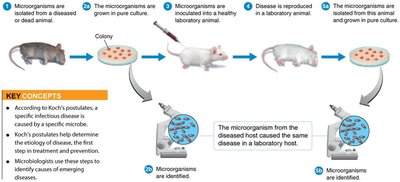
Exceptions: Some pathogens cause multiple diseases, only infect humans, or cannot be cultured (e.g., Treponema pallidum).
Different pathogens may cause similar symptoms (e.g., pneumonia).
Classifying Infectious Diseases
Symptoms, Signs, and Syndromes
Diseases are classified based on their observable and subjective effects on the host.
Symptoms: Subjective changes felt by the patient (e.g., pain).
Signs: Objective, measurable changes (e.g., fever).
Syndrome: A specific group of signs and symptoms that characterize a disease.
Communicability of Diseases
Communicable disease: Spread from one host to another (e.g., COVID-19, influenza).
Contagious disease: Easily and rapidly spread (e.g., measles).
Noncommunicable disease: Not spread between hosts (e.g., tetanus).
Occurrence of Disease
Incidence and prevalence are key epidemiological measures.
Incidence: Number of new cases in a specific time period.
Prevalence: Total number of cases (old and new) at a specific time.
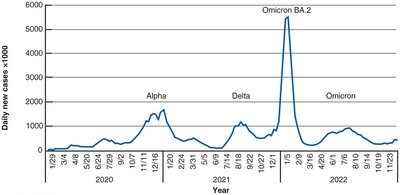
Sporadic disease: Occurs occasionally (e.g., typhoid fever).
Endemic disease: Constantly present in a population (e.g., common cold).
Epidemic disease: Many people acquire in a short time (e.g., influenza).
Pandemic disease: Worldwide epidemic (e.g., COVID-19).
Severity and Duration of Disease
Acute disease: Rapid onset, short duration (e.g., influenza).
Chronic disease: Develops slowly, lasts long (e.g., hepatitis).
Latent disease: Inactive for a time, then activates (e.g., shingles).
Herd immunity: Immunity in most of a population reduces disease spread.
Severity of Disease (COVID-19 Example)
Asymptomatic: No signs or symptoms.
Mild: Fever, dry cough, tiredness.
Moderate: Breathlessness, persistent cough, higher fever.
Severe: Pneumonia, extreme breathlessness, chest pain.
Critical: Severe acute respiratory syndrome (SARS), may require ventilator.
Sepsis: Extreme inflammatory response to infection.
Extent of Host Involvement
Local infection: Limited to a small area (e.g., boils).
Systemic infection: Spread throughout the body (e.g., measles).
Focal infection: Starts local, spreads systemically (e.g., bacterial endocarditis).
Sepsis: Toxic inflammatory condition from spread of microbes or toxins.
Bacteremia: Bacteria in the blood.
Septicemia: Growth of bacteria in the blood.
Toxemia: Toxins in the blood.
Viremia: Viruses in the blood.
Primary infection: Initial acute infection.
Secondary infection: Opportunistic infection after primary infection.
Subclinical infection: No noticeable symptoms (e.g., hepatitis A).
Predisposing Factors
Factors that increase susceptibility to disease or alter its course include:
Nutrition, sex, genetic inheritance, climate, environment, vaccination, age, lifestyle, compromised host status.
Development of Disease
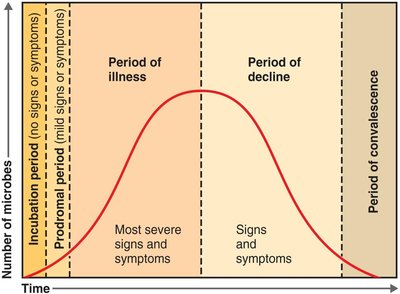
The progression of disease follows several stages, each with characteristic features.
Incubation period: Time between infection and first symptoms.
Prodromal period: Early, mild symptoms.
Period of illness: Most severe signs and symptoms.
Period of decline: Symptoms subside.
Period of convalescence: Recovery; return to prediseased state.
Reservoirs and Transmission of Infection
Reservoirs of Infection
Reservoirs are continual sources of infection, which may be human, animal, or nonliving.
Human reservoirs: People with symptoms or carriers (asymptomatic, incubating, convalescent, chronic, passive).
Animal reservoirs: Zoonoses are diseases transmitted from animals to humans (e.g., rabies, Lyme disease).
Nonliving reservoirs: Soil, water, and food (e.g., Clostridium tetani in soil).
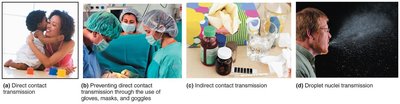
Contact Transmission
Contact transmission involves direct or indirect transfer of pathogens between hosts.
Direct contact: Physical contact between infected and susceptible individuals.
Congenital transmission: From mother to fetus or newborn.
Indirect contact: Via fomites (nonliving objects).
Droplet transmission: Airborne droplets within 1 meter.
Vehicle Transmission
Vehicle transmission occurs via inanimate reservoirs such as air, water, or food.
Airborne: Pathogens carried on dust or droplets over long distances.
Waterborne: Contaminated water transmits pathogens.
Foodborne: Contaminated food transmits pathogens; cross-contamination is possible.

Vector Transmission
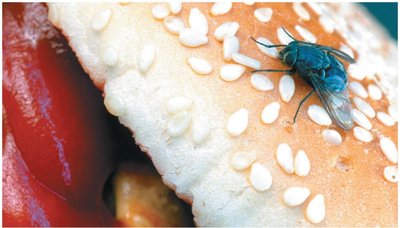
Vectors, mainly arthropods, transmit pathogens by mechanical or biological means.
Mechanical transmission: Pathogen carried on vector's body (e.g., fly's feet).
Biological transmission: Pathogen reproduces in vector and is transmitted via bites or feces.
Healthcare-Associated Infections (HAIs)
Overview of HAIs
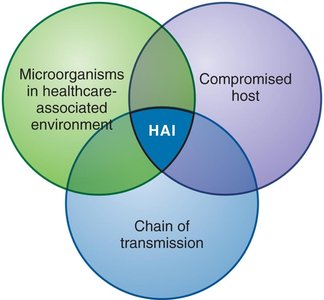
HAIs, or nosocomial infections, are acquired during treatment in healthcare facilities and are a significant public health concern.
1 in 31 hospital patients in the U.S. acquire HAIs annually.
Causes: Microorganisms in hospitals, compromised hosts, and chains of transmission.
Compromised host: Individual with impaired resistance due to disease, therapy, or burns.
Types and Causes of HAIs
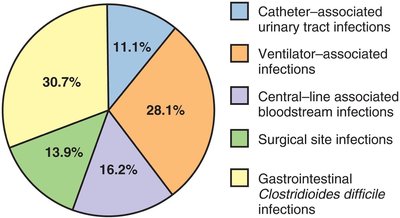
Common pathogens: Clostridium difficile, antibiotic-resistant bacteria.
Risk factors: Broken skin, suppressed immune system, invasive procedures.
Chain of Transmission in Hospitals
Direct contact: Staff to patient, patient to patient.
Indirect contact: Fomites (catheters, needles, dressings), ventilation systems.
Emerging Infectious Diseases
Definition and Contributing Factors
Emerging infectious diseases are new, changing, or increasing in incidence, often zoonotic and vector-borne.
Genetic recombination (e.g., E. coli O157:H7, avian influenza H5N1).
Evolution of organisms (e.g., Vibrio cholerae O139).
Antibiotic/pesticide use leading to resistance.
RNA viruses: High genetic instability, antigenic shift/drift.
Climate change, modern transportation, ecological disruption, animal control, public health failures, bioterrorism.
Epidemiology
Principles and Roles
Epidemiology studies the occurrence, distribution, and control of diseases in populations.
Determines etiology and spread patterns.
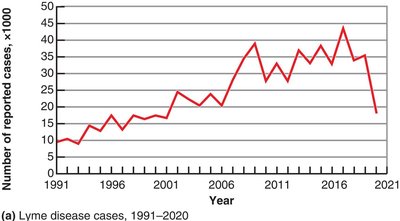
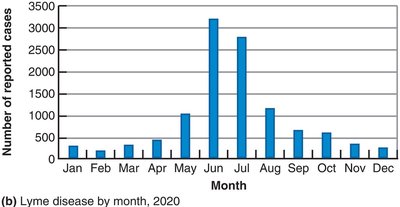
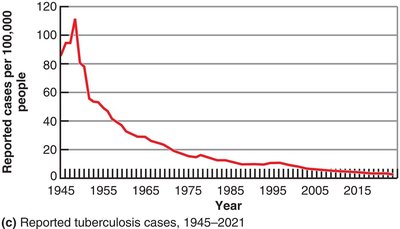
Assembles data and graphs to track disease incidence.
Predicts spread using the reproductive number (): average number of people infected by one case.
Develops control strategies.
Historical Contributions
John Snow: Mapped cholera outbreak in London (1848–1849).
Ignaz Semmelweis: Demonstrated handwashing reduced puerperal sepsis (1846–1848).
Florence Nightingale: Showed improved sanitation reduced epidemic typhus (1858).
Epidemiological Graphs
Types of Epidemiology
Descriptive epidemiology: Collects and analyzes data (e.g., Snow's cholera study).
Analytical epidemiology: Determines probable cause/risk factors (e.g., Nightingale's work).
Experimental epidemiology: Tests hypotheses with controlled experiments (e.g., Semmelweis).
Clinical trial: Involves test and control groups.
Case Reporting and Public Health
Case reporting helps establish chains of transmission and provides early outbreak warnings.
Notifiable infectious diseases must be reported to health authorities.
The Centers for Disease Control and Prevention (CDC)
Collects and analyzes epidemiological data in the U.S.
Publishes the Morbidity and Mortality Weekly Report (MMWR).
Morbidity: Incidence of a specific notifiable disease.
Mortality: Deaths from notifiable diseases.
Morbidity rate: Number of affected individuals per population in a time period.
Mortality rate: Number of deaths per population in a time period.
