 Back
BackPrinciples of Disease and Epidemiology – Study Notes
Study Guide - Smart Notes
 Tailored notes based on your materials, expanded with key definitions, examples, and context.
Principles of Disease and Epidemiology
Pathology, Infection, and Disease
Understanding the principles of disease and epidemiology is fundamental in microbiology. These concepts define how diseases originate, develop, and spread within populations.
Pathology: The scientific study of disease, including its causes, development, and effects on the body.
Etiology: The cause or origin of a disease.
Pathogenesis: The mechanism by which a disease develops in the host.
Infection: The invasion or colonization of the body by pathogenic microorganisms.
Infectious disease: A disease in which an infection leads to a change in health status.
Colonization: The presence of microorganisms in or on a host without causing disease at that time.
Key Definitions and Concepts
Carrier state: A person who harbors a pathogen without showing symptoms but can transmit it to others.
Pathogen: An organism capable of causing disease.
Overt pathogen: Likely to cause disease in healthy hosts.
Opportunistic pathogen: Causes disease mainly in immunocompromised hosts.
The Human Microbiome
Establishment and Composition
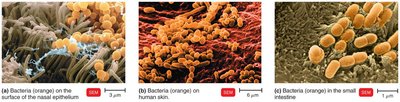
The human microbiome consists of all the microorganisms that reside on and within the human body. It begins to establish before birth and continues to develop throughout life, influenced by various factors.
Microbiome establishment begins in utero (placental microbiome).
Lactobacilli colonize the neonate's intestine during vaginal birth.
Microorganisms are acquired from food, people, and pets.
The microbiome contributes to both health and disease.
Normal microbiota (flora): Permanently colonize the host without causing disease under normal conditions. Transient microbiota: Present temporarily and then disappear.
Factors Influencing Normal Microbiota
Nutrients, physical and chemical factors, mechanical factors, and host defenses.
Other influences: age, diet, geography, hygiene, occupation, and lifestyle.
Normal microbiota play a role in immune system development.
Representative Normal Microbiota by Body Region
Region | Principal Components | Comments |
|---|---|---|
Skin | Propionibacterium, Staphylococcus, Corynebacterium, Micrococcus, Acinetobacter, Brevibacterium, Candida (fungus), Malassezia (fungus) | Secretions inhibit microbes; low pH and moisture; keratin barrier. |
Eyes (Conjunctiva) | Staphylococcus epidermidis, S. aureus, diphtheroids, Propionibacterium, Corynebacterium, streptococci, Micrococcus | Tears and blinking remove/inhibit microbes; lysozyme present. |
Nose and Throat | S. aureus, S. epidermidis, diphtheroids, Streptococcus pneumoniae, Haemophilus, Neisseria | Microbial antagonism; mucus and ciliary action remove microbes. |
Mouth | Streptococcus, Lactobacillus, Actinomyces, Bacteroides, Veillonella, Neisseria, Haemophilus, Fusobacterium, Treponema, Staphylococcus, Corynebacterium, Candida (fungus) | Moist, warm, food-rich; saliva contains antimicrobials. |
Large Intestine | E. coli, Bacteroides, Fusobacterium, Lactobacillus, Enterococcus, Bifidobacterium, Enterobacter, Citrobacter, Proteus, Klebsiella, Candida (fungus) | Largest numbers; microbial antagonism; mucus and shedding prevent attachment. |
Urinary and Genital Systems | Staphylococcus, Micrococcus, Enterococcus, Lactobacillus, Bacteroides, diphtheroids, Pseudomonas, Klebsiella, Proteus, Candida albicans (fungus), Trichomonas vaginalis (protozoan) | Acidic secretions; urine flow removes microbes; mucus and cilia expel microbes. |
Colonized vs. Sterile Sites
Colonized: Intestinal tract, upper respiratory tract, distal genitourinary tract, skin.
Sterile: Blood, cerebrospinal fluid (CSF), interstitial fluid, lymph.
Birth and Microbiome
Vaginal birth: Microbiome dominated by Lactobacillus and Bacteroides.
Cesarean birth: Microbiome resembles skin flora, e.g., Staphylococcus aureus.
Relationships Between Microbiota and Host
Microbial Antagonism and Symbiosis
Normal microbiota protect the host by competing with pathogens, producing harmful substances, and altering environmental conditions (pH, oxygen).
Microbial antagonism: Competition between microbes for nutrients and space.
Fecal Microbial Transfer (FMT): Used to restore normal microbiota, e.g., in Clostridium difficile infections.
Types of Symbiosis
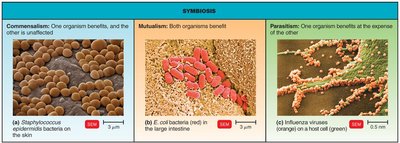
Commensalism: One organism benefits, the other is unaffected.
Mutualism: Both organisms benefit.
Parasitism: One organism benefits at the expense of the other.
Some normal microbiota are opportunistic pathogens.
Koch’s Postulates
Steps and Importance
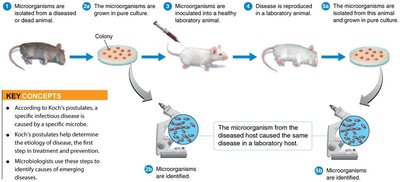
Koch’s postulates are a set of criteria used to establish a causative relationship between a microbe and a disease.
The same pathogen must be present in every case of the disease.
The pathogen must be isolated and grown in pure culture.
The cultured pathogen must cause disease when introduced into a healthy host.
The pathogen must be re-isolated from the experimentally infected host and identified as the original organism.
Exceptions: Some pathogens cause multiple diseases, only infect humans, cannot be cultured, or share symptoms with other pathogens.
Classifying Infectious Diseases
Symptoms, Signs, and Syndromes
Symptoms: Subjective changes felt by the patient (e.g., pain, fatigue).
Signs: Objective, measurable changes (e.g., fever, rash).
Syndrome: A specific group of signs and symptoms that characterize a disease.
Communicability
Communicable disease: Spread from one host to another (e.g., influenza, tuberculosis).
Contagious disease: Easily and rapidly spread (e.g., measles).
Noncommunicable disease: Not spread between hosts (e.g., tetanus).
Occurrence of Disease
Incidence and Prevalence
Incidence: Number of new cases in a specific time period (indicates spread).
Prevalence: Total number of cases (old and new) at a specific time (indicates how widespread and long-lasting a disease is).
Patterns of Occurrence
Sporadic: Occurs occasionally.
Endemic: Constantly present in a population.
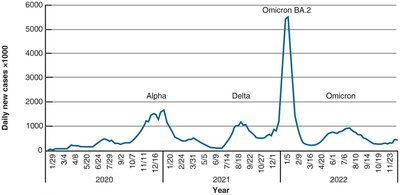
Epidemic: Many people acquire in a short time.
Pandemic: Worldwide epidemic.
Severity and Duration of Disease
Types of Disease Courses
Acute: Rapid onset, short duration.
Chronic: Develops slowly, lasts long.
Subacute: Intermediate between acute and chronic.
Latent: Pathogen inactive for a time, then activates (e.g., herpesvirus).
Herd immunity: Immunity in most of a population reduces disease spread.
Severity Examples (COVID-19)
Asymptomatic, mild, moderate, severe, critical (e.g., pneumonia, sepsis).
Fatality Ratios
Infection Fatality Ratio (IFR):
Case Fatality Ratio (CFR):
Extent of Host Involvement
Local infection: Confined to a small area.
Systemic infection: Spread throughout the body via blood or lymph.
Focal infection: Local infection that spreads to other areas.
Sepsis: Toxic inflammatory response to infection spreading in the body.
Bacteremia: Bacteria in the blood.
Septicemia: Proliferation of bacteria in the blood.
Toxemia: Toxins in the blood.
Viremia: Viruses in the blood.
Primary infection: Initial acute infection.
Secondary infection: Opportunistic infection after a primary infection.
Subclinical infection: No noticeable symptoms.
Predisposing Factors
Nutrition, sex, genetics, climate, environment, vaccination, age, lifestyle, compromised host status.
Development of Disease
Incubation period: Time between infection and first symptoms.
Prodromal period: Early, mild symptoms.
Period of illness: Most severe symptoms.
Period of decline: Symptoms subside.
Period of convalescence: Recovery phase.
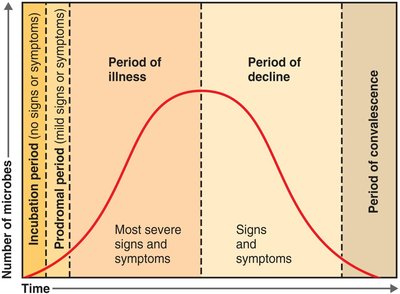
Spread of Infection
Encounter
Entry
Spread
Multiplication
Evasion of host defenses
Damage
Outcome: transmission to new host or recovery
Reservoirs of Infection
Human reservoirs: Symptomatic individuals, carriers (asymptomatic, incubating, convalescent, chronic, passive).
Animal reservoirs: Zoonoses (diseases transmitted from animals to humans).
Nonliving reservoirs: Soil, water, food.
Selected Zoonoses
Disease | Causative Agent | Reservoir | Transmission |
|---|---|---|---|
Influenza (some types) | Alphainfluenzavirus | Swine, birds | Direct contact |
Rabies | Lyssavirus | Bats, skunks, dogs, etc. | Bite (direct contact) |
Plague | Yersinia pestis | Rodents | Flea bites |
Malaria | Plasmodium spp. | Monkeys | Anopheles mosquito bite |
Ringworm | Trichophyton, etc. | Domestic mammals | Direct contact, fomites |
Transmission of Disease
Contact Transmission
Direct contact: Physical contact between infected and susceptible host.
Congenital transmission: Mother to fetus/newborn.
Indirect contact: Via fomites (nonliving objects).
Droplet transmission: Airborne droplets <1 meter.
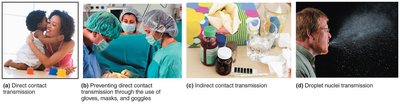
Vehicle Transmission
Airborne: Pathogens carried by dust or droplets over distances.
Waterborne: Contaminated water.
Foodborne: Contaminated food, cross-contamination.

Vector Transmission
Vectors: Arthropods (fleas, ticks, mosquitoes).
Mechanical transmission: Pathogen carried on vector's body parts.
Biological transmission: Pathogen reproduces in vector, transmitted via bite or feces.
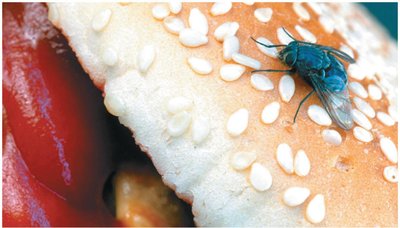
Healthcare-Associated Infections (HAIs)
Overview and Risk Factors
Acquired during treatment in healthcare facilities (nosocomial infections).
Result from interaction of microorganisms, compromised host, and chain of transmission.
High antimicrobial resistance among HAIs.
Clostridioides difficile is a leading cause.
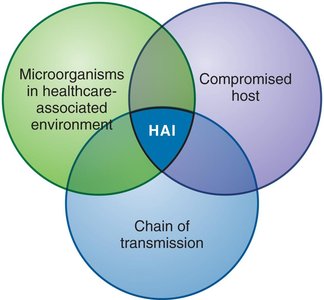
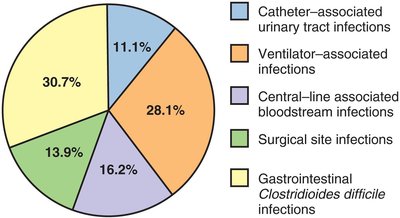
Principal Sites of HAIs
Catheter-associated urinary tract infections
Ventilator-associated infections
Central-line associated bloodstream infections
Surgical site infections
Gastrointestinal infections (e.g., C. difficile)
Control of HAIs
Universal precautions: Reduce transmission in healthcare settings.
Standard precautions: Hand hygiene, PPE, disinfection, safe practices.
Transmission-based precautions: For highly transmissible or epidemiologically important pathogens (contact, droplet, airborne).
Reduce pathogens: handwashing, cleaning, disposable equipment.
Improve resistance: prudent antibiotic use, minimize invasive procedures.
Infection control committees oversee practices.
Emerging Infectious Diseases
New, changing, or increasing in incidence.
Most are zoonotic, viral, and vector-borne.
Contributing factors: genetic recombination, evolution, antibiotic use, climate change, travel, ecological changes, public health failures, bioterrorism.
Epidemiology
Definition and Roles
Study of where, when, and how diseases occur and spread in populations.
Determines etiology, patterns, and control methods.
Calculates reproductive number (average number of secondary cases from one infected individual).
Types of Epidemiology
Descriptive: Data collection and analysis (e.g., John Snow's cholera map).
Analytical: Determines probable cause/risk factors (e.g., Nightingale's work).
Experimental: Hypothesis testing and controlled experiments (e.g., Semmelweis).
Case Reporting and Notifiable Diseases
Healthcare workers report specified diseases to authorities.
Provides early warning of outbreaks.
CDC publishes Morbidity and Mortality Weekly Report (MMWR).
Morbidity rate:
Mortality rate:
