Back
BackPrinciples of Disease, Epidemiology, and Host-Microbe Interactions
Study Guide - Smart Notes
 Tailored notes based on your materials, expanded with key definitions, examples, and context.
Pathology, Infection, and Disease
Key Definitions
Pathology: The scientific study of disease, including its causes, development, and effects on the body.
Etiology: The study of the cause of a disease.
Pathogenesis: The process by which disease develops in the host.
Infection: The colonization of the body by pathogenic microorganisms.
Disease: An abnormal state in which the body is not functioning normally.
Normal Microbiota and the Host
Types of Microbiota
Normal microbiota: Microorganisms that permanently colonize the host without causing disease under normal conditions.
Transient microbiota: Microbes that are present in the body for a short period (days, weeks, or months) and then disappear.
Symbiosis
Symbiosis: The relationship between normal microbiota and the host.
Commensalism: One organism benefits, the other is unaffected.
Mutualism: Both organisms benefit.
Parasitism: One organism benefits at the expense of the other.
Some normal microbiota are opportunistic pathogens, causing disease under certain conditions.
Microbial Antagonism and Host Protection
Microbial antagonism: Competition between microbes for resources and space.
Normal microbiota protect the host by:
Occupying niches that pathogens might occupy
Producing acids
Producing bacteriocins (antimicrobial peptides)
Probiotics: Live microbes administered to confer a health benefit to the host.
Distribution of Normal Microbiota
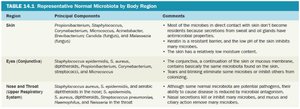
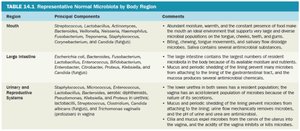
Normal flora are found in the skin, conjunctiva, nose & throat, mouth, large intestine, and urinary/reproductive systems.
Some body sites are sterile (free of microbes): back of the eye, lower respiratory tract, blood/heart, kidneys, abdominal and thoracic cavities, gonads, and uterus during pregnancy.
Koch’s Postulates
Steps to Prove Causation of Disease
The same pathogen must be present in every case of the disease.
The pathogen must be isolated from the diseased host and grown in pure culture.
The pathogen from the pure culture must cause the disease when inoculated into a healthy, susceptible animal.
The pathogen must be re-isolated from the inoculated animal and shown to be the original organism.
Exceptions: Some pathogens cause multiple diseases, only infect humans, or cannot be cultured (e.g., Rickettsia, viruses).
Types of Pathogens
Non-pathogen: Does not cause disease in healthy individuals.
True pathogen: Causes disease in healthy hosts.
Opportunistic pathogen: Causes disease only when the host's defenses are compromised.
Classifying Infectious Diseases
Symptoms, Signs, and Syndromes
Symptom: Subjective change in body function felt by the patient (e.g., pain, nausea).
Sign: Objective change that can be measured or observed (e.g., rash, fever).
Syndrome: A specific group of signs and symptoms that accompany a disease.
Communicability
Communicable disease: Spread from one host to another.
Contagious disease: Easily spread from one host to another.
Noncommunicable disease: Not transmitted from host to host.
Occurrence of Disease
Incidence: Number of new cases during a specific time period.
Prevalence: Total number of cases (old and new) at a specific time.
Sporadic disease: Occurs occasionally.
Endemic disease: Constantly present in a population.
Epidemic disease: Many people acquire the disease in a short time.
Pandemic disease: Worldwide epidemic.
Severity or Duration of Disease
Acute disease: Rapid onset, short duration (e.g., influenza).
Chronic disease: Develops slowly, lasts a long time (e.g., tuberculosis).
Subacute disease: Intermediate between acute and chronic.
Latent disease: Periods of inactivity; agent becomes active later (e.g., chickenpox/shingles).
Herd immunity: Resistance of a population to infection due to immunity of a high proportion of individuals, often achieved through vaccination.
Extent of Host Involvement
Local infection: Pathogens limited to a small area (e.g., boils, abscesses).
Systemic infection: Microorganisms or toxins spread throughout the body (e.g., measles).
Focal infection: Local infection spreads to another part of the body.
Sepsis: Toxic inflammatory condition from spread of microbes or toxins.
Septicemia: Systemic infection from multiplication of pathogens in blood; often fatal.
Bacteremia: Presence of bacteria in blood.
Toxemia: Presence of toxins in blood (e.g., tetanus).
Viremia: Presence of viruses in blood.
Primary infection: Acute infection causing initial illness.
Secondary infection: Caused by opportunistic pathogen after primary infection weakens host (e.g., HIV patients).
Subclinical disease: No noticeable signs or symptoms (e.g., poliovirus, hepatitis A).
Predisposing Factors
Factors that increase susceptibility to disease include:
Short urethra in females
Inherited traits (e.g., sickle cell gene)
Climate and weather
Fatigue
Age
Lifestyle
Chemotherapy
Development of Disease
The sequence of disease development:
Incubation period
Prodromal period
Period of illness
Period of decline
Period of convalescence
Each stage has characteristic signs and symptoms.
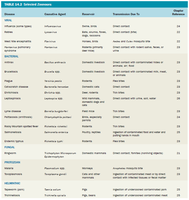
Reservoirs of Infection
Reservoir: Continual source of disease organisms, allowing survival and multiplication.
Types:
Human reservoirs: People with active disease or carriers (incubation, convalescent, asymptomatic).
Animal reservoirs: Wild and domestic animals (zoonoses).
Non-living reservoirs: Soil and water.
Transmission of Disease
Contact Transmission
Direct contact: Person-to-person physical contact (e.g., touching, kissing, sexual intercourse).
Indirect contact: Transmission via nonliving object (fomite).
Droplet transmission: Short-range airborne droplets (less than 1 meter).
Vehicle Transmission
Transmission by a medium such as water, food, or air.
Waterborne: Contaminated water (e.g., cholera).
Foodborne: Improperly prepared or stored food (e.g., food poisoning).
Airborne: Droplets or dust traveling more than 1 meter (e.g., tuberculosis).

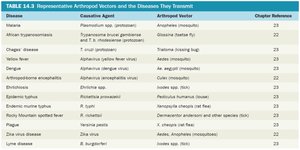
Vector Transmission
Vectors: Animals (often arthropods) that transmit pathogens.
Mechanical transmission: Passive transport on body parts.
Biological transmission: Pathogen reproduces in vector; transmitted via bite or feces.
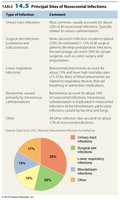
Healthcare-Associated Infections (HAIs)
Infections acquired during treatment in a healthcare facility (nosocomial infections).
Affect 1 in 25 hospital patients; significant cause of morbidity and mortality.
Result from microorganisms in the hospital, compromised hosts, and chain of transmission.
Compromised host: Individual with impaired resistance to infection.
Prevention of HAIs
Universal and standard precautions (handwashing, disinfection, disposable equipment).
Transmission-based precautions for known/suspected infections (contact, droplet, airborne).
Infection control committees monitor and enforce protocols.
Emerging Infectious Diseases (EIDs)
New or changing diseases increasing in incidence.
About 75% are zoonotic, often viral/vector-borne.
Contributing factors:
Genetic recombination (e.g., avian influenza H5N1)
Evolution of new strains (e.g., Vibrio cholerae O139)
Widespread use of antibiotics/pesticides (antibiotic resistance)
Climate change, modern transportation, ecological changes, public health failures, bioterrorism
Epidemiology
The study of where, when, and how diseases occur and are transmitted in populations.
Epidemiologists determine etiology, spread, and control methods; assemble data and graphs.
Types of Epidemiologic Investigations
Descriptive epidemiology: Collection and analysis of data (e.g., John Snow).
Analytical epidemiology: Determines probable cause (e.g., Florence Nightingale).
Experimental epidemiology: Hypothesis and controlled experiments (e.g., Semmelweis).
Centers for Disease Control and Prevention (CDC)
Collects and analyzes epidemiological data in the U.S.
Publishes Morbidity and Mortality Weekly Report (MMWR).
Morbidity: Incidence of a specific notifiable disease.
Mortality: Deaths from notifiable diseases.
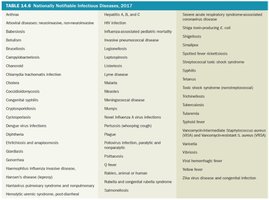
Notifiable infectious diseases: Diseases that must be reported by physicians.
Morbidity rate: Number of people affected in relation to the population in a given time.
Mortality rate: Number of deaths from a disease in relation to the population in a given time.