 Back
BackPrinciples of Disease, Epidemiology, and Transmission in Microbiology
Study Guide - Smart Notes
 Tailored notes based on your materials, expanded with key definitions, examples, and context.
Principles of Disease
Symbiotic Relationships Between Humans and Microorganisms
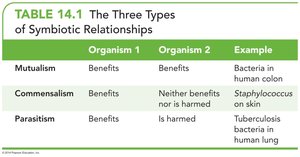
Microorganisms interact with humans in various symbiotic relationships, which can be beneficial, neutral, or harmful. Understanding these relationships is fundamental to microbiology and disease processes.
Mutualism: Both organisms benefit. Example: Bacteria in the human colon synthesize vitamins for the host and receive nutrients.
Commensalism: One organism benefits, the other is neither helped nor harmed. Example: Staphylococcus on the skin.
Parasitism: One organism benefits at the expense of the other. Example: Tuberculosis bacteria in the human lung.
Normal Microbiota
Normal microbiota are the microorganisms that reside on or within various parts of the human body without causing disease under normal conditions. They play essential roles in health, such as preventing colonization by pathogens and aiding digestion.
Resident microbiota: Permanently colonize the host and are established during birth and early life.
Transient microbiota: Present for a short time and do not persist.
Normal microbiota can become opportunistic pathogens if they gain access to areas of the body where they are not normally found or if the host's immune system is compromised.
Distribution of Resident Microbiota
Upper Respiratory Tract: Includes genera such as Pseudomonas, Haemophilus, Lactobacillus, Streptococcus, and Staphylococcus. The lower respiratory tract is typically sterile.
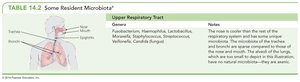
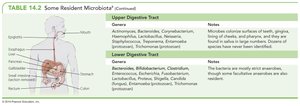
Upper Digestive Tract: Includes Actinomyces, Lactobacillus, Streptococcus, and others. Microbes colonize the surfaces of teeth, gums, and mucosa.
Lower Digestive Tract: Includes Bacteroides, Bifidobacterium, Clostridium, and others. The colon is densely populated with anaerobes.
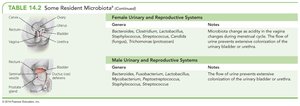
Urinary and Reproductive Systems: Female systems include Bacteroides, Clostridium, Lactobacillus, and Candida. Male systems include Mycobacterium, Pseudomonas, and Staphylococcus.
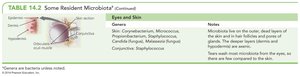
Eyes and Skin: Includes Corynebacterium, Micrococcus, Staphylococcus, and Malassezia. The skin is a major barrier but supports a diverse microbiota.
When Normal Microbiota Become Pathogenic
Normal microbiota can cause disease if they are introduced into unusual sites or if the host's defenses are compromised. For example, Streptococcus pneumoniae is a normal inhabitant of the mouth but can cause pneumonia if it enters the lungs.
Epidemiology and Disease Occurrence
Definitions of Disease Occurrence
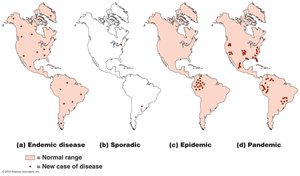
Epidemic: Disease occurs at a greater than normal frequency in a given area or population.
Endemic: Disease is constantly present in a population.
Pandemic: An epidemic that occurs on a global scale.
Epidemiology
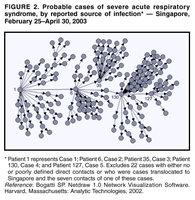
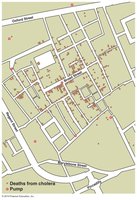
Epidemiology is the study of the occurrence, distribution, and spread of disease in human populations. Epidemiologists use maps, graphs, and contact tracing to understand and control outbreaks.

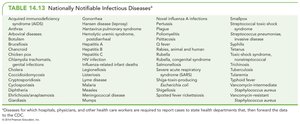
Nationally Notifiable Infectious Diseases
Certain diseases must be reported to health authorities to monitor and control their spread. These include diseases such as tuberculosis, measles, and rabies.
Disease Terminology
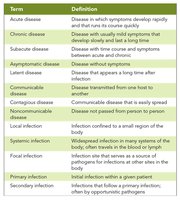
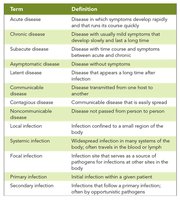
Understanding the terminology used to describe diseases is essential for accurate communication in microbiology.
Term | Definition |
|---|---|
Acute disease | Disease in which symptoms develop rapidly and that runs its course quickly |
Chronic disease | Disease with usually mild symptoms that develop slowly and last a long time |
Subacute disease | Disease with time course and symptoms between acute and chronic |
Asymptomatic disease | Disease without symptoms |
Latent disease | Disease that appears a long time after infection |
Communicable disease | Disease transmitted from one host to another |
Contagious disease | Communicable disease that is easily spread |
Noncommunicable disease | Disease not passed from person to person |
Local infection | Infection confined to a small region of the body |
Systemic infection | Widespread infection in many systems of the body, often travels in blood or lymph |
Focal infection | Infection site that serves as a source of pathogens for infections at other sites in the body |
Primary infection | Initial infection within a given patient |
Secondary infection | Infections that follow a primary infection, often by opportunistic pathogens |
Manifestations of Disease: Signs and Symptoms
Diseases are characterized by signs (objective changes observed by others) and symptoms (subjective changes felt by the patient).
Symptoms: Pain, nausea, headache, chills, sore throat, fatigue, malaise, discomfort, itching, abdominal cramps.
Signs: Swelling, rash, redness, vomiting, diarrhea, fever, pus formation, anemia, leukocytosis/leukopenia, bubo, tachycardia/bradycardia.
Koch’s Postulates
Steps to Identify the Causative Agent of Disease
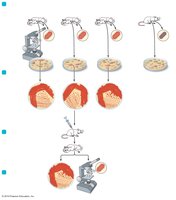
Koch’s postulates are a series of criteria used to establish a causative relationship between a microbe and a disease:
The suspected agent must be present in every case of the disease.
The agent must be isolated and grown in pure culture.
The cultured agent must cause the disease when inoculated into a healthy, susceptible host.
The same agent must be reisolated from the diseased experimental host.
Exceptions: Some diseases are caused by multiple agents, some agents cannot be cultured, and some diseases lack a suitable experimental host (e.g., HIV, Hepatitis B).
Stages of Infectious Disease
Progression of Disease
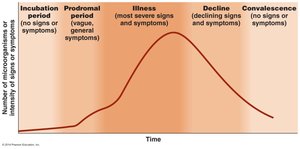
Acute infectious diseases typically progress through several stages:
Incubation period: Time between infection and appearance of symptoms.
Prodromal period: Mild, nonspecific symptoms appear.
Illness: Most severe signs and symptoms.
Decline: Signs and symptoms subside as the immune response controls the infection.
Convalescence: Recovery and return to normal function.
Reservoirs and Transmission of Infectious Disease
Reservoirs
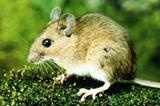
A reservoir is any person, animal, plant, soil, or substance in which an infectious agent normally lives and multiplies. Reservoirs can be living (humans, animals) or nonliving (soil, water).
Host: Organism that supports the growth of a pathogen.
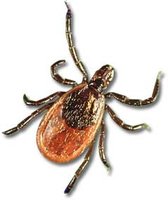
Vector: Arthropod capable of transmitting pathogens (e.g., ticks, mosquitoes).


Rabies: An Example of Multiple Reservoirs
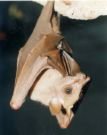
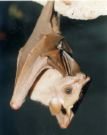
Rabiesvirus is a (-) ssRNA virus that is enveloped and causes rabies. It is transmitted through the bite of an infected animal and is almost always fatal if post-exposure vaccination is not administered. Rabies has multiple animal reservoirs, including bats, dogs, raccoons, and others.

Transmission of Infectious Diseases
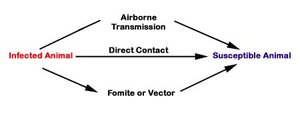
Transmission refers to the mechanisms by which a pathogen moves from a reservoir or infected individual to a susceptible host. Modes of transmission include:
Direct transmission: Physical contact or droplet spread.
Indirect transmission: Via fomites (inanimate objects) or vectors (arthropods).
Vehicle transmission: Through air, water, or food.
Nosocomial Infections
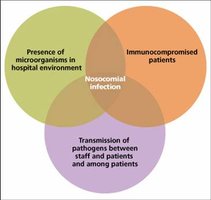
Nosocomial (hospital-acquired) infections are those acquired in healthcare settings. They result from the interaction of microorganisms in the hospital environment, immunocompromised patients, and transmission between staff and patients.
Additional info: These notes integrate foundational concepts from microbiology, including disease processes, epidemiology, and transmission, as outlined in standard college-level microbiology curricula.
