 Back
BackPrinciples of Disease, Pathogenicity, Immunity, and Antimicrobial Drugs
Study Guide - Smart Notes
 Tailored notes based on your materials, expanded with key definitions, examples, and context.
Principles of Disease and Epidemiology
Symbiosis and Disease Types
Symbiosis describes the close relationship between two organisms, where at least one organism depends on the other. In the context of microbiology, symbiotic relationships can influence the development and transmission of diseases. Diseases are classified based on their progression and duration:
Acute disease: Develops rapidly and lasts a short time (e.g., influenza).
Chronic disease: Develops slowly, with less severe symptoms, but persists or recurs over a long period (e.g., mononucleosis).
Latent disease: The causative agent remains inactive for a period before becoming active to produce symptoms (e.g., shingles).
Development of Disease
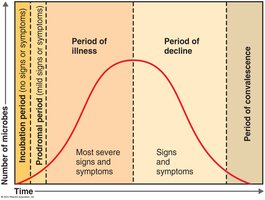
The progression of an infectious disease in a host follows several distinct stages:
Incubation period: Interval between initial infection and appearance of symptoms.
Prodromal period: Short period with mild signs or symptoms.
Period of illness: Disease is most severe; characteristic signs and symptoms are evident.
Period of decline: Signs and symptoms subside.
Period of convalescence: Body returns to its pre-diseased state; recovery occurs.
Fomites and Epidemiology
Fomite: Any nonliving object that can transmit infectious agents (e.g., stethoscopes, towels, drinking cups).
Epidemiology: The scientific study of when and how diseases occur and are transmitted within populations.
Microbial Mechanisms of Pathogenicity
Virulence and Pathogenic Factors
ID50: Infectious dose required to infect 50% of a sample population; measures microbe virulence.
LD50: Lethal dose required to kill 50% of a sample population; measures toxin potency.
Siderophores: Pathogen-secreted proteins that bind iron more tightly than host proteins, aiding in microbial survival.
Bacterial Toxins
Exotoxins: Proteins produced and secreted by bacteria (mainly Gram-positive); can cause damage even in small amounts.
Superantigens: Exotoxins that provoke intense immune responses by stimulating excessive cytokine release.
Endotoxins: Components of Gram-negative bacterial cell walls released upon cell lysis; can trigger strong inflammatory responses.
Viral Pathogenicity
Cytopathic effects: Observable changes in host cells due to viral infection, such as cell death, inclusion body formation, or cell fusion (syncytia).
Innate and Adaptive Immunity
Innate Immunity
Innate immunity provides immediate, non-specific defense against pathogens and does not adapt or remember specific microbes.
Key features: Present at birth, rapid response, no memory, not specific to particular pathogens.
Adaptive Immunity
Adaptive immunity develops in response to specific pathogens and provides long-lasting protection through memory cells.
Key features: Specific recognition of antigens, slower initial response, memory for future encounters.
Opsonization and Inflammation
Opsonization: The process by which pathogens are coated with molecules (e.g., antibodies) that enhance their uptake and destruction by phagocytes.
Stages of Inflammation:
Vasodilation and increased vascular permeability
Phagocyte migration and phagocytosis
Tissue repair
Adaptive Immune Response
Antigens and Antibodies
Antigens: Substances that provoke an immune response (e.g., components of microbes, toxins).
Antibodies: Proteins produced by B cells that specifically bind to antigens to neutralize or mark them for destruction.
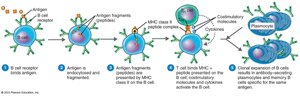
B Cell Activation (T-Dependent Antigen)
B cells require help from T cells to respond to most protein antigens. The process involves antigen presentation, T cell activation, and B cell proliferation and differentiation.
Agglutination
Agglutination: The clumping of particles, such as when antibodies bind to particulate antigens, facilitating their removal.
Practical Applications of Immunology
Types of Vaccines
Attenuated whole-agent vaccines: Contain live, weakened pathogens (e.g., measles, mumps).
Inactivated vaccines: Contain killed microbes (e.g., rabies, polio).
Toxoid vaccines: Contain inactivated toxins (e.g., tetanus, diphtheria).
Monoclonal Antibodies and ELISA
Monoclonal antibodies: Identical, highly specific antibodies produced in large quantities for diagnostics and therapy.
Direct ELISA: Laboratory test that detects antigens in a patient sample using specific antibodies.
Disorders Associated with the Immune System
Hypersensitivity Reactions
Type I (Immediate) Reactions: Occur within minutes of antigen exposure in sensitized individuals; involve IgE antibodies and can cause systemic anaphylaxis.
Desensitization: Gradual exposure to increasing antigen doses to reduce allergic response.
Type III (Immune Complex) Reactions: Involve antibodies against soluble antigens, leading to immune complex formation and complement activation.
Immunosuppression and Immunodeficiencies
Immunosuppression: Use of drugs to suppress immune responses, especially in transplantation to prevent rejection.
Congenital immunodeficiencies: Genetic defects present at or soon after birth.
Acquired immunodeficiencies: Develop later in life due to external factors (e.g., infections, drugs).
Antimicrobial Drugs
Types and Mechanisms
Antimicrobials: Synthetic substances that inhibit microbial growth, especially bacteria.
Broad-spectrum antibiotics: Effective against a wide range of Gram-positive and Gram-negative bacteria (e.g., tetracycline).
Penicillins and cephalosporins: Inhibit cell wall synthesis.
Macrolides: Inhibit protein synthesis.
Antimicrobial peptides: Natural defense molecules in animals and plants that disrupt bacterial membranes.
Drug Resistance
Drug resistance: The ability of microbes to withstand the effects of antibiotics, often due to misuse or overuse of these drugs.
