 Back
Principles of Epidemiology and Nosocomial Infections: Study Notes
Study Guide - Smart Notes
 Tailored notes based on your materials, expanded with key definitions, examples, and context.
Principles of Epidemiology
Communicable and Non-Communicable Diseases
Epidemiology is the study of how diseases spread and can be controlled within populations. Diseases are classified based on their ability to be transmitted between hosts.
Communicable disease: Transmitted from one host to another. Requires a chain of events: a suitable environment (reservoir), a portal of exit, and transmission to a susceptible host.
Non-communicable disease: Not spread from host to host; often caused by an individual's own normal flora or environmental reservoirs.
Rates of Disease in Populations
Epidemiologists use specific rates to measure and compare disease occurrence:
Attack rate: Proportion of exposed individuals who develop disease (e.g., 10 out of 100 exposed = 10%).
Morbidity rate: Number of cases of illness divided by the population at risk.
Mortality rate: Proportion of the population that dies from the disease.
Incidence: Number of new cases in a specific time period.
Prevalence: Total number of existing cases at a given time.
Endemic: Disease constantly present in a population.
Epidemic: Unusually large number of cases in a population.
Pandemic: Epidemic that spreads worldwide.
Outbreak: Cluster of cases in a brief time affecting a specific population.
Reservoirs of Infectious Disease
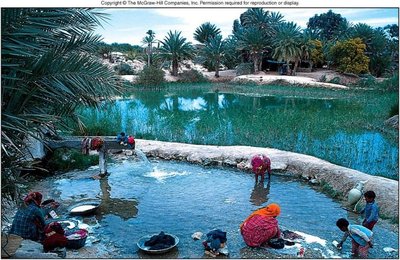
The reservoir is the natural habitat of a pathogen and affects the extent and distribution of disease. Recognizing reservoirs helps in disease control.
Human reservoirs: Infected humans (symptomatic or asymptomatic carriers) are the most significant reservoirs for communicable diseases.
Non-human animal reservoirs: Source of zoonotic diseases, which are often more severe in humans.
Environmental reservoirs: Includes water and soil; pathogens here are difficult to eliminate.
Portals of Exit and Entry
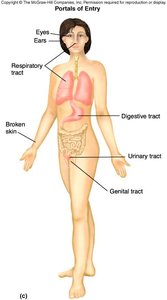
Pathogens must exit the reservoir and enter a new host to cause disease. The route of entry is called the portal of entry.
Portals of exit: Feces (intestinal tract), respiratory droplets (respiratory tract), skin cells (skin).
Portals of entry: Eyes, ears, respiratory tract, broken skin, digestive tract, genitourinary tract.
Transmission of Infectious Agents
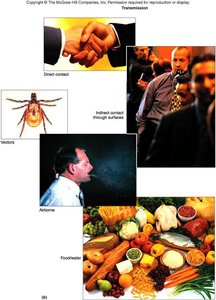
Transmission is the movement of pathogens from the reservoir to a susceptible host. It can be classified as horizontal (person-to-person, food, water, vectors) or vertical (mother to fetus or infant).
Direct contact: Physical contact between individuals (e.g., handshake).
Indirect contact: Via inanimate objects (fomites) such as doorknobs or utensils.
Droplet transmission: Respiratory droplets inhaled by people in close proximity.
Food and water transmission: Pathogens transmitted through contaminated food or water; cross-contamination is a risk.
Airborne transmission: Droplet nuclei remain suspended in air and can be inhaled.
Vector transmission: Living organisms (often arthropods) carry pathogens between hosts.
Factors Influencing Epidemiology of Disease
Several factors affect the occurrence and spread of disease in populations:
Dose: Probability of disease increases with the number of pathogens encountered.
Incubation period: Longer incubation allows wider spread before detection.
Population characteristics: Immunity, general health, age, gender, cultural practices, and genetic background all influence susceptibility.
Epidemiological Studies
Types of Studies
Epidemiologists use various study designs to investigate disease outbreaks and identify risk factors:
Descriptive studies: Define characteristics of affected individuals (person, place, time).
Analytical studies: Identify relevant risk factors (cross-sectional, retrospective, prospective studies).
Experimental studies: Test cause-effect relationships and effectiveness of interventions (often double-blind).
Infectious Disease Surveillance
National and International Surveillance
Surveillance networks monitor and control infectious diseases:
Centers for Disease Control and Prevention (CDC): Collects and publishes data, conducts research, and assists in outbreak control.
Public health departments: State-level surveillance and reporting of notifiable diseases.
World Health Organization (WHO): Provides global guidance, sets standards, strengthens health programs, and develops technology.
Reduction and Eradication of Disease
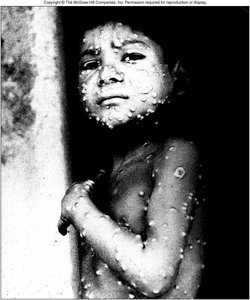
Efforts to reduce or eliminate disease include sanitation, reservoir/vector control, vaccination, and antibiotic treatment. Smallpox is an example of a disease that has been globally eradicated.
Emerging and Reemerging Diseases
New diseases continue to emerge, and previously controlled diseases can reappear. Contributing factors include microbial evolution, breakdown of public health, changes in human behavior, technology, population expansion, food distribution, war, and climate change.
Nosocomial Infections (Hospital-Acquired Infections)
Overview and Common Pathogens
Nosocomial infections are acquired in healthcare settings and can range from mild to fatal. Factors include exposure time, manner of exposure, virulence, and host defenses. Common pathogens include Enterococcus spp., Escherichia coli, Pseudomonas spp., and Staphylococcus aureus.
Reservoirs and Transmission in Hospitals
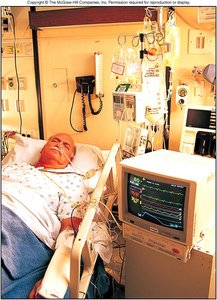
Reservoirs include other patients, the hospital environment, healthcare workers, and the patient's own flora. Transmission occurs via medical devices, healthcare personnel, and airborne routes.
Sites of Nosocomial Infections
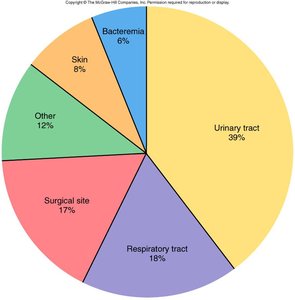
Nosocomial infections most commonly affect the urinary tract, respiratory tract, surgical sites, skin, and bloodstream.
Site | Percentage of Cases |
|---|---|
Urinary tract | 39% |
Respiratory tract | 18% |
Surgical site | 17% |
Other | 12% |
Skin | 8% |
Bacteremia | 6% |
Prevention of Nosocomial Infections
Prevention relies on recognizing infections and establishing control policies. Infection Control Committees and practitioners conduct surveillance and implement strategies such as handwashing, sterilization, and isolation protocols.
