Back
BackPrinciples of Infectious Disease and Epidemiology (chapter 9)
Study Guide - Smart Notes
 Tailored notes based on your materials, expanded with key definitions, examples, and context.
Principles of Infectious Disease and Epidemiology (chapter 9)
Introduction
This chapter explores the foundational concepts of infectious diseases and epidemiology, focusing on the causes, transmission, and control of infectious diseases, as well as the public health strategies used to monitor and prevent outbreaks.
Causes of Infectious Diseases
Pathogens and Disease Terminology
Infectious disease: Illness caused by a pathogen (disease-causing agent).
Epidemiology: The study and control of disease occurrence to promote public health.
Pathogens include: viruses, prions, bacteria, protozoans, helminths, and fungi.
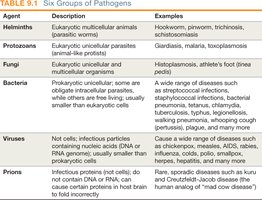
Types of Pathogens
Opportunistic pathogens: Cause disease only when the host is weakened (e.g., immunocompromised individuals).
True pathogens: Cause disease in healthy hosts without the need for host compromise.
Disease Occurrence Patterns
Sporadic: Isolated infections in a population (e.g., Ebola).
Endemic: Routinely detected in a population or region (e.g., head colds).
Epidemic: Widespread outbreak in a region during a specific time.
Pandemic: Epidemic that spreads to multiple countries.
Emerging and Reemerging Diseases
Emerging pathogens: Newly identified or previously rare agents with increased incidence or geographic range (e.g., SARS-CoV-2, Zika virus).
Reemerging pathogens: Previously controlled agents that are resurging (e.g., antibiotic-resistant bacteria).
~60% of emerging infections since the 1970s are zoonotic (spread from animals to humans).
Communicable vs. Noncommunicable Diseases
Communicable diseases: Transmit from human to human.
Contagious diseases: Easily transmitted between hosts.
Noncommunicable diseases: Do not spread from person to person.
Clinical Descriptions of Infection
Active infection: Patient is symptomatic (shows signs and symptoms).
Signs: Objective, measurable indicators (e.g., fever, rash).
Symptoms: Subjective experiences (e.g., pain, fatigue).
Latent infection: Asymptomatic; pathogen may persist in dormant state.
Acute vs. Chronic Diseases
Acute diseases: Rapid onset and progression.
Chronic diseases: Slower onset and progression.
Koch’s Postulates
Four criteria to identify the causative agent of a disease:
The same organism must be present in every case of the disease.
The organism must be isolated and grown as a pure culture.
The isolated organism should cause disease when inoculated into a susceptible host.
The organism must be re-isolated from the inoculated, diseased animal.
Limitations: Not applicable to noninfectious diseases, obligate intracellular pathogens, agents that cannot be cultured, or diseases with no animal model.
Infectious Disease Transmission and Stages
Sources and Reservoirs
Reservoir: Natural habitat (animate or inanimate) where a pathogen is found.
Source: Site from which the pathogen is transmitted to a new host.
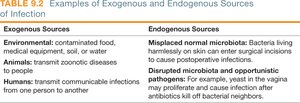
Endogenous source: Pathogen originates from the host’s own body.
Exogenous source: Pathogen originates from outside the host.
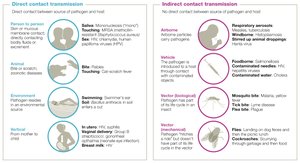
Modes of Transmission
Direct contact: Physical contact with the source (e.g., touching, kissing, animal bites).
Vertical transmission: Mother to offspring (in utero, delivery, breastfeeding).
Indirect contact: No direct contact; includes airborne, vehicle, and vector transmission.
Biological vectors: Organisms involved in the pathogen’s life cycle (e.g., mosquitoes, ticks).
Mechanical vectors: Organisms that transmit pathogens without being part of the life cycle (e.g., flies, cockroaches).
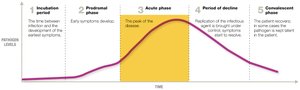
Stages of Infectious Disease
Incubation period: Time between infection and symptom onset.
Prodromal phase: Early, mild symptoms appear.
Acute phase: Peak of disease; full symptoms present.
Period of decline: Pathogen replication decreases; patient recovers.
Convalescent phase: Pathogen eliminated; patient regains strength.
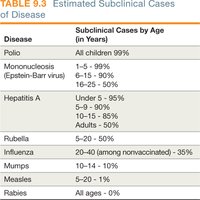
Subclinical and Asymptomatic Cases
Some infections are subclinical (mild or no symptoms).
Chronic carriers: Harbor pathogens long-term, often asymptomatically.
Epidemiology Essentials
Definition and Goals
Epidemiology: Study of disease patterns in populations.
Goals:
Describe the nature, cause, and extent of diseases.
Intervene to protect and improve public health.
The Epidemiological Triangle
Links host, etiological agent, and environment.
Host factors: Health, age, lifestyle, genetics.
Environmental factors: Climate, geography, vectors, water/food sources.
Etiological agent: Type of pathogen (bacteria, virus, etc.).

Breaking the Epidemiological Triangle
Strategies: Education, quarantine, vector control.
Public health education (e.g., vaccination campaigns, prenatal care).
Quarantine: Confinement to prevent disease spread; effective for diseases with short incubation periods.
Vector control: Reducing populations of disease-carrying organisms (e.g., mosquitoes, ticks).
Epidemiology in Clinical Settings
Hospital Epidemiology and HAIs
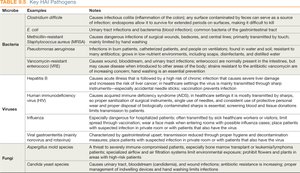
Healthcare-acquired infections (HAIs): Infections acquired during medical care.
Common sources: Contaminated devices, healthcare workers’ hands.
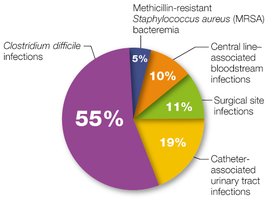
Common HAIs: Clostridium difficile infections, catheter-associated UTIs, surgical site infections, MRSA bacteremia, ventilator-associated pneumonia.
Prevention and Control of HAIs
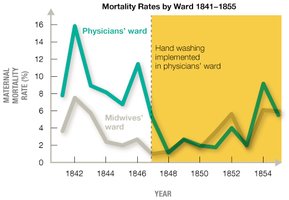
Up to 70% of HAIs are preventable.
Prevention strategies: Hand washing, PPE, environmental cleaning, equipment sterilization, patient isolation, aseptic technique for invasive devices.
Monitoring and surveillance are essential for identifying and controlling outbreaks.
Antibiotic resistance is a major concern in healthcare settings.
Surveillance, Eradication, and Ethics in Epidemiology
Disease Surveillance
Surveillance programs monitor disease prevalence and incidence.
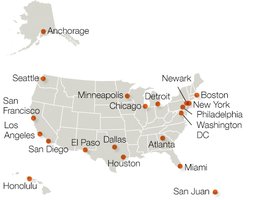
CDC and other agencies collect and share data to detect outbreaks early.
Emerging and Reemerging Diseases
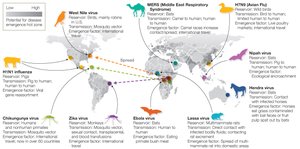
Emerging diseases: New or newly identified infections (e.g., Ebola, HIV, SARS).
Reemerging diseases: Previously controlled, now increasing in incidence (often due to antibiotic resistance or increased immunosuppression).
Contributing factors: Population crowding, poverty, climate, urbanization, deforestation.
Eradication of Infectious Diseases
Eradication: Complete elimination of a disease worldwide (e.g., smallpox).
Best candidates: Easily identifiable, treatable/preventable, human-specific.
Challenges: Latent infections, cost, need for strong social/political support.
Ethical Issues in Epidemiology
Research must balance individual rights and public good.
Historical abuses (e.g., Tuskegee syphilis study) highlight the need for informed consent and ethical oversight.
Genetic research raises concerns about discrimination (e.g., Genetic Information Nondiscrimination Act).
Vaccination policies may restrict individual choice to protect vulnerable populations (herd immunity).
Visual Summary