 Back
BackPrinciples of Infectious Disease and Epidemiology: Study Guide
Study Guide - Smart Notes
 Tailored notes based on your materials, expanded with key definitions, examples, and context.
Infectious Disease Basics
Definition and Categories
Infectious diseases are illnesses caused by pathogenic microorganisms. These pathogens can be classified into several categories, each with unique characteristics and modes of transmission.
Opportunistic pathogens: Cause disease when the host is weakened.
True pathogens: Cause disease regardless of host health.
Categories of pathogens:
Viruses
Bacteria
Fungi
Helminths
Protozoans
Prions
Key Definitions
Sporadic: Isolated cases in a population.
Endemic: Routinely detected infections in a population.
Epidemic: Widespread outbreak in a region.
Pandemic: Disease spreads to numerous countries.
Emerging pathogen: Newly identified or previously sporadic pathogens with increased distribution.
Reemerging pathogen: Previously controlled agent resurfacing.
Types of Infection and Disease Progression
Active infection: Patient shows signs and symptoms.
Signs: Objective indicators (e.g., fever, rash).
Symptoms: Subjective indicators (e.g., pain, fatigue).
Noncommunicable: Not spread person-to-person.
Communicable: Spread person-to-person (contagious).
Acute disease: Rapid onset and progression.
Chronic disease: Slower onset and progression.
Koch’s Postulates
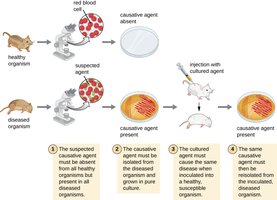
Koch’s postulates are a set of criteria used to establish a causative relationship between a microbe and a disease. However, they do not apply to all pathogens or diseases.
Do not apply to:
Noninfectious diseases
Obligate intracellular pathogens
Human-specific infectious agents
Latent infections
Third postulate is difficult to fulfill for some pathogens.
Transmission and Stages of Disease
Sources and Reservoirs
The source and reservoir of a pathogen are critical concepts in understanding disease transmission.
Reservoir: Natural habitat where the pathogen is found.
Source: Habitat that disseminates the agent from reservoir to host.
Endogenous source: Pathogen originates from the host’s own body.
Exogenous source: Pathogen originates externally.
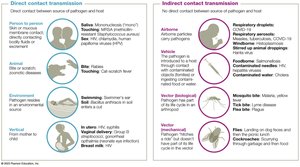
Modes of Transmission
Pathogens can be transmitted through various direct and indirect means. Understanding these modes is essential for disease prevention.
Stages of Infectious Disease
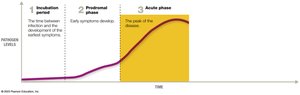
The progression of infectious disease follows distinct stages, each characterized by specific clinical features.
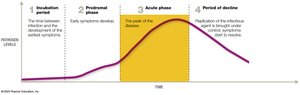
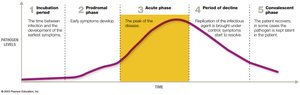
Incubation period: Time between infection and symptom onset.
Prodromal phase: Mild symptoms begin.
Acute phase: Full-blown symptoms; peak of disease.
Period of decline: Pathogen replication decreases; patient improves.
Convalescent phase: Pathogen eliminated; recovery occurs.
Incubation, Prodromal, and Acute Phases
Period of Decline
Convalescent Period
Pathogen eliminated from body.
Some pathogens remain indefinitely (chronic/asymptomatic carriers).
Chronic carrier: Dormant state, symptoms reemerge occasionally.
Asymptomatic carrier: Harbor pathogens without symptoms (e.g., Typhoid Mary).
Epidemiology
Definition and Goals
Epidemiology is the study of disease patterns in populations. It aims to understand, prevent, and control illness in communities.
Describe: Nature, cause, and extent of diseases.
Intervene: Protect and improve population health.
Epidemiological Triangle and Public Health Strategies
Public education: Breaks the triangle, reduces drug resistance.
Quarantine: Confinement to prevent transmission.
Vector control: Limits spread by controlling fleas, mosquitoes, ticks.
Epidemiological Measures
Ratio: Occurrence in one group vs. another.
Proportion: Percentage of a whole.
Rate: Occurrence over time.
Measures of frequency: Disease occurrence at a given time.
Morbidity: Existence of disease in a population.
Prevalence rate: Influenced by incidence rate and duration.
Prevalence and Incidence
Incidence rate: Number of new cases in a defined population at a time.
Duration: How long an infection lasts.
High prevalence: Long duration and many new cases.
Incidence rate helps determine vaccine effectiveness.
Measures of Association
Identify risk factors linked to disease cases.
Mortality rate: Number of deaths during a specific period.
Descriptive Epidemiology
Who: Who is infected?
Where: Where do cases occur?
When: When do cases occur?
Includes correlation studies, case reports, cross-sectional studies.
Analytical Epidemiology
What: What caused the disease?
Why: Why do people get the disease?
How: How can it be prevented or treated?
Includes observational and experimental studies.
Clinical Settings
Ignaz Semmelweis and Hand Hygiene
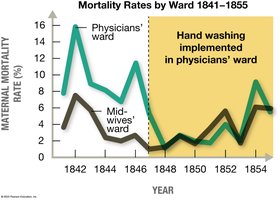
Semmelweis observed lower maternal death rates in wards staffed by midwives compared to physicians. He linked this to hand hygiene and implemented hand washing with chlorine bleach, significantly reducing deaths.
Healthcare-Acquired Infections (HAIs)
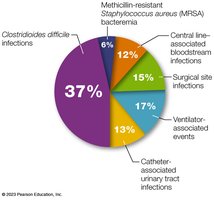
Transmitted through direct or indirect contact.
Can be localized or systemic.
Common sources: contaminated medical devices, healthcare worker’s hands.
Preventing HAIs
Establish surveillance: Track prevalence, incidence, and nature of infections.
Basic preventive measures: Handwashing, personal protective wear, sanitization, sterilization, limiting patient transport.
Preventing superbugs: Monitor antibiotic-resistant strains, test pathogens for antibiotic susceptibility.
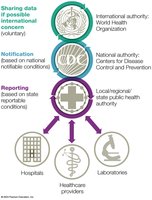
Reporting and Surveillance
National Notifiable Diseases Surveillance System (CDC): Gathers information on reportable and notifiable diseases.
Reportable diseases: State/local tracking list.
Notifiable diseases: CDC interest; ~60 infectious and multiple noninfectious diseases.
Eradication and Ethics
Eradication
Eradication: No cases anywhere in the world.
Only succeeded with smallpox (1977).
Polio and guinea worm are close to eradication.
Best candidates: Identifiable, treatable, preventable, only humans transmit/catch.
Ethics in Health Studies
Tuskegee syphilis experiment: Unethical study in Alabama (1932–1972).
Participants misled and denied treatment.
Informed consent: Essential for ethical research.
Vaccines and Herd Immunity
Herd Immunity
Herd immunity occurs when a pathogen cannot find enough susceptible hosts in a community, protecting even nonvaccinated individuals. Typically, at least 85% of the population must be immune for effective communal protection.
Allows nonvaccinated individuals to benefit from immunization.
Critical for preventing outbreaks and maintaining public health.
