 Back
BackCH. 9 Principles of Infectious Disease and Epidemiology: Study Notes
Study Guide - Smart Notes
 Tailored notes based on your materials, expanded with key definitions, examples, and context.
Principles of Infectious Disease and Epidemiology
Disease Terminology
This section introduces foundational terms and concepts in infectious disease and epidemiology, essential for understanding how diseases spread and are controlled in populations.
Infectious disease: Illness caused by a pathogen (e.g., prions, viruses, bacteria, protozoans, helminths, fungi).
Epidemiology: The study and control of disease occurrence to promote public health.
Opportunistic pathogens: Cause disease only in weakened hosts (e.g., immunocompromised individuals).
True pathogens: Can cause disease in healthy hosts.
Patterns of Disease Occurrence
Sporadic: Isolated infections in a population (e.g., Ebola).
Endemic: Routinely detected in a population or region (e.g., cold viruses).
Epidemic: Widespread outbreak in a region during a specific time.
Pandemic: Epidemic that spreads to multiple countries.
Emerging and Reemerging Pathogens
Emerging pathogens: Newly identified or previously rare agents (e.g., SARS-CoV-2, Zika virus).
Reemerging pathogens: Previously controlled agents now resurfacing (e.g., antibiotic-resistant bacteria).
Zoonotic diseases: Spread from animals to humans; many are noncommunicable.
Communicability and Disease Experience
Communicable diseases: Transmit from human to human.
Contagious diseases: Easily transmitted between hosts.
Active infection: Symptomatic, with measurable signs (objective) and symptoms (subjective).
Latent infection: Asymptomatic, with no signs or symptoms.
Onset and Duration of Disease
Acute diseases: Rapid onset and progression.
Chronic diseases: Slower onset and progression.

Koch’s Postulates and Their Limitations
Koch’s Postulates
Koch’s postulates are four criteria used to establish a causative relationship between a microbe and a disease:
The same organism must be present in every case of the disease.
The organism must be isolated and grown as a pure culture.
The isolated organism should cause disease when inoculated into a susceptible host.
The organism must be re-isolated from the inoculated, diseased animal.
Limitations:
Not applicable to noninfectious diseases.
Some pathogens cannot be cultured in the lab or infect nonhuman hosts.
Attenuation in pure culture and latent diseases complicate application.
Sources and Transmission of Pathogens
Reservoirs and Sources
Reservoir: Natural habitat (animate or inanimate) where a pathogen is found.
Source: Site from which the pathogen is transmitted to a new host.
Endogenous source: Pathogen originates from the host’s own body.
Exogenous source: Pathogen is external to the host.
Exogenous Sources | Endogenous Sources |
|---|---|
Contaminated food, water, soil, medical equipment; animals; humans | Misplaced normal microbiota; disrupted microbiota and opportunistic pathogens |
Modes of Transmission
Direct contact: Physical contact with the source (e.g., touching, kissing, animal bites).
Vertical transmission: Mother to offspring (in utero, delivery, breastfeeding).
Indirect contact: No direct contact; includes airborne, vehicle, and vector transmission.
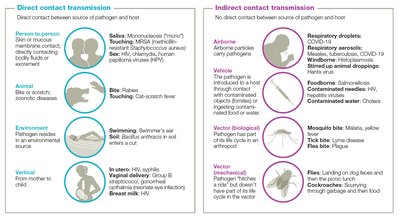
Indirect Contact Transmission
Airborne: Inhalation of pathogen-laden droplets.
Vehicle: Contaminated fomites (e.g., doorknobs, food, needles).
Vector: Transmission by arthropods (biological or mechanical vectors).
Stages of Infectious Disease
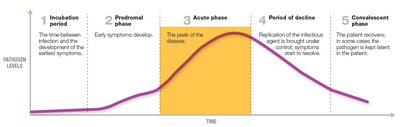
Five General Stages
Incubation period: Time between infection and symptom onset.
Prodromal phase: Mild, nonspecific symptoms appear.
Acute phase: Full-blown symptoms; peak of disease.
Period of decline: Pathogen replication decreases; symptoms resolve.
Convalescent phase: Recovery; pathogen eliminated or becomes latent.
Epidemiology Essentials
Definition and Goals
Epidemiology: Study of disease in populations to understand and prevent illness.
Goals: Describe disease nature, cause, and extent; intervene to protect and improve health.
The Epidemiological Triangle
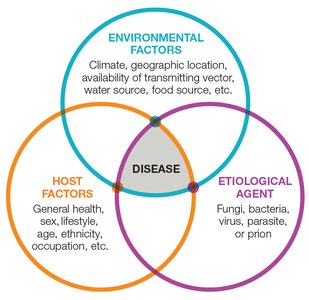
The epidemiological triangle links three factors: host, etiological agent, and environment. Disease results from the interaction of these factors.
Host factors: Health, age, nutrition, lifestyle, genetics.
Etiological agent: Type of pathogen (bacteria, virus, etc.).
Environmental factors: Climate, geography, vector presence, sanitation.
Breaking the Epidemiological Triangle
Public education: Vaccination campaigns, hygiene promotion, STD education.
Quarantine: Isolation of infected individuals to prevent spread.
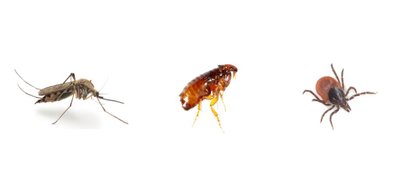
Vector control: Reducing populations of disease-carrying arthropods.

Epidemiological Measures
Rates, Ratios, and Proportions
Rate: Occurrence of an event over time.
Ratio: Comparison of occurrence between groups.
Proportion: Percentage of a whole.
Prevalence and Incidence
Prevalence: Morbidity in a population during a specified time.
Incidence: Number of new cases in a defined population during a defined time frame.
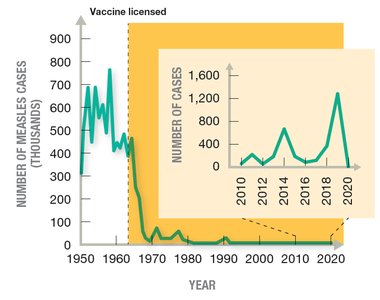
Measures of Association
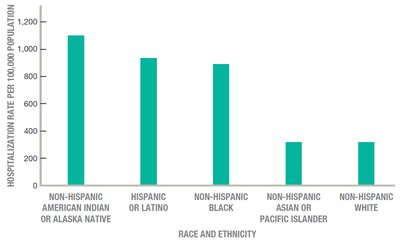
Identify risk factors and at-risk populations.
Common measure: Mortality rate (number of deaths in a specific period).
Term | Definition |
|---|---|
Crude mortality rate | General death rate in a population |
Cause-specific mortality rate | Deaths due to a specific cause |
Infant mortality rate | Death rate of children under age 1 |
Maternal mortality rate | Maternal deaths per 100,000 live births |
Case fatality rate | Percentage of diagnosed individuals who die in a specified period |
Epidemiological Study Designs
Descriptive Epidemiology
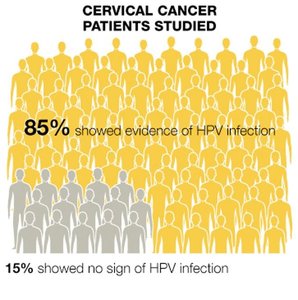
Characterizes health problems and at-risk populations.
Includes correlation studies, case reports, and cross-sectional studies.
Does not reveal causation.
Analytical Epidemiology
Tests hypotheses about disease causes and risk factors.
Observational studies: Track cases without intervention (e.g., cohort, case-control studies).
Experimental studies: Researcher manipulates variables (e.g., clinical trials).
Healthcare-Associated Infections (HAIs)
Overview and Impact
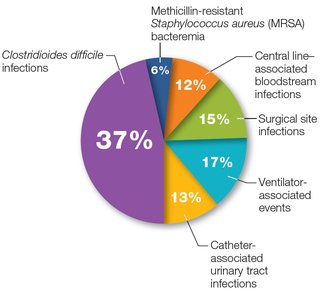
5–10% of acute care patients contract at least one HAI.
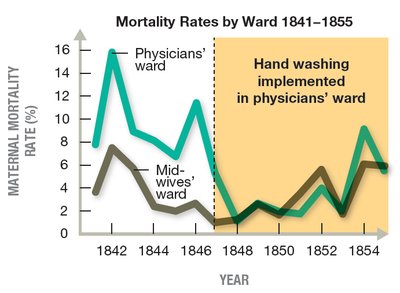
Common sources: contaminated medical devices, healthcare workers’ hands.
Common HAIs: Clostridioides difficile infections, catheter-associated UTIs, surgical wound infections, MRSA bacteremia, ventilator-associated pneumonia.
Bacteria are the most common cause; antibiotic resistance is a growing concern.
Microbe | Examples | Notes |
|---|---|---|
Bacteria: Clostridioides difficile | Colitis | Endospores, survives on surfaces |
Bacteria: E. coli | UTIs, bacteremia | GI tract, common HAI |
Bacteria: MRSA | Wound, bloodstream infections | Touch transmission, hand washing limits spread |
Viruses: Hepatitis B, HIV, Influenza, Norovirus | Various | Transmitted by sharps, respiratory droplets, or contaminated surfaces |
Fungi: Aspergillus, Candida | Infections in immunocompromised | Air filtration, device management important |
Prevention and Control
Surveillance and monitoring systems are essential.
Basic measures: hand washing, PPE, environmental sanitization, equipment sterilization, patient isolation.
Strict aseptic technique for catheters and central lines.
Monitoring and reporting antibiotic resistance.
Disease Surveillance and Reporting
Surveillance Programs
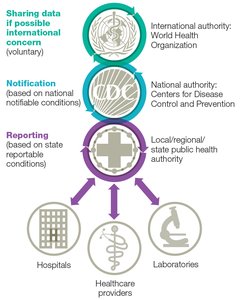
CDC develops recommendations and collects data.
National Notifiable Diseases Surveillance System (NNDSS) tracks reportable diseases.
Case reports are compiled into national statistics.
Emerging and Reemerging Diseases
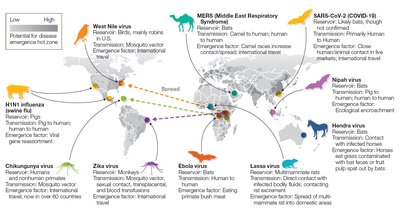
Emerging: New or newly identified infections (e.g., Ebola, HIV, Zika, COVID-19).
Reemerging: Previously controlled, now increasing (often due to antibiotic resistance or increased immunosuppression).
Contributing factors: crowding, poverty, climate, urbanization, deforestation.
Eradication
Eradication: No cases worldwide (e.g., smallpox in 1977).
Polio and guinea worm are close to eradication.

Ethical Issues in Epidemiology and Public Health
Research Ethics
Informed consent is essential.
Studies must not put participants at serious risk.
Genetic research raises new ethical concerns (e.g., Genetic Information Nondiscrimination Act).
Vaccination Ethics
Herd immunity protects the community when a high percentage is immune.
Debates exist over individual rights versus public safety (e.g., mandatory vaccination policies).
Clinical Case Study: Listeriosis Outbreak
Case Summary
Pregnant patient with fever, muscle aches, diarrhea, and fetal loss; Listeria monocytogenes isolated.
Linked to a 2011 cantaloupe-associated outbreak (147 cases, 33 deaths).
Listeria is a foodborne, Gram-positive bacterium; can grow at refrigerator temperatures.
Pregnant women and elderly are at higher risk; incubation period 3–70 days.
Key Epidemiological Questions
Source: Soil, water, animals; contaminated food (e.g., cantaloupe).
Transmission: Vehicle (foodborne) transmission.
Infectious disease? Yes; caused by a pathogen.
Communicable? No; not typically spread person-to-person.
Case fatality rate (2011):
Incidence rate (U.S.): per million
True incidence underestimated: Many cases are asymptomatic and unreported.
Examples: Rate: incidence rate; Proportion: % of pregnant women affected; Ratio: case fatality rate.
Epidemiological challenges: Long incubation, asymptomatic cases, food distribution.
Study design for recall: Analytical (case-control) study.
Interview without outbreak? Possibly, for surveillance, but more likely during outbreak investigation.
