 Back
BackPrinciples of Infectious Disease and Epidemiology: Microbiology Study Guide
Study Guide - Smart Notes
 Tailored notes based on your materials, expanded with key definitions, examples, and context.
Principles of Infectious Disease
Definitions and Disease Classification
Infectious diseases are illnesses caused by pathogenic microorganisms, including prions, viruses, bacteria, protozoans, helminths, and fungi. Understanding the classification and behavior of these pathogens is essential for epidemiology and public health.
Opportunistic pathogens: Cause disease only in hosts with weakened immune systems.
True pathogens: Cause disease in healthy hosts.
Sporadic cases: Isolated infections in a population (e.g., Ebola).
Endemic infections: Routinely detected in a population or region (e.g., cold viruses).
Epidemic: Widespread outbreak in a region during a specific time.
Pandemic: Epidemic that spreads to multiple countries.
Emerging pathogens: Newly identified or expanding pathogens (e.g., SARS-CoV-2).
Reemerging pathogens: Previously controlled agents resurfacing (e.g., antibiotic-resistant bacteria).
Zoonotic diseases: Spread from animals to humans; often noncommunicable.
Communicable diseases: Transmit from human to human.
Contagious diseases: Easily transmitted between hosts.
Signs, Symptoms, and Disease Progression
Diseases are characterized by their signs and symptoms, which help in diagnosis and monitoring.
Signs: Objective indicators measurable by clinicians (e.g., fever, rash).
Symptoms: Subjective experiences reported by patients (e.g., pain, fatigue).
Latent infection: Asymptomatic phase with no signs or symptoms.
Acute diseases: Rapid onset and progression.
Chronic diseases: Slow onset and progression.
Stages of Infectious Disease
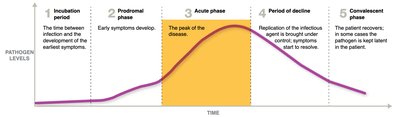
The progression of infectious diseases typically follows five stages:
Incubation period: Time between infection and symptom development.
Prodromal phase: Mild symptoms begin.
Acute phase: Full-blown symptoms; peak of disease.
Period of decline: Pathogen replication decreases; symptoms resolve.
Convalescent phase: Pathogen eliminated; recovery.
Epidemiology and Disease Transmission
Reservoirs and Sources of Pathogens
Reservoirs: Natural habitats (animate or inanimate) where pathogens are found.
Sources: Disseminate infectious agents from reservoirs to new hosts.
Endogenous source: Pathogen originates from host's own body (e.g., misplaced microbiota).
Exogenous source: Pathogen is external (e.g., contaminated food, water, animals, humans).
Modes of Transmission
Pathogens spread via direct or indirect contact.
Direct contact: Physical contact with the source (person-to-person, animal bites, environmental sources, vertical transmission).
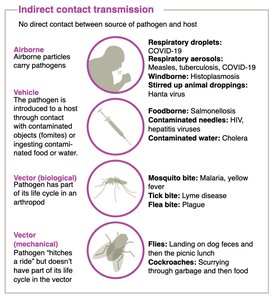
Indirect contact: No direct contact between source and host; includes airborne, vehicle, and vector transmission.
Indirect Contact Transmission
Airborne: Pathogen carried by particles in the air (e.g., respiratory droplets).
Vehicle: Pathogen introduced via contaminated objects (fomites), food, water.
Vector (biological): Pathogen has part of its life cycle in the vector (e.g., mosquitoes, ticks).
Vector (mechanical): Pathogen "hitches a ride" on vector without being part of its life cycle (e.g., flies, cockroaches).
Quantifying Disease Spread
Communicability (R0): Average number of susceptible people one infected person will infect.
Case Fatality Rate (CFR): Proportion of infected individuals who die from the disease.
Epidemiology: Study and Prevention
Goals and Methods
Epidemiology focuses on understanding and preventing illness in populations.
Describing: Nature, cause, and extent of diseases.
Intervening: Protecting and improving health in populations.
The Epidemiological Triangle
Disease prevalence is influenced by the interaction of host factors, etiological agents, and environmental factors. 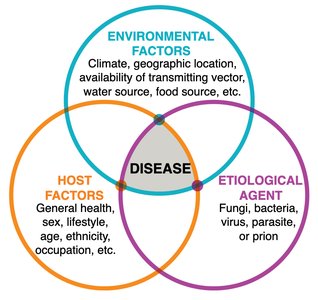
Host factors: Health, age, nutrition, lifestyle.
Etiological agent: Type of pathogen (fungi, bacteria, virus, parasite, prion).
Environmental factors: Climate, geography, vector availability, water/food sources.
Prevention Strategies
Preventing disease is preferable to treatment. Public health strategies include:
Public education (e.g., hand washing, safe sexual practices).
Quarantine and isolation.
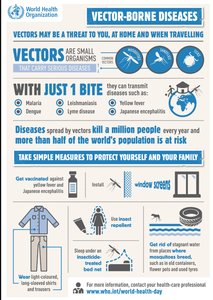
Vector control.


Measuring Disease in Populations
Key Epidemiological Terms
Population: Defined group of people.
Morbidity: Existence of disease in a population.
Mortality: Number of deaths due to a disease.
Prevalence: Morbidity in a population during a specified time.
Incidence: Number of new cases over a certain time period.
Duration: How long the infection lasts.


Measures of Association
Measures of association help identify risk factors and guide public health interventions.
Data can be organized by ethnicity, age, geography, etc.
Correlation does not imply causation.
Establishing Causality: Koch’s Postulates
Koch’s Postulates
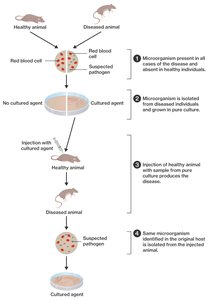
Koch’s postulates are criteria used to establish a causative relationship between a microbe and a disease.
The same organism must be present in every case of the disease.
The organism must be isolated and grown as a pure culture.
The isolated organism should cause the disease when inoculated into a susceptible host.
The organism must be re-isolated from the inoculated, diseased host.
Limitations of Koch’s Postulates
Do not apply to noninfectious diseases.
Some infectious agents cannot be grown in the lab (e.g., viruses, prions).
Some microbes lose infectivity in pure culture.
Some microbes do not infect nonhuman hosts.
Latent diseases are difficult to demonstrate causality.
Healthcare-Associated Infections (HAIs)
Overview and Prevention
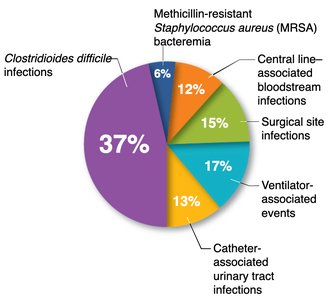
HAIs are infections acquired during healthcare interventions.
5-10% of acute care patients contract at least one HAI.
Common sources: contaminated medical devices, healthcare workers’ hands.
Prevention: hand washing, personal protective wear, environmental sanitization, equipment sterilization, patient isolation.
Common Bacterial HAIs
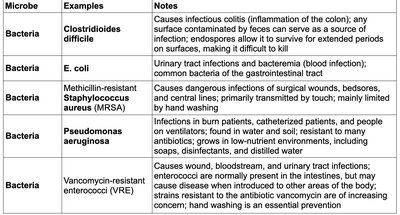
Microbe | Examples | Notes |
|---|---|---|
Bacteria | Clostridioides difficile | Causes infectious colitis; survives on surfaces; difficult to kill. |
Bacteria | E. coli | Urinary tract infections and bacteremia; common GI bacteria. |
Bacteria | Methicillin-resistant Staphylococcus aureus (MRSA) | Surgical wounds, bedsore, central lines; limited by hand washing. |
Bacteria | Pseudomonas aeruginosa | Burn patients, catheterized patients; resistant to many antibiotics. |
Bacteria | Vancomycin-resistant enterococci (VRE) | Bloodstream, urinary tract infections; resistant to vancomycin. |
Disease Surveillance and Reporting
Surveillance Systems
Surveillance programs monitor disease prevalence and incidence.
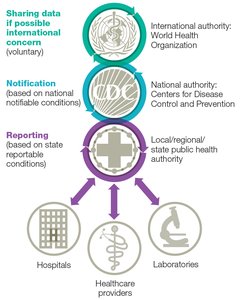
CDC develops recommendations and collects data.
National Notifiable Diseases Surveillance System (NNDSS) tracks reportable diseases.
Reporting chain: local → state → CDC → national statistics.
Reportable Diseases
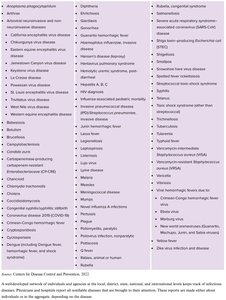
Certain diseases must be reported to health agencies by law.
CDC publishes weekly Morbidity and Mortality Report.
Reportable diseases include infectious agents of public health concern.
Emerging, Reemerging, and Eradicated Diseases
Emerging Diseases
New or newly identified infections (e.g., Ebola, HIV, H1N1, Zika, COVID-19).
Factors: population crowding, poverty, tropical climates, wildlife diversity, deforestation, urbanization.
Reemerging Diseases and Eradication
Previously controlled diseases showing increased incidence (e.g., antibiotic resistance).
Eradication: No cases worldwide (e.g., smallpox eradicated in 1977).
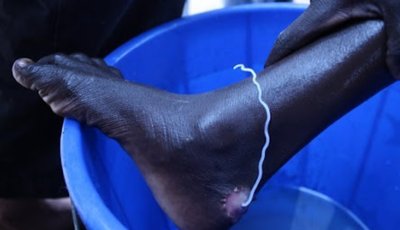
Polio and guinea worm are close to eradication.
Epidemiology and Ethics
Ethical Considerations
Public health priorities should be evidence-based.
Informed consent is essential in research.
Historical abuses (e.g., Tuskegee Syphilis Experiment) highlight the need for ethical standards.
Vaccination and Herd Immunity
Herd immunity requires high percentage of immune individuals (>85%).
Protects vulnerable populations unable to receive vaccines.
Public health policies must balance individual rights and community safety.
